Looking Through Letterboxes
Format:Paperback
Publisher:Carcanet Press Ltd
Published:28th Feb '02
Should be back in stock very soon
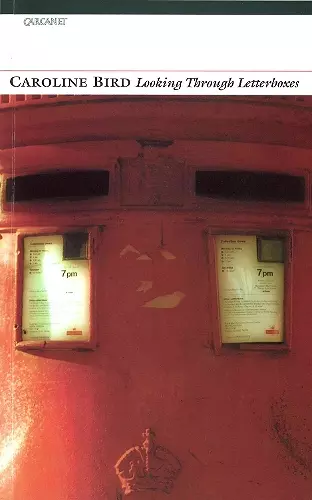
Caroline Bird first appears to be a traditional storyteller. But the stories she tells (or conceals) are suspended in a language charged with metaphor, and most of them are built upon foundations which are strangely familiar: fairy tale, fantasy and the bitter-sweet world of romance. The further one reads in her haunted tales, the more remarkable becomes the variety of forms, metres and rhythms she uses, and the clearer their appropriateness to her themes.
The poems can at first appear to be topical, 'Year of the Woman', for example, 'Gothic', 'Dusk and Petrol' - yet the poets take on reality is informed by a paradoxically knowing innocence. Things are not ever as they seem, and the poems bring us closer to how the world 'really' is. They work metaphorically through our expectations and prejudices, those that are encapsulated in cliché and aphorism, which she rearranges and reanimates ('with a step/ in your dance, a forecast for lightning'), or those that relate to the world of childhood ('I came to see if you were ok')where language itself has never quite got a grip. In the poems of Caroline Bird gender politics are starkly redefined, as are the languages with which generations communicate and fail to agree.
'The tone fuses knowing innocence and integrity; some poems are faux naif with a ballad lilt, others are sad, funny surreal; all are studded with fresh imaginative insights.'
Ruth Padel, Financial Times
'Her poems burst with linguistic energy, and the book is profligate with striking lines and images.'
Times Literary Supplement
'An astonishingly assured piece of work.'
Ruth Padel, Financial Times
'Her poems burst with linguistic energy.'
Stephen Knight, Times Literary Supplement
Ruth Padel, Financial Times, Saturday 18th March 2002
Caroline Bird grew up in Leeds; Carcanet is bringing out her first collection before her 18th birthday. Looking Through Letterboxes is an astonishingly assured piece of work, Escher-like remixes of fairytale in today's teen world. The tone fuses knowing innocence and integrity; some poems are faux naif with a ballad lilt, others are sad, funny, surreal; all are studded with fresh, imaginative insights and phrases: "if you cross your eyes slightly the lawn is on fire". May it all prosper and grow.
Stephen Knight, the Times Literary Supplement, Friday 19th April 2002
The first book is an enticing prospect not only for its author but also for any reader fascinated by the gestation of a poetic voice. While there are likely to be bad notes and stylistic cul-de-sacs, there is also the hope of untutored energy; for all their miscues and lack of polish, some debuts remain their author's most vibrant creations...
...
...Caroline Bird's five-line author's note includes no birthdate. Perhpas her publishers are chary of hyperbole. In fact, Bird was born in 1987, and though Looking Through Letterboxes is a precocious debut, it is not the work of a Rimbaud or a Dylan Thomas. If the Welsh poet's language was powered by the Old Testament, the Bird's has a flavour of the pop lyric: "there's thing I wish I didn't know, / arms I'd like to catch you with". That said, her poems burst with linguistic energy, and the book is profligate with striking lines and images: "Years crash like colours / against the sides of the washing machine", "here we are, face down / like playing cards on the brink of the hill", "Even the rain was throwing back its head".
Almost inevitably, Bird considers matters of love, identity and the journey from childhood to adolescence. The book closes with 'Year of the Woman':
Years at school taught you how to hide your gum
at the top of your mouth. A teacher opened a book
on page forty-nine for a decade. Oh the silence
when you sat down for class and found her gazing
with horror at middle age.
For all its ludic flourishes, artful repetitions and surreal detours, there is real unease in Looking Through Letterboxes; the adult world, teenage mores and fairy-tale iconography are treated with equal scepticism. This impressive focus is only blurred by a handful of poems with their provenance in the creative-writing workshop; poems in the voice of a phone booth and a pane of stained glass, a piece that rebeliliously opens "I refuse to write about an owl", and poems that use as models William Carlos Williams's 'This is Just to Say' and Stevens's 'Thirteen Ways of Looking at a Blackbird'.
The Scotsman, Saturday 23rd February 2002:
Looking Through Letterboxes by Caroline Bird came with a press release announcing that Ms Bird was born, not just 30 or even 20 years ago, but in 1987. I phoned the Carcanet people and pointed out their mistake. "I mean," I pointed out, "that would mean that she is only fourteen." "She is," they replied. "But we don't want to make a big deal of it." Quite right too: if the poetry is any good (and Bird's is) the age of the poet is irrelevant.
Ms Bird, Leeds-born but now living in London with her parents, has also won the Poetry Society's Young Poet of the Year Award for the last couple of years, and her work has been published in a number of poetry reviews. Looking Through Letterboxes is her first (and quirkily quite magical) book.
If she develops into the poet Carcanet believe she will, a first edition may well be worth something in a few years time. "Mmmmm," I can imagine the anticquarian booksellers of the future cooing appreciatively, "that's a really early Bird."
Christina Dunhill, Poetry London, Summer 2002
What is Soul, Baby?
...No soul for Caroline Bird, she's all mouth and skirt, but, hey, look at her name. Maybe she just is soul. Her poetic world is one of the paraphernalia of everyday life - telephones, toothpaste, letterboxes etc - gone surreal, gone a bit schizo. She has a great way with similes: 'with a voice like sinking bread', 'Years crash like colours / against the sides of the washing maching', 'You ordered the ambulance like a pizza'. Characteristically she'll skip out from what might have been the heart of a poem into a joke or another direction. Typically, this will involve a playful punning concretization. This gives her some wicked endings:
Love
is a double bladed knife. I find it much easier to make enemies,
I can make them out of gingerbread, playdoh, leaves,
I can model them to look like you.
I can place them face-down in the sink.
(from 'Dusk and Petrol')
There are shades of Plath's 'I do it exceptionally well / I do it so it feels like hell' and a bit of a feeling of Carol Ann Duffy behind her work. But it's quite different, and she's so young! No one has sung the hyperboles of adolescence and its corresponding cynicisms quite like she does - its sick humour and its worldly romance ennui: 'I like you best when you're not here, my love.'
Here's another good ending: this one from 'Your Heartbreak':
No one else is having your heartbreak.
Or the way it makes the sound of horses' hooves
if you hold a piece in either hand
and bang it together like a coconut.
...overall, what a de
ISBN: 9781857545906
Dimensions: 215mm x 136mm x 6mm
Weight: 104g
80 pages