The Boning Hall
New and Selected Poems
Format:Paperback
Publisher:Carcanet Press Ltd
Published:23rd Oct '02
Should be back in stock very soon
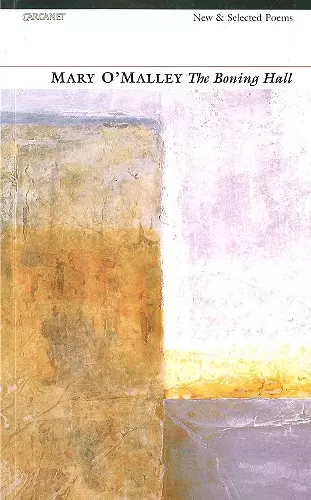
Mary O'Malley is a natural musician. Her poetry alludes to music – the music of Ireland, the Iberian peninsula, the America of jazz and spiritual – and shares forms with it. Music is spiritual and political at the same time. Her themes embrace the child colonised and the adult journey, Ireland and America and Southern Europe, a poetry exploring love, place, loss, and locating the poet's one true home in language. When her native Irish language is lost to her, finding that true home becomes a special kind of challenge.
The Boning Hall is the first book of poems by Mary O'Malley to be published by Carcanet. It includes work drawn from her previous collections, Where the Rocks Float (1993), The Knife in the Wave (1997) and Asylum Road (2001), all published by Salmon Poetry.
Katie Donovan's Introduction for Mary O'Malley at the Launch for The Boning Hall at Kenny's, Galway October 2002
There is nothing like happening upon a book of poems that makes you feel exhilarated about the possibilities of writing.For me, now that I have written three collections myself, it is harder and harder to find that sheer simple delight and excitement when reading poetry, to lose the sense that this is somehow a busman's holiday and just enjoy.
Sitting up in bed with my nine-month-old daughter Phoebe the other night, I began reading some of the poems from this new book by Mary O'Malley.Phoebe and I were both jetlagged, a little delirious from lack of sleep and disorientation.As if intuiting my reactions to Mary's poems, Phoebe began kicking her little legs and squealing with glee.She could see how much I was taken by the book, and quickly grabbed it out of my hand only to stuff it into her mouth.I had to grab it back and began reading some of the poems aloud, to taste the music which Mary creates with a seemingly effortless and natural ease.
It is with great pleasure that I want to launch this fifth volume of Mary's poems.The Boning Hall, published by Carcanet, is a timely new and selected poems, giving us a welcome chance to discover new work and revisit earlier favourites.The title of this book encapsulates her ability, most particularly and unflinchingly in the new poems, to cut deep into the marrow of her subject.The narrative voice comes from a middle-aged perspective which takes a long hard look at life, saying (quote) "goodbye to the fixed idea", questioning everything from relationships to the need for a home, from accepted versions of history to social and cultural sacred cows.
The story of Persephone is visited twice, once from the perspective of the daughter, the other, in The Wineapple, perhaps the finest poem in the book, from the mother.Whilst many of the poems give voice to the travails of different women, often real figures like Billie Holiday and Edna St Vincent Millay, lurking behind the women is the dark man, the violent lover, the one who entraps, enthrals, cuts and holds, the king of the underworld.
As always Mary's poems encompass both harshness and sensuality, a sense of desolate loneliness and a wicked sense of humour.Her cosmopolitan references to geographies that extend beyond her native Connemara make her poems wide-ranging and reflective of the enormous change in Irish society which has occurred in her lifetime, the turning inside out of insularity to multiculturalism.
Of the new poems I congratulate her particularly on two wonderful, fanciful poems, The King of the Cats and PMT ¾ The Movie (which marries Hollywood and premenstrual tension with classical Greece).Also on the simply beautiful Bowbend, the towering Wineapple (which must join Paula Meehan's poem about a mother and daughter, The Pattern, as a timeless touchstone ¾ Meehan's from the daughter's point of view, O'Malley's from the mother's), and searing poems of hope and loss, Tobar Mhaire and The Dinner Table.
As for the earlier work, all published by Salmon press, I am sorry that some of my favourites from A Consideration of Silk have not been included here, such as the luscious Gluttony and the hilarious Hormones.Those that are reflect O'Malley's enduring concern with the innocent victims of political violence.
When I first met Mary, she was writing the intensely personal cycle of poems that forms the centre of Where the Rocks Float and I was struck by the unique quality of her vision.The recollections of a young fisherman's daughter feeling doubly disinherited on the basis of being born a girl and being born outside the walls of the Big House was balanced by the poet who found refuge inside those same walls when they were owned by the late poet, George MacBeth.By the end of that book she is like no other Irish woman poet before her, claiming her own landscape and seascape, fuelled partly through the daring of her ancestor, the pirate queen Granualie, to find the voice to speak her birth place.
From The Knife in the Wave we re-encounter the dazzling Miss PanaceaRegrets, which speaks the agony of surgery and the aftermath of physical frailty with unselfpitying humility reminiscent of Brendan Kennely's fine work, The Man Made of Rain.In Asylum Road O'Malley revisits her recurrent theme of violation both local and international:
why when history's black hags dive into our personal sky
at inappropriate times, the woods are full of hump-backed beasts
and all the lovely dancing girls emerge
from Kosovo and Africa and places around here
with their giggling dreams in rags around their breasts?
O'Malley, unlike many poets who stick to fey or intellectual themes, is not afraid to be angry, to address political situations, to dissect fear and mutilation, while never losing the silken flow of her writing to sentimentality or jingling stacked rhymes.With an anarchic eye, she inhabits our world of Pepsi and Wonderbra, of city planners, abandoned babies and divorce referenda, without excluding the mythic framework of silkies, Cuchulainn's gae bolga and Artemis turning Acteon into a stag.
A woman after my own heart, she won't be pigeonholed as some kind of predictable earthy feminist.She is acutely aware of the risks of romanticising the bonds between women, writes deftly about their cruelties, and wittily about the easy clichss of "the earth girls" who like to see womb shapes anywhere.O'Malley wields her pen like a knife to cut the subject into its exact size and proportions, a pitiless yet compassionate artistry that sparkles with memorable imagery and the clarity of emotional honesty; the existence of hope beyond illusion, the flower in the spring that buds out of the dark earth.
Her work is an inspiration to me and I am delighted to see this addition to her œuvre, which has already won her a deserved place in Aosdana.She is also a consummate reader of her work and I hope she is going to perform for us now.
ISBN: 9781857545982
Dimensions: 216mm x 135mm x 10mm
Weight: 159g
120 pages