Over the Land and Over the Sea
Selected Nonsense and Travel Writings
Edward Lear author Peter Swaab editor
Format:Paperback
Publisher:Carcanet Press Ltd
Published:26th May '05
Should be back in stock very soon
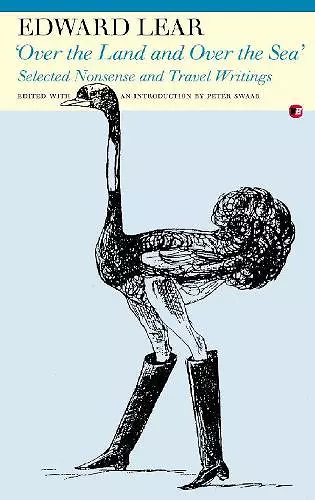
Edward Lear (1812-1888) is one of the best-loved of English poets. His comic invention and unconstrained sense of the absurd have been enjoyed by generations of children, and treasured by adults conscious of the subtle melancholy that underlies the fun.
This collection includes all the favourite nonsense poems. Peter Swaab sets them alongside a generous selection from Lear's six travel books (including his three Journals of a Landscape Painter), first published between 1841 and 1870, and long out of print. For the first time Lear is presented as an adventurer, not only in the fabled lands of the Jumblies and the Yonghy-Bonghy-Bo, but also in nineteenth-century Albania, Greece, Calabria and Corsica, where his encounters with the people and customs of these sometimes equally strange and challenging cultures are recorded with the same acute and rueful comic imagination.
Modern Painters, Friday 1st July 2005
Edward Lear is one of the few figures in history to have achieved a (largely) positive reputation for consciously producing nonsense. (Remember, most of the artists and art critics you're now thinking of don't do it on purpose). Aldous Huxley described Lear's lymericks as part of an 'eternal struggle between the genius or the eccentric and his fellow human beings', and George Orwell also found his work to be an example of the right to individuality and difference (commenting on 'The Old Man of Whitehaven': 'There was an Old Man of Whitehaven, / Who danced a quadrille with a Raven;/ But they said - "It's absurd, to encourage this bird!" / So they smashed that Old Man of Whitehaven.' - he said 'to smash somebody just for dancing a quadrille with a raven is ['exactly what "They" would do'). More often than not, though, Lear still comes across as a poor man's Lewis Carroll (albeit darker and more adult). A greatest hits collection of his limericks forms the first part of the book. In the second half, however, Lear swaps the land of the Jumblies and the Yonghy-Bonghy-Bo for the more sensible territories of Albania, Greece and Italy, which he records in a series of travel journals. Written in his guise as a landscape painter (which was how Lear earned a living after giving up working as a zoological illustrator), these texts provide an insight into the finely honed powers of real-world observation on which all that nonsense is based.
A Summer Reading Selection by the London Review of Books, 7th July 2005:
Lear's nonsense verse is familiar to everyone, but his travel writing remains almost unknown: much of it has been out of print for more than a century. In this valuable anthology, Peter Swaab brings together both genres, arguing that they arise from the same restless sensibility. 'What, after all,' he asks in his introduction, 'is nonsense poetry if not a poetry of departures, always departing from our usual norms, often in stories of voyaging and questing?'
ISBN: 9781857547597
Dimensions: 216mm x 135mm x 27mm
Weight: 503g
265 pages