In My Father's House
Format:Paperback
Publisher:Carcanet Press Ltd
Published:22nd Sep '05
Should be back in stock very soon
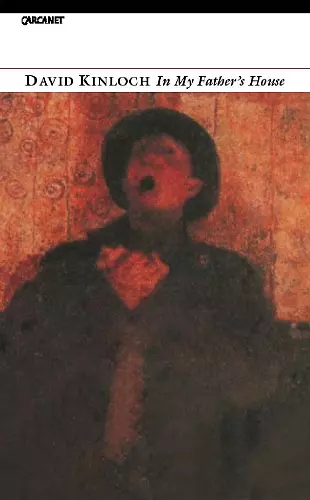
From a quick-tempered singing grandmother to a performance of The Mikado in an African village: David Kinloch's exploration of his relationship with his father is both unexpected and affectionate. An extended sequence of poems moves from personal memory to reflections on the values embodied in such cultural father-figures as the explorer David Livingstone and the Irish patriot Roger Casement. Translations of poems by Paul Celan and others into vivid Scots weave through the sequence, illuminating the disturbing connections between patriarchy and twentieth-century violence. In contrast, moving and humorous 'dissections' of adult relationships evoke images of the body both scientific and spiritual, culminating in a long narrative poem that celebrates the loving relationship between two seventeenth-century diplomats and doctors, against the background of the bustling city of Constantinople.
'A sparkling collection: full of sensuous richness and linguistic inventiveness. As the punning title of the book might suggest, there is much about fathers and sons, including the moving simplicity of a walk with a dead father 'and then/I let him go,/but this moment/which is farthe hardest pain/remains'. But Kinloch unrolls a convincing set of unexpected scenarios: outspoken excerpts from Roger Casement's diaries intercut with the horrors of the Belgian oppression in Africa; tightly drawn translations of Celan into Scots; and a most impressive long poem, 'Baines His Dissection', where a medical man is seen embalming the body of his friend and lover, against the background of a brilliantly evoked Middle East of the seventeenth century.'
Edwin Morgan
Alison Prince, the Glasgow Herald, Saturday 29th October 2005
The landscapes we live in and the languages we speak
In My Father's House is David Kinloch's wide-ranging and often wry collection of poetry and prose, celebrating - if that's the word - the life of his father.
That night, Dad Pagliacci'd
our front room with his
stentorian baritone,
frightened his small sons
back beneath a tent of sheets
behind the pink settee...
Kinloch writes both in English and in Scots, ranging into extended metaphors of a father who was both wonderful, frightening and mysterious: 'If Dad was Doctor Livingstone, I am Stanley trying to think / what I will say to him across the rapids / of our handshake.'
Perhaps there are many people who, at the death of a father, can echo Kinloch's phrase "he died before he even got to know me'. Few, though, can produce, as this accurate poet does at the end of 'Loch Morar', three simple lines that encapsulate the fears and faith felt in childhood.
But Dad said "Monsters do not change
their spots". How did he know?
Oh, he did, just did, just did.
Katie Gould, The List, 20th October 2005
The world of David Kinloch's poetry is surprising and often surreal. Lady Macbeth is found on the beach on a family holiday; a cantankerous grandmother declares herself the Callas of Cardross; the pages of underwear catalogues are 'thumbed to apalimpsest'; Roger Casement's infamous diaries are interspersed with the horrors of colonial absuse against which he campaigned; The Mikado is performed in Africa by Henry Morton Stanley and his thespian troupe; and an elegy is delivered to a lover as his body is embalmed.
Kinloch's salutation of Rimbaud ('eftir thi Arabic of Mou'in Bsissou'), his rendering of Lazarus ('eftir thi Latin o Prudentius'), and translations of German poet Paul Celan, into Scots are inventive literary feats. However, he is at his most expressive - his lyrics most profound - when drawing on personal remembrances. he may call upon the greats for inspiration, but his own story is the most affecting.
S. B. Kelly, the Sunday Herald, 23rd October 2005
David Kinloch's In My Father's House has, indeed, many mansions. It is a 'concept album' collection, that includes bitter-sweet elegies and reminiscences of Kinloch's own father, alongside more problematic images of patriarchs; most notably in a sequence of Holocaust-survivor Paul Celan's poems translated into a vigorous and uncouthy Scots. There are times when a 'single-issue' gathering of work can become rather too problematic: Kinloch avoids any potential repetitiveness through the vast, and experimental, range of forms. In addition to the Scots language translations, there are variations on Palestinian poems, long, dramatic monologues (including the exceptional 'Baines His Dissection') and prose-poems, a notoriuosly difficult mode that Kinloch inhabits breezily. In 'Painting by Numbers', the reader gets a peek into the particular method of composition:
One day he came across an old dictionary of the Scots language [...] He wanted neither abstraction nor representation but a fluid, tactile metissage. He wanted to paint sound dissolving into meaning and meaning frittering away into the joy of not having to mean anything at all.
Kinloch's work hovers on the hiatus between 'public' meaning and 'private' denotation. The poetry is full of impersonations and metamorphoses - this is a world where 'Cardross was Caer Paravel' - a concern which Kinloch shares with Morgan, and which has been linked to a specifically 'gay' aesthetic. Yet when he does address the questions of sexuality, it is with a winning directness:
The interviewer asks me about
'your homosexuality'
as if it were a mildly embarrassing
essential adjunct I carry
like a colostomy bag.
In My Father's House is much more than the sum of its parts; its particular tone can't be captured in a single word - perhaps a combination of resigned celebration and stricken praise.
Robert Potts, The Guardian, Saturday 17th December 2005
Robert Potts rounds up the poetic year
...Two other Scottish poets also produced interesting books. Richard Price's Lucky Day, seen as a first collection but in reality gathering excellent work from a variety of small-press publications over the past decade or more, is a book full of pleasures, from the tiny, perfectly crafted pop-like lyrics of love and fatherhood to longer, exploratory poems, in which a careful hesitancy and wry questioning combines with a winning musicality. And David Kinloch, with In My Father's House, has created an elegiac volume that ranges in unexpected directions - sexuality, colonialism, theatre - and intriguingly punctuates all this with translations of Celan into Scottish. "Celallans", one might term
ISBN: 9781857547665
Dimensions: 216mm x 135mm x 7mm
Weight: 127g
128 pages