New York Poets II: from Edwin Denby to Bernadette Mayer
Mark Ford editor Trevor Winkfield editor
Format:Paperback
Publisher:Carcanet Press Ltd
Published:26th Jan '06
Should be back in stock very soon
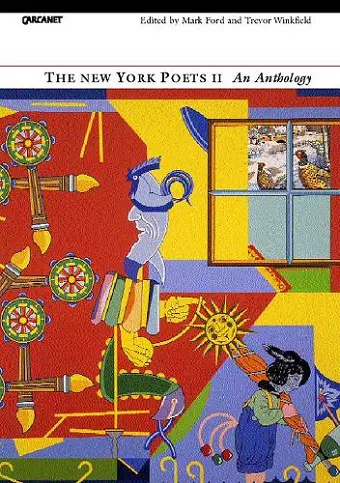
Mark Ford’s selections from the work of John Ashbery, Kenneth Koch, Frank O’Hara, and James Schuyler for The New York Poets: an anthology (2004) offered an exhilarating introduction to the poetic innovations of the ‘New York School’. New York Poets II celebrates the continuing vitality of that unruly ‘school’. The painter and writer Trevor Winkfield, who has worked in New York since the 1960s and knows the scene intimately, joins Mark Ford in the task of mapping this radical sequel to the first anthology. Following a general preface, each selection of works by the eleven poets is preceded by a brief introduction; a bibliography provides an indispensable guide to major publications.
The writers included in New York Poets II span a crucial period in twentieth-century culture. Their poetic responses to their changing times were varied and challenging, and have proved enormously influential on American writing. Linking them is a buried narrative of experiment and creative interaction that brought about the emergence of a new kind of poetry.
The London Review Bookshop recommended title (6th February 2006):
Mark Ford's previous anthology covered the New York School: Ashbery, O'Hara, Schuyler and Koch. This second anthology covers the work of 11 poets, for the most part friends and lovers of those four, who built on the stylistic innovation of their predecessors to create a poetic tradition of unruly vitality. Most of the work here will be new to British readers, and there is much that deserves a far wider audience. Here is 'Living with Chris' by Ted Berrigan:
It's not exciting to have a bar of soap
in your right breast pocket
it's not boring either
it's just what's happening in America in 1965.
Jim Burns, Ambit Magazine, May, 2006:
I don't think the New York Poets ever attracted a wide readership in this country, aside from a couple of the bigger names like John Ashbery and Frank O'Hara. And even they, I suspect, never really broke through convincingly, though people now pay lip-service to Ashbery simply because they've been told often enough that he's significant. But do they really enjoy reading him? Some of O'Hara's poems probably appeal more, though a lot of readers may feel uneasy about the seemingly casual approach to technique. British poetry readers often prefer more formal styles, even though the New York Poets have been around for a long time and have influenced some British poets.
This second volume focuses on poets who, even more than Ashbery and O'Hara, are not likely to cause a stampede to the bookshops. But readers who won't take a chance delving into the anthology will miss some lively work. The ever-engaging Ted Berrigan, for example, wrote poems which drew heavily on his problems and those of his friends, and laced them with literary allusions and a kind of running commentary on life in New York. They can appear light and like diary jottings about the activities of a small in-group (and they are, to a degree), but Berrigan managed to make them appealing to outsiders. The poems drew the reader into their world and made it interesting.
The point is made in the introduction that there was no such thing as school of New York Poets.They mostly knew each other and published in the same magazines, but there were no definite agreements about questions of style, technique, subject matter. There were no group manifestos. It was usually a case of like-minded individuals recognising that what other poets were doing was interesting. Reading Barbara Guest, Edwin Denby, Bill Berkson, Ron Padgett, and the other seven poets, reminded me that they were marvellously diverse and yet had a common liking for what the editors refer to as 'a rare mixture of high seriousness leavened with a sense of humour, and a faith in the acrobatic capabilities of language.'
I've known the work of the New York Poets for well over forty years and it still delights me at its best. Are all the poems in this anthology good? Of course not, but they're nearly all fun to read. The anthology is well-edited, with an informative introduction, notes on the individual poets, and a useful bibliography. And credit is given to the little magazines where, in the 60s and after, the poets published alongside each other.
Sion Hamilton, The Bookseller, 25th November 2005:
This anthology can be seen as a sequel to 2004's New York Poets. The first anthology rapidly became a core stock title. It gave the reader an introduction to the New York School of poets: John Ashbery, Kenneth Koch, Frank O'Hara and James Schuyler. This new collection looks at the contemporaries and heirs of these four writers.
Jeremy Noel-Tod, The Guardian
So good they invented it twice. After Mark Ford's The New York Poets (2003), this gives British readers a further opportunity to see what American poets are doing these days. Although all those included are over 60, and several already dead, the poems still read with a revolutionary freshness: from Ted Berrigan's post-Frank O'Hara swagger to Bernadette Mayer's mysterious weighing out of monosyllables: "The corn they sought / was sown by night".
One editorial decision seems equally mysterious: Kenward Elmslie's elegy for the painter Joe Brainard and Berrigan's sonnet "I Remember" both allude to Brainard's classic prose poem "I Remember", yet this itself is not excerpted. But there will always be arguable omissions from such a varied and innovative body of work: a poetry anthology as illuminating and necessary as any major art exhibition.
Rupert Loydell, Stride Magazine
The first Carcanet New York Poets anthology contained an excellent selection of work by John Ashbery, Kenneth Koch, Frank O'Hara and James Schuyler. This follow-up is far more diverse and surprising -- though my surprise is perhaps a mark of ignorance than the selection. I say this because whilst I would have expected poems by Ted Berrigan and Ron Padgett to be included, I wouldn't have thought of Clark Coolidge or Barabara Guest as New York poets.
But this is obviously my mistake, for the editors make it clear that all the poets included, known or unknown to me, are writers 'whose work falls roughly under the aegis of New York School ideals and practices'. What these practices or ideals are, however, are never clearly articulated (by the editors or poets); the editors also disingenuously declare that the anthology does not 'attempt to represent the range of poets at work in New York in the period 1950-80'.
So what we have are an intriguing, but not representative, group of poets whose work emerged from the bustling international city of New York as art forms flourished and cross-pollinated. Here we have the confessional, a mundane exploration of the everyday, early experiments in cut-up and collage, urban lyric, chant, oulipian games, mild surrealism, and the first hesitant works that might eventually lead to L=A=N=G=U=A=G=E poetry.
Whilst in the last few years I've warmed to the intimate and personal diary poems of Paul Blackburn, along with Ted Berrigan's sonnets and New York snapshots, I don't really know what to make of much of the work in here. Edwin Denby doesn't know whether to declaim on the beauties of nature and epiphanic moments in the city, or actually engage with the modern life of dope, smoke and the subway. His work seems slight and archaic, rooted in a poetry that declaims and observes, offering slight comment all the while. Harry Mathews' work -- mostly written without the oulipian restraints and controls of his prose -- is slight and unformed, often taking the most squiblike phrase as a starting point. 'Shall I compare thee to a summer's bay'? -- I mean, come on, this is student pastiche.
Kenward Elmslie came through theatre and lyric writing to poetry, and his poems beg to be heard rather than read on the page. They are chants, full of repetition and pattern, rich in sound and energy, but lacking in subtlety or longevity. One feels bowled over by them rather than engaged with them.
my nerves my nerves I'm going mad
my nerves my nerves I'm going mad
round-the-world
hook-ups
head lit up head lit up head lit up
the fitting the poodle
MGM MGM MGM
MGM MGM MGM
MGM MGM MGM
the fitting the poodle
and so on, goes 'Girl Machine'. Other poems read like Ginsberg with their long over-run lines and litanies of observation and desire. 'COLLAGE ME ! COLLAGE ME ! Turn me into jewels!' he says in 'Bare Bones'; one only wishes for more jewels among the verbiage.
Best of the bunch are Berrigan himself, with a good selection from 'The Sonnets' and some later, more freeform work, and Barbara Guest and Clark Coolidge. I know these author's later work, but here we find early examples of their work. Guest's roots in lyric and confession are more to the fore [however exprimental she got her work remains musical], and Coolidge has yet to develop his hit & run approach to collage and improvisation. Here, his work more ordinary, still attached to story and linear narrative[s].
While I was writing this, the news that Guest had died came in. Interestingly, Ron Silliman writes about Guest as a direct precedent for Coolidge. Something, again, I wouldn't have thought of. Silliman has also written about Ted Berrigan's Collected Poems, remarking how good it is to see something done right. I can but agree: The Collected Poems of Ted Berrigan is a sumptuously produced big volume of Berrigan's work.
It's interesting that the kind of work Berrigan wrote -- personal, often diarylike, seemingly casual poems -- gains strength from rubbing shoulders with other poems of the same type. One is drawn into Berrigan's New York, drawn into his way of thinking, his original approach to language. [I have the same feeling about Paul Blackburn, especially in response to his journal poems -- what starts out leaving me outside the author's world actually ends up inviting me and introducing me to that world.]
'The Sonnets' remains, for me, an original, marvellous set of experimental poems which subvert both expectations and form, amuse and intrigue. The collaging, gathering and re-ordering informs individual poems elsewhere though, so that the whole book accumulates meanings both intertextual and meta. That is poems inform each other throughout the book, and the work also reaches out -- sometimes literally as a reource or footnote -- to the literary world outside. This is a witty, profound and marvellous book.
ISBN: 9781857548211
Dimensions: 216mm x 154mm x 12mm
Weight: unknown
228 pages