Spirit Brides
Format:Paperback
Publisher:Carcanet Press Ltd
Published:27th Jul '06
Should be back in stock very soon
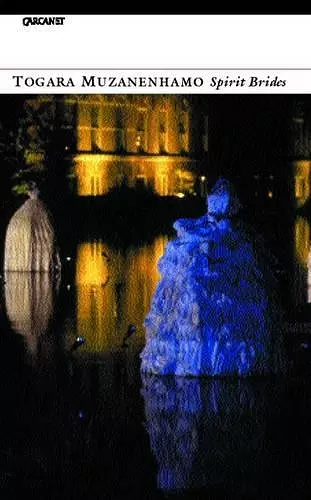
Togara Muzanenhamo's first collection of poems evokes a number of worlds, familiar and unfamiliar. He takes us from his vivid, vanished childhood in Zimbabwe to Europe, where he lived for some years, making as he goes the stories and connections that coax a meaning out of time and change. These are less poems of memory than of creation. There exists a fractured world, partly hidden from the poet, in which dream makes a different kind of order. This unpredictable, parallel world provides an undertone, a treacherous reflection. "Spirit Brides" combines the real and the surreal, stone and steel on the one hand, and air on the other. The plains of the veldt in Zimbabwe are as tangible as the bookstore in Antwerp or the bottle-shop in Paris. There is a language here that fills some of the troubling silences of our time, that engages death, violence and, most particularly, love.
Bladed farmsJohn Greening It is perhaps unfair to assume that a poet brought up in Zimbabwe will write about that country's difficulties, but while turmoil continually threatens in the language of Spirit Brides (the mob in "The Armchair"; the bodies in "The Craft"; the mounds and burying and blood-colour of "Leaves"; the "guillotine changeover" in "The Slide"), this young writer's concerns are ostensibly more personal, more oblique. The real sense of upheaval comes from his first collection's many roads, trains, boats and planes, and from his own multicultural background.
Togara Muzanenhamo (born in Zambia, in 1975, to Zimbabwean parents) writes in English, but studied in France and the Netherlands -both of which, together with Belgium and England-provide identifiable settings for poems in Spirit Brides. Others (such as"Den Haag" or "The Dawn Chorus") wander into an Ishiguro-like dream zone, conjured occasionally through sonnet or sestina, more often in relaxed, loosely bundled stanzas, and frequently in prose. Curiously, the Orkney poet, and translator of Kafka, Edwin Muir, came to this reader's mind -not so much because Muir's poetry apparently ignored the momentous events he lived through in post-war Prague, but because there is a similar reaching for the facelessly allegorical ("The Craft"), the mysteriously heraldic ("The Spirit Brides"), the Kafkaesque ("The SmallRoom"), perhaps as a way of suppressing something more painful.
Zimbabwe itself features in the opening poem,where Muzanenhamo remembers how an anthill became a make-believe lighthouse,called "Land's End", the pirate language not entirely convincing as he playfully shifts it into "Aye, methinks, me miss my brother". Such witty juggling with tones and dialects is not the poet's strong point: he can be "cool" but seldom "light". His best writing makes no reference to itself, does not allow itself to be damaged by overexuberant metaphor. He is a tactile poet, agently erotic poet in "The Laughing Wood", tenderly lyrical in "Pine Thicket" and "Roads". The most powerful explorationof Zimbabwean landscape, and the book's most sustained achievement, is the concluding sequence, the elegiac prose-poem, "Gumiguru"("October").
Muzanenhamo juxtaposes an account of his father's dying hours with memories of their farm,including a dramatic fire in the vast orange orchard: "It crept with the silence of light -then, with the speed of the wind came rushing through the night with the sound of bones snapping clean and joints popping". Togara Muzanenhamo's is undoubtedly an unusual voice, if an immature one as yet. Some of the apparently experimental poems in Spirit Brides weaken the overall effect (the "Nationalist Archives" prose sequence really slows things down) and distract from the genuine successes, which are mostly those concerned with personal memories, particularly of childhood (sliding on a frosty lawn on "the worn out soles of our school shoes", rushing to catch falling leaves) and of love: "Helpless Goodbyes", with its potent image of staring though his own palm print on a train window to "a field where a ruined / Church fosters a tree"; a charming sestina, "Six Francs Seventy-five", which casually avoids all that form's pitfalls; or the simple record of a day walking in the Calder Valley in "Tea and Sandwiches", whose culminating imagery makes one wonder whether Zimbabwe had been in the poet's mind all along:
A flask of tea and sandwiches; all day the
walk; now I take cover
In a bird hide where the heather claws the
wood. The swollen clouds
In the distance, dark gatherings of fluid,
pressing their weight over
The bladed farm; the black winds splitting
and spitting out this way.
Togara Muzanenhamo’s first collection draws on an extraordinarily diverse series of cultures and geographies, moving almost seamlessly from his Zimbabwe childhood to Holland, Belgium, France and England, as well as into frighteningly featureless countries of political parable. The effect is disconcerting, as the readeris compelled constantly to reassess his or her sense of perspective – the more so, because the poems are not grouped by location. Places disappear from view and reappear as in a kaleidoscope, with Zimbabwe serving as a leitmotif, constantly resurfacing.
It is clear that these dislocations are deliberate, reflecting Muzanenhomo’s view of the often violent unpredictability of the world. In this collection, events come out of the blue. The first part of the prose poem ‘Nationalist Archives’ suggests an idyll (‘Autumn brings a strange sense of warmth to the old buildings, the windows filled with early evening light’) but ends in vividly realized grotesque, as the woman at the window ‘stares vacantly across the darkening street remembering her mother: naked, headless and pregnant … She tried to lift her mother – holding both ankles, and after struggling for a while – realised the absurdity of it all: a scrawny teenager on her own – her mother’s body resembling a wheelbarrow, her missing head the missing wheel.’Conversely, although the man driving his nephew and niece at well over 100 mph in ‘Excursion’ is clearly courting disaster, this too is a poem of the unexpected: the family arrives safely home, ‘the German car rolling into the garage as safe as warm honey twirling into a jam jar.’ Muzanenhamo so consistently undermines expectations that he seems to have internalized the old saying: ‘When you hear something, that’s nothing. When you hear nothing, that’s the Indian.’
The resulting sense of disorientation is heightened by Muzanenhamo’s disturbingly unidiomatic turns of phrase. When he writes of ‘the anthill / where brother and I climb and call Land’s End’ the anacoluthon gives the impression of reading a work in a non-native tongue; when the brilliantly evocative ‘This is how water flies, whole shapes of liquid light, hovering, descending, pulling up and taking to air’ concludes: ‘gracefully, without any immediate organic strain’, the sudden flatness suggests a work in translation. The effect is jarring. Yet these moments can also be oddly effective, drawing attention to the opacity of language, and suggesting thatthe difficulty of translating the world into words matches the difficulty of making any kind of sense of it.What Muzanenhomo says to a former girlfriend in ‘Photographer’ might be said of him as well: ‘You were awkward, struggling through the world – trying to keep pace with every moving thing. Trying to stop the world.’
His attempts to make sense of what is experienced as essentially incoherent are visible at every level of the work, not only at the local level of the language, but in the poems that work by juxtaposition of incompatible viewpoints, and in the frequent shifts from poetry to prose or from parable to particular detail and back again. The first impression on reading the collection is that it would benefit from strong editorial intervention – yet in obliging the reader to share the poet’s work of interpretation, it becomes hauntingly memorable. In a stunning line in one of several poems that commemorate his brother, Muzanenhomo writes that: ‘We were the past of our own futures, the things that don’t go away.’ The collection as a whole is a record of precisely those things – and an attempt to order them that is too honest to be tidy-minded.
ISBN: 9781857548525
Dimensions: unknown
Weight: unknown
64 pages