Trouble Came to the Turnip
Format:Paperback
Publisher:Carcanet Press Ltd
Published:28th Sep '06
Should be back in stock very soon
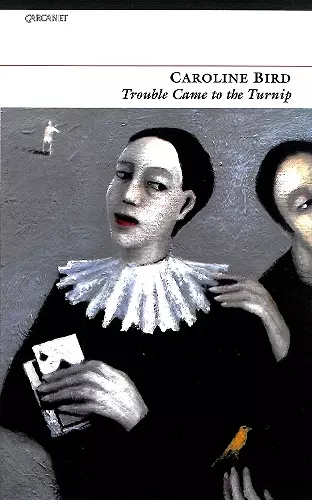
Following Looking Through Letterboxes, her first collection (2002), Caroline Bird was acclaimed as a vivid and precocious new talent. Trouble Came to the Turnip confirms her originality as she strikes out again in new directions, taking nothing for granted. Her poems are ferociously vital, fantastical, sometimes violent, almost always savagely humorous and self-mocking. Caroline Bird's world is inhabited by failed and (less often) successful relationships, by the dizzying crisis of early adulthood, by leprechauns and spells and Miss Pringle's seven lovely daughters waiting to spring out of a cardboard cake. And the turnip.
Matt Simpson, www.Stridemagazine.co.uk
...let's start with a firework display. Caroline Bird's Trouble Came to the Turnip is a second collection from someone still only nineteen. It is like nothing I've read before. At times surreal, hallucinatory, playful, always vividly imaginative, yet controlled, in a way I can't quite put my finger on - the poems somehow feel 'achieved', somehow make us aware of a genuinely serious shaping spirit behind the highly entertaining flights of fancy Bird enjoys and allows herself. These are remarkable poems and, if anything (though it would be wrong to claim direct influence), they remind me of the verbal exuberance of the young Dylan Thomas. Caroline Bird has given the language of poetry a real shot in the arm.
Herbert Lomas, Ambit 188, Spring 2007
Caroline Bird is twenty-one, and this is her second book. She writes brilliantly, passionately and with humour about everything from money to opera, which she's evidently absorbed a lot of already, as of life. But it's clearly the search for love under the pressure of adolescent hormones that obsesses her. There's no beating about any kind of bush, or prissiness about speech: 'It takes more than pants and zips/ to hide my cunt, it yells in its sleep...'
The title poem's about fleeing from trouble with 'my love'. It's a nursery-rhyme in structure and style. Escape is attempted in everything from a cabbage-cart and a sewage pipe to the inside of a rat. None of this works, leading to prison, the madhouse and other nasty places, including the soup. But some relief comes at the end, perhaps because she's chosen the turnip-lorry, rather than the original cabbage-cart:
When trouble came to the village
I put my love in the turnip-lorry
and we sneaked, wrapped in turnip,
a hurried kiss.
The last poem in the book also chooses a homely comestible for love:
I wish
to cherish you, or Larry, or anyone
with a blind bread love
that is fresh and plain
and steady on the stomach...
But it's going to be a long search through some rough territory, often feeling like a frog - 'every lover she meets has a different slime' - and includes a lament for lost virginity:
If I was a virgin I could wear white in winter,
read your dirty magazines with a shy and puzzled look,
like I didn't know a crotch from a coffe-table...
...you'd spend the night on the sofa,
dreaming of the gentle way I breathed inside my bra,
my nightgown would remind you of fragrant summer orchards...
There's not a dull poem here. She's brainy, carries her culture casually, is never at a loss for a phrase or an image and can slip convincingly and revealingly into the surreal. The poet's so alive, and living so intensely, the only worry is she'll burn herself out. This is a great talent whom I recommend you enjoy straight away at its second pressing.
David Mason, 'The Poetry Circus', Hudson Review, Vol. LX, No. 1 (Spring 2007)
... One of the more remarkable books to come across my desk is the second collection by a twenty-year-old poet, England's Caroline Bird.At this rate, she is likely to stop writing poetry and disappear on some African gun-running trail before she's the age Keats was when he died, but I hope she sticks with writing. She has great verbal energy; and if I'll play the old fart by advocating restraint, I wouldn't do so if there weren't real vitality to restrain. Power comes from shaping, and Bird's lesser poems fail to follow through on clever premises - like lame clowning or stand-up that dies on the stage. 'Our Lollipop Lady' is a case in point, a poem that closes with a Ho-hum instead of an Ahhh.
What attracted me first to this Bird's book was its title: Trouble Came to the Turnip, perhaps a nod to the land of Nod. The title poem itself is Muldoonishly formal, palatable more than suss-able, I would say. Having come for the shape, though, I found one of her more shapeless rants, 'This Time Last Week', to be deeply compelling. Here are two stanzas extracted almost at random to give you a sense of her intelligence:
I want to write.
I want to be respected.
I want to be a respected writer.
I want to meet people who will inspire me
to write letters to them when I am forty
saying 'Thanks for inspiring me.'
But who are these people
in their ironed shirts and their reading glasses
and their well-funded quests?
Are you kidding me with this?
...
It wasn't that I met some very alarming people
with horrific backgrounds and unspeakable foregrounds.
I’m not a daddy's-girl nurse
limping back from the war with blood on her bonnet
and no more love for daddy.
I'm not saying I've seen the ruins of the world
And now my world is in ruins....
Going on for three more pages, it's a bit of a Howl for a new generation, and no doubt a crowd-pleaser when performed, but it's alive in ways some of our more laurelled bards couldn't dream of being. Two more favourites, 'Mope' and 'Chaining Bikes To This Girl Is Strictly Prohibited,' are among her punchier poems. I'd love to see her bring this kind of fire into a ring, where it could burn productively for many years to come.
...
Caroline Bird has achieved many an accolade for her poetry already from her elders, the most notable being an Eric Gregory Award in 2002,and for such a young poet this is an impressive achievement.The blurb on the back cover of this her second collection describes her as ‘a vivid and precocious new talent’. This is certainly true as this series of poems is riddled with such striking imagery that the reader sometimes might find it hard to believe that someone not even in her twenties could have written them.
‘What I would say with flowers,/if the flowers didn’t speak so strange./I gather
nettles with love.’
These poems sting, the attitude and tone is fierce and there is often macabre humour that can at times make the poet appear hostile. One might go as far as to say that in many of these poems she is in a state of provocation, in a possible attempt to illustrate how tough she has to be as a young woman in the modern world.It appears though that this may be a defence against letting the reader gain an insight into the true ‘personality’ of the poet.There are, however, some wonderful experiences recorded in poems such as ‘This Time Last Week’, ‘Virgin’, ‘Mope’, and ‘It Will Come to Pass’.The true wonder in this collection is in the vignettes which utilise all her fantastical imagery to best effect; poems such as ‘Mary Jane’, ‘Board Rubber Dust’, ‘War Poem’, ‘The Fairy Is Bored with Her Garden’, and ‘The Lady with the Lamp’, are short stories that draw the reader in and do not disappoint, as displays of her tenacity they are a sheer delight.
Caroline Bird’s poems are often surreal in their nature and seem to strive to obtain a sense of otherworldliness.But when attempting to achieve a sense of otherworldliness should the poet not be acutely aware that although her imagination can enter, explore, and examine the realms of fantasy, the poet is also physically rooted in the modern world, with which her reader’s natural sensations are preoccupied? I am all for poetry attuning itself to a state of the unexplainable, the excitement of the mysterious, and I appreciate poets who take on the poetic test of attributing a description or image to a sensation or vision that appears indescribable or unfathomable, but in the case of Caroline Bird the images are often so surreal that they are impenetrable to the reader, difficult to decipher in relation to the poem as a whole entity.
The poems are without question the work of a poet who is adept and dynamic in her use of language, and the poems stand as testament to her ability to provide music for the ear.The diction, rhythm, and cadence are nearly flawless throughout, but the sticking point once again is that the images can inhibit and muddle the clear direction some of the poems are intending to take. It can often appear that there is no cohesion between the lines and images as they move in succession.This is not to say that there are not some mesmerizing lines in this collection.The problem with some of the poems is that because there are often so many wildly fantastical images coupled with an apparent lack of cohesion, the reader’s attention is deflected from the overall sensation or perception the poem is attempting to convey; the images detract from each other and dilute the poem’s powers to attract and seduce the reader.
Robert Frost asserted that ‘to write poetry without form is like playing tennis with the net down’,and, indeed, in this collection there is no real use of form; not a clear cut sonnet in sight, in fact there are no significantly recognisable forms to be found.This is not necessarily a bad thing (and certainly not when considering Caroline Bird’s natural poetic talents), but to be able to write free verse one must be fully aware of its pitfalls.
Caroline Bird has a very keen sense of enjambment which means there is rarely a weak line ending in her collection. However, the poems are very long; the vast majority of them are the full length of a page, sometimes spilling out onto a second, third and fourth page. I am curious to know how competent the poet is at controlling her voice, in that the poems seem to pour out with a relentless energy that can clearly compromise the poems.Bird may well learn to conquer this as she gets older, and more practised in harnessing her expression. Then again this could just be her style. If it is her style, and not just youthful exuberance, then so be it, but I feel the poems would benefit a great deal from being much more economical in their expression.
Given the length of the poems and their ‘liberal’ structures, I was reminded of the wise words of W.H. Auden: ‘Rhymes, metres, stanza forms, etc., are like servants. If the master is fair enough to win their affection and firm enough to command their respect, the result is an orderly happy household. If he is too tyrannical, they give notice: if he lacks authority, they become slovenly, impertinent, drunk and dishonest. The poet who writes "free" verse is like Robinson Crusoe on his desert island: he must do all his cooking, laundry and darning for himself.’
Overall, this is a fine collection of poems for a nineteen year old to have produced. The book is full of amazing images and stunning lines such as ‘watching toothless men eat yoghurt with their mouths open’, ‘the sun comes down/like a massive lid’, ‘shouting men with beards are priceless fountains’. Bird’s collection exudes confidence and is confrontational at times, but I would encourage readers to contend with her and her immediacy, for she is a truly contemporary poet who can only prove herself more and more given time.
Trouble Came to the Turnip, Carcanet, £9.95, ISBN 1 857548 87 6
Robert Herbert was a student at this year’s Tower Poetry Summer School. He has just finished an MA in Creative and Life Writing at Goldsmiths College, University of London.
The views expressed by contributors to the reviews section of Poetry Matters are not those of Tower Poetry, or of Christ Church, Oxford, and are solely those of the reviewers.
- Short-listed for Dylan Thomas Prize (Literary Excellence) 2008
ISBN: 9781857548877
Dimensions: 216mm x 135mm x 10mm
Weight: 136g
64 pages