Talking to the Dead
Format:Paperback
Publisher:Carcanet Press Ltd
Published:29th Mar '07
Should be back in stock very soon
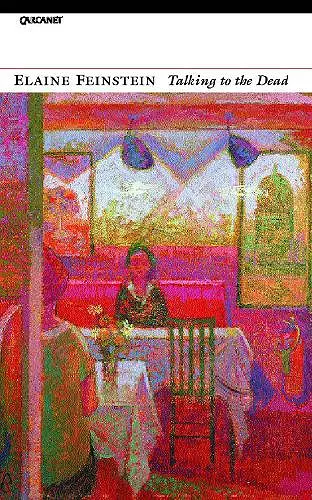
Opening with a death in winter, this is a tender work of mourning which is wonderfully moving but never dispiriting.Elaine Feinstein uses the remembered words of a much-loved husband - sometimes affectionate, sometimes querulous - to invoke his solid presence; it is the man rather than her grief which is the centre of the book.Many lyrics recall the closeness of their last months together; others confess the ambivalence of a long marriage.Theirs was never an easy relationship, and she is not afraid to register the differences between them. With wry humour, she questions her own life before their meeting, and looks steadily at a future without him. As she imagines that future, she confronts the myths of an afterlife, a belief in God, her debts to other poets and her dependence on friends and children. Always in complete control of rhythm and tone, these beautiful lyrics explore the most intimate thoughts with a clarity and tenacity Ted Hughes once described as 'unique'. It is Elaine Feinstein's most passionate book of poetry.
'For more than 40 years, Feinstein has been writing intensely lyrical, finely crafted poems. Those in [Talking to the Dead] are honest and moving, and are among her very best.'
No. 1 in 'The Ten Best New poetry collections' - theIndependent, 2007
Her memorial poems, most of which are collected in Talking to the Dead (2007) are remarkably frank. So well-judged is their cold tone that the poems, which never dissemble or conceal, win the reader's total confidence; yet, even when reliving past hurts, her post-mortems never wallow in vindictiveness or victimhood, recrimination or revenge. They are, in fact, oddly affirmative and unexpectedly affectionate.
Dennis O'Driscoll, The Widow's Tale (Galley Press)
'Talking to the Dead is arguably Elaine Feinstein's best collection. Beautifully crafted, deeply felt, totally earned, these poems of love and bereavement, and more, will expand her readership well beyond the readers and writers of contemporary poetry who have long loved and treasured her exemplary contribution to the art.'
Carol Ann Duffy
'These are more than elegies, they are alchemy; the emotional force of the book is so strong that the dead come walking out of the pages.'
Jo Shapcott
'Beautiful, generous, wonderfully intense poems ... Anyone who has ever felt comforted in grief by words, or who has lived through that tension between tenderness, longing and guilt, will recognize their precision and their truth.'
Ruth Padel
John Horder, West End Extra, 18 May 2007
Small details of a life together
Elaine Feinstein's new book of poems, Talking to the Dead, is her memorial to her dead husband Arnold, a scientist and academic. They lived for many years in England's lane, Belsize Park.
Ted Hughes said of her poetry: 'She is an extremely fine poet... Reading her poems one feels cleansed and sharpened.' That's all very fine as far as it goes. But it doesn't take into account Elaine relentlessly trying to make sense of her and Arnold's transience throughout their long-lasting marriage.
Writing about her father's 'presence' and ordinariness in 'Father' in the first of her Selected Poems, she gives more than one clue why their marriage, with all its ups and downs, worked as well as it did:
Still the boss of his own shop
he labours in the chippings
without grudge
loading the heavy tables,
shabby and powerful as an
old bus.
In Talking to the Dead, it is Arnold's presence and absence which is the key to Elaine's transcending both through embracing the smallest details of their life together:
Your spirit comes to me in a mackintosh
scented with volatile esters from the lab.
Elaine writes of their ordinariness again with the greatest compassion in 'Wheelchair' and the poems leading up to his death. The most telling line for me in Elaine's new book is 'the niche we make on earth is all we share.'
The last stanza of 'A Match', with Arnold getting the last punch, demonstrates a genius that dares to embrace the small details most of us prefer to neglect:
All our worst faults we shared:
disorder, absentmindedness, neglect.
You asked me once: How
did you get away with it?
before concluding harshly:
You must have been a tank.
Antonia Byatt, The Guardian, 5 May 2007
Memorial to a marriage
Elaine Feinstein has written an extraordinarily moving collection of poems dedicated to the memory of her husband, Arnold Feinstein. They evoke him and his absence with painful clarity, charting both the discords and harmonies of a marriage. Feinstein offers no easy retreat into the false comfort of shared sentiment in grief; instead her poems bravely probe human transience.
'Winter', the opening poem, is bleakly set on a wet London street, lit with harsh headlights. Feinstein, driving alone, introduces her husband's voice: 'You never did learn to talk and find the way / at the same time'. These poems conjure up the intimate presence of her husband again and again: he appears in small, matter-of-fact memories but, as in 'Winter', the conversational ease and the intimacy of the moment often shifts:
Well, you're right, I've missed my turning,
And smile a moment at the memory.
Always knowing you lie peaceful and curled
like an embryo under the squelchy ground,
without a birth to wait for, whirled
into that darkness where nothing is found.
The absence she confronts is immense. The sense that the universe is far greater than men's own lives is explored further in 'Hubble'. In it, the 'Lord God' watches the Hubble telescope ('a delicate toy') attempting to measure 'heavenly secrets'. Our lives, to Him, are touching but not significant. This God offers no heavenly paradise. Instead, in these poems, paradise is often found in London gardens, paintings and music, and the Earth's round of seasons. 'If I believed in an old fashioned Paradise / then you, my love, would still be talking in it.'
Feinstein brilliantly makes personal significance ring loud. There is a simplicity in some of the poems that is wrenching. In 'Beds', 'Last night I wondered where you had found to sleep. / You weren't in bed. There was no one in your chair'. This starkness is here again in the poems that track Arnold's illness and death. Modern, hospitalised death is often intrusive and dehumanising. Arnold appears in hospital, hauled by the nurses: 'you'd been inside so many hospitals, / ticking your menus, shrugging off jabs and scans'. Thom Gunn's elegy, 'Lament', describes the physical horror of the tubes inserted into his dying friend, recording how 'your body sought out martyrdom / In the far Canada of a hospital room'. Feinstein, too, is excruciated by her husband's fear: 'At your bedside, I feel like someone / who has escaped too lightly / from the great hell of the camps.' But her description of what her husband later has become is acutely painful and tender: 'Darling, they brought you in like a broken bird. / Your shoulder blades were sharp beneath your skin, / a high cheekbone poignant against the pillow.' It is, however, the moment of their coming together in his death that resonates: 'That Monday, while I phoned, you waited loyally / for my return, before your last breath.' In 'Hands' he says in hospital, 'Hold my hand ... I feel / I won't die while you are here'. But his conjured-up voice dissolves back into the air.
Feinstein achieves this fine balance between presence and absence through a set of repeated images. Arnold's mackintosh, smelling of chemicals, frayed and dirty, appears empty, flung on the end of the bed while they make love; much later, when he is an old man, it opens awkwardly as he bends over to pick lavender. In 'Stuff' she finds him lingering in the iMac, in his sleeping pills, in his teeth in a drawer. There is much physical memory in these poems but it isn't sentimental: 'I still remember love like another country / with an almost forgotten landscape / of salty skin and dry mouth.' Feinstein is wary of 'dangerous nostalgia' remarking 'It's easy to love the dead. / Their voices are mild'. Instead she tracks the vagaries of her marriage. In 'Widow's Necklace' she asks: 'Why should I now recall a loving presence?' Other poems record the lurches and pushes of 'the damage we do to one another'. But again and again she comes back to her husband as her 'skin': 'You were always home to me / I long for home.'
Finding home, 'the niche we make on earth', and asking whether it can be permanent is taken beyond the metaphor of a marriage as the settled place of being. Feinstein contemplates what home means to homeless peoples. In 'Moving House' She notes that her Jewish 'Grandparents knew / how to pack up and go in a single night, / with house spirits in a shoe', and in 'Afghan' her own loss is likened to an Afghan taxi driver in exile who misses 'the sense that what he does matters to anyone'.
Feinstein knows only too well that 'most of what we work at disappears', but here are profound, deeply felt and complex poems that will last. Beautifully and delicately crafted, they dance between presence and absence, grief and joy, bleakness and rejuvenation. In the last poem she shifts the Hubble telescope; her granddaughter looks down on a London which is a 'field of lights'. The precision and focus in these poems make them infinitely moving for everyone.
The cover of this collection tells us that it “is Elaine Feinstein’s most passionate book of poetry”, and there is nothing careful about these elegies, or the memories and memorials which surround them. Yet to read Talking to the Dead is to be taken through its dark matter by an absolutely sure-footed guide, a mistress of the most difficult literary and human subjects. It is as if the poetic voice has the capacity to contain not only those experiences the author explores, but the reader’s own intimate terror of bereavement and death. Dante famously understood how only a true poet – a Virgil – can guide us through this territory; and few writers have the range and dignity equal to this task.
Coincidentally, the last eighteen months have seen the publication of two moving and important ‘Widow’s Necklace’s’: Penelope Shuttle’s Redgrove’s Wife and the Russian Inna Lisnianskaya’s Far from Sodom (itself with an introduction by Feinstein). The phrase ‘Widow’s Necklace’ is Feinstein’s; and it is the title of one of the shortest and yet most fully-incorporated of the poems, and one in which we begin to see, perhaps, the secret of an enormous poetic toughness.
The first of five couplets declares: “Friends try my stories on their teeth or / with a match: are they plastic or amber?”. The pentameter which underpins much of the book is at its loosest here, and the narrator seems to suggest she’s isolated, perhaps even untrustworthy. A lesser poet would make much of this ekphrastic technical variation but, as she segues into more stable form and explication – of the ambivalence at the heart of marriage – Feinstein instead offers us something to take our eye off the technical ball. “[…] my story as a wife / is threaded on the string of my own life”; “I still remember your warm back / as we slept like spoons together”.
It is a risk to be emotionally declarative like this, especially in today’s climate of poetry cool. It’s also a risk to use the cosy imagery of pillow-talk. But Feinstein’s work effortlessly earns its emotion; and is never cosy. Instead, it brings both intensity and range of diction to bear, with certainty and discernment, on the central challenges addressed. These are, as always in bereavement, problems of love: at once its ambivalence and irreplaceability. Talking to the Dead gives us a – perhaps inadvertent – picture of love as tender observation: “What hurt me, as you chose slowly, / was the delicacy of your gesture” (‘Rosemary in Provence’); “After so many fevers and such loss, / I am holding you in my arms tonight, as if / your whole story were happening at once” (‘Bonds’); “once home from / hospital, you called me wife and mother –
ISBN: 9781857549027
Dimensions: 216mm x 135mm x 5mm
Weight: 91g
64 pages