Night Tree
Format:Paperback
Publisher:Carcanet Press Ltd
Published:27th May '04
Should be back in stock very soon
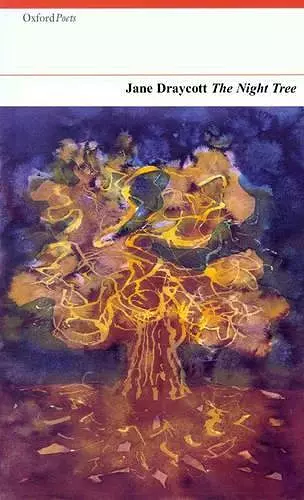
This collection travels many paths and by-ways, beside some of which lie burning cars, or a young man speechless on a forest floor, or girls lost far from home. And there is a lighthouse...Travellers pass along these ways, in the darkness, in transit, hoping for safe passage through unknown territory. All are imagined with what Sean O'Brien describes as Draycott's 'quizzical, exultant, exact music'. The Night Tree is Jane Draycott's second book of poems, following Prince Rupert's Drop, a Poetry Book Society Recommendation short listed for the Forward Prize in 1999, and two smaller collections, Tideway (Two Rivers Press, 2002, illustrated by Peter Hay) and No Theatre (Smith/Doorstop) short listed for the Forward Prize for Best First Collection 1997.
Reviewed by David Morley in The Guardian
Poetry persuades by the precision of its language, and this necessary exactness is carefully and coldly won over years of drafting and redrafting.Jane Draycott's first collection, Prince Rupert's Drop, was well received and rightly so.Her work had a patient intelligence of practice, and concision of address, not only in every poem in that book but in the very philosophy of perception informing her poetics.Her collection set a lofty point from which to advance.Happily for her growing number of readers The Night Tree goes even further in its elegance and imaginative force.
She succeeds because, in the end, it's down to her confidence: a writerly coolness coupled with a sense of a workable, completely engaged aesthetic.The price of precision can be perfectionism, an attitude that can result in freezing before the headlights of your own expectations.At this point in a poet's vocation, the resilience of a personality has a great say in whether or not artistic progress is made or not.In short, you either freeze or thaw.Everything experienced so far, everything written and read, decides that outcome.It is a learned process and the consequence is ultimately decisive and life-changing.It can precipitate artistic crisis: poetic careers can fall apart, the language becoming clinical or unraveled.
Not so for Draycott.The Night Tree is a calculated, amazing thaw, made up from icy, prickly detail.Her attention to detail has paid off hugely; and she knows he price of it.One example, from the sequence "Tide Away" (a series of meditations on the Thames), is the short poem, "It begins with razors", the lift-off point for which is that lightermen on the river once bought their pipes pre-packed, then threw them over-board.Here it is in full:
It begins with razors or lighters,
its sharpness or fire akin to a ship
that is passing, a fragment or sample
of something much bigger and further away
such as fathomless caverns of silver,
whole acres of indigo, saffron or hemp
or hillside on hillside of spices or tea
laid out like a rug to lie down on or sleep.
But capping the bowl like the door
to a furnace some made it last longer,
run cooler for breathing in deeper
its skyfuls of clouds, so that burdens
grown lighter could rise in the water
like palaces turning to smoke,
for a pipe once alight is a dream
which is now or is never and ends
like a pipe of disposable bones
washed up on the foreshore
where in the same place the body
of a river ran just before.
What Draycott manages in two sentences contains a world.It isn't just the concise audacity of the imagery created here that is persuasive ("sharpness of fire akin to a ship that is passing"; "capping the bowl like a door to a furnace"), it's also her adroit control of language within the determined rhythmic clarity of what's almost a sea-shanty form ("a pipe once alight is a dream / which is now or is never and ends / like a pile of disposable bones").It is very hard to write this simply, nor is it simple to set so many internal rhymes in place, their gears interlocking almost soundlessly, without making the poem clank as wildly as a cartoon grandfather clock.Draycott's confidence secures the registers and makes a fine, clear lyric.Moreover, she makes significance out of insignificance.Sat it out loud: you'll want to sing it in time.Time's the theme.
Like the best poets at the peak of confidence, Draycott can also be playful.The way she plays, however, is by making strange, such as in the poem "How he knew he was turning to glass", an artful examination of the proofs of that transformation: "By the playing like wind in his hair of exaltations / from the distant leper colony. /By the images of himself repeated in the candelabras / of his erections..."
Or she can play on expectations by taking something familiar, and setting it in another unrelated but again familiar context, and seeing what emerges.I enjoy any ceremony in which literature proposes to science.The children of such a coupling usually lack any dread of reason (while some poets fly the room at the smell of it).Draycott plainly enjoys this observance too, especially in a cunning poem in which Sherlock Holmes receives a fellowship from the Royal Society of Chemistry: "He appears for a moment to fade, lost / in the fog which encircles his head. / The microphone leans towards him / like a question shouted into the wind / Who are you waiting for on such a freezing night?Areas of his brain / are needless of fire, clear signals across / open ground.The carpet rolls its red road / out across centuries of snow. / And what is it you fear so greatly? / Disembodies mond swirls in freefall / beyond the window pane frost calculates / its way across the floor.As you value / your reason, keep away from the moor."
As you value your reason, the you probably value good poetry.I've waited some time to read something this intelligent, this sensuous and this crystalline.In fact The Night Tree is the finest collection I've read for ages.What are you waiting for?
Reviewed by Sean O'Brien in The Sunday Times, 14 November 2004-11-16
The Nigh Tree, Jane Draycott's second full collection, confirms that she possesses an imaginative intensity and concentration.This book includes Tideway, a set of poems arising during a period spent with Thames watermen.Water, drowning, transformation, the lost and found - these subjects are as old as poetry itself.Draycott remakes them with a close sensory weave and a light, compelling music.Her task is not to bring back reports but to immerse the reader's own imagination in her medium, liked the submerged diver/sleeper in Salvage: "Far off he hears the approaching engine / of her name, a deep chest knocking.In his hand / the blue flame flowers and he begins to cut.
ISBN: 9781903039724
Dimensions: unknown
Weight: unknown
64 pages