Fathom
Format:Paperback
Publisher:Carcanet Press Ltd
Published:31st May '07
Should be back in stock very soon
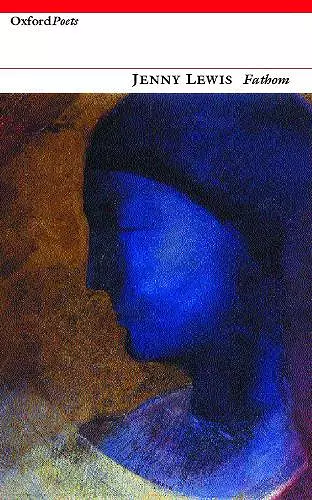
The glowing, painterly poems of Jenny Lewis's first collection take soundings in the depths: of the layers of the pasts that create a life, of the sources of self and creativity, of the structures beneath the surface. It is a region of loss and of recovery, the realm where memories are stored and poetry is made. Ghosts appear. An unknown father, the 'young South Wales Borderer' who died when Lewis was a few months old, bequeaths an irrecoverable sense of incompleteness to his child. Poems about being sent away to a Masonic school, aged seven, reflect the shadow that loss casts, while a later sequence suggests how the missing pieces may be recovered from the depths. Fathom is an intense and textured collection that leads the reader from surfaces to the heart of things. In the end is a sense of affirmation, where self is made whole.
'Her poems delve into her own past, recalling with powerful specificity...'
Sarah Crown, the Guardian
'In this haunted and haunting collection, intuition leads cognition in a pas de deux of great power and beauty.'
Jon Stallworthy, Oxford Times
Sarah Crown, The Guardian
The 'fathom' of Jenny Lewis's title resounds through her collection as noun and verb, implying both depth and the reckoning of it. Physically, it is present as water, the element in which fathoms are measured (as in Ariel's song from The Tempest, a snatch of which prefaces the collection). The surface can be beautiful but the depths are deadly (fear of drowning seeps into several of the poems). Metaphorically, the depths Lewis plumbs are internal. Her poems delve into her own past, recalling with powerful specificity her mother, who 'always had fresh flowers'; a beloved grandmother who "said 'hark!' instead of 'listen!''; the loneliness of boarding school, its chill undiminished by the passage of time.
Curiosity about what lies beneath is matched by a fascination with facades. Paintings feature frequently, of particular interest because they are all surface; in them, depth is an illusion. Her poems, in fact, employ many of the techniques of painting, drawing readers in through the gleam of colours so intense and appealing as to be almost edible: 'dark plum and liquorice', 'rose and burnt caramel', 'sunlight in squares as shiny as toffee'.
Jon Stallworthy, The Oxford Times
Poetry from the depths
Jenny Lewis's poems rise from dark depths, defined by the title of a book dedicated to a father she never met: 'The dead hero, the young South Wales Borderer who led his troops/ across the Mesopotamian desert, guided by stars.'
Her title poem, 'Fathom', with its 'bones and the dead', remembers Shakespeare's song from The Tempest: 'Full fathom five thy father lies,/ of his bones are coral made.'
Understandably, there are no sightings of her father in these poems by his orphaned daughter, but his presence in the shadows of her imagination is continually sensed in the recurrence of the words 'father', 'bones', 'drowning'; the imagery of waves and water; that of the space between the departing mother and schoolgirl 'turned to no-man's land' - and in poems about the departure from home of her own sons.
In this haunted and haunting collection, intuition leads cognition in a pas de deux of great power and beauty.
Helen Peacocke, The Oxford Times
Life and love the themes of Oxford women poets
No literary festival would be complete without a a contribution from today's poets and Oxford's contemporary poetry will represented by the talents of Jenny Lewis and Sasha Dugdale. Over the years Jenny Lewis has staged countless performances of her work and this time she and her fellow poet will be at Christ Church for a reading.
Jenny's first collection, entitled Fathom, has been published by Carcanet, a publishing house which began life in 1962 as a literary magazine publishing poetry, short fiction and criticism. Carcenet acquired Oxford University's fine poetry list in 1999. Sasha's second collection, The Estate, is also published by Carcanet.
Jenny says that Carcanet have taken infinite care with her book.
'They committed themselves to making it the best - a good editor makes all the difference,' she said.
Jenny's poems have ranged from stories of a young medieval nun living in an enclosed cell to tales of a gypsy dancer who was in love with an Indian prince.
Her collection this time concentrates on a woman's experience of loss and recovery. The work exorcises the ghost of her unknown father, the young South Wales Borderer who died when she was just a baby. The sense of incompleteness which he bequeathed to his child haunts her even now, which may be why many of the poems that touch on her father are so evocative.
She wrote the title poem, Fathom, at three in the morning, while revising for the finals of her degree in 2000. It was at a time when she seemed overwhelmed by the was depressed by the relentless academic pressure and felt as if she was swimming in the ocean beside a huge, dark oil tanker that was blocking the light and threatening to crush her.
'I think it was a cry from the depths of my subconscious, to let my creative juices start flowing again,' she said, adding that the time we have on earth is so short, it's a pity to waste too much of it not doing the thing you feel you were born to.
Three subsequent poems were written last year when Jenny decided to get away from it all and rented a cottage in Wales.
'It was a really tiny cottage, but it was in the middle of nowhere and overlooked the sea. When I first got there I just slept and slept. Then after three days of sleeping I got myself together and wrote. I wrote to my father, my mother, my lover. Just ten minutes at a time.
'After scribbling away for days, I distilled all I had written down to three poems, which I added to the ones already written, some of which had taken months, even years, to complete.'
Jenny has no idea where the reflective poems come from.
'It's no Blake's vision, but the urge to write is a hunger. It's there and you can't fight it. If you deny it, it makes you ill. Poetry is also important to me because it puts us in touch with our intuition, the collective unconsciousness and our deeper selves.' She admits that form and structure are important too if you want to give meaningful shape to the sublimi
ISBN: 9781903039816
Dimensions: 216mm x 135mm x 5mm
Weight: 95g
64 pages