Over
Format:Paperback
Publisher:Carcanet Press Ltd
Published:28th Apr '09
Currently unavailable, our supplier has not provided us a restock date
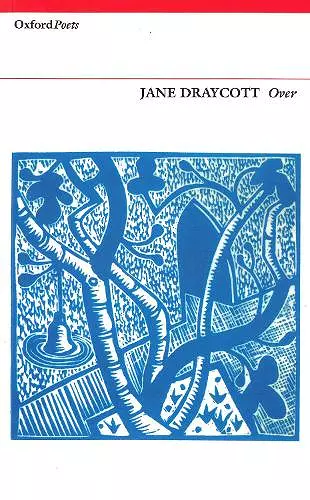
Over, Jane Draycott's third book, takes its title from a sequence of twenty-six poems based on the international phonetic alphabet: Alpha, Bravo, Charlie, Delta... In these and other pieces Draycott creates a world of echoing voices and reflections. She evokes the mirrors and doorways, dreams and night-time journeys that transform the familiar: entrances into a different reality. Over explores liminal places where ocean meets land, land drops to ravine, lives intersect in piazzas. The poems cross thresholds between what is finished and what is 'not over yet', between present and past and, in an extract from her new translation of the medieval dream-vision Pearl, between a sunlit garden and the mysterious landscape of the world to come.
When poetry is described as 'quiet', this may mean that it lacks a sense of musical order and consequence, as is true of the quietly prosy work that is widespread in magazines - the decent, earnest kind that tends to be all language and no song. On the other hand, quietness may be a power, a precise instrument for framing and concentrating the attention of poem and reader. Those who enjoyed Jane Draycott's 'Tideway' poems, deriving from her work with the Thames watermen in her previous book, The Night Tree (2004), will know how well she evokes the otherness of the underwater river-world, its shifts, silences, doorways and vaulted depths, and it is in this sense that the word 'quiet' should be applied to the chords and modulations of Draycott's eerie and beautiful poems. She listens, and therefore so do we.
'both austere and beautiful'
What Draycott sustains into her new book, Over, is a sense of intimate, imaginative apprehension combined with the knowledge that much of the world lies beyond reach, whether because of its pastness or because loss is a condition of understanding it. In 'The Square', a woman is seen looking out from a window: 'In her sleeveless linen dress she is beautiful, / a cool candle in the vast dark glass, / like my mother in a time before I knew her.' In the image as Draycott reads it in the remainder of the poem, it is mortality which grants both dignity and autonomy to this distant figure, so that the conclusion, 'She isn't interested in me any more' is affirmation of love rather than a mawkish protest.
This is both austere and beautiful (and near-impossible in everyday life). Characteristically, Draycott presents the human figure in transition from selfhood to artistic representation; this is done to poignant and humorous effect in 'The Girls' Book of Model Making', where she shows how:
Girls then wore their hair in shining helmets
and their brothers rushed across the lawn to swim
out from the shadows, from the stifling willows,
between the wars.
This 'outdated annual' and its lightly classicised hack illustrations enable Draycott to recall the conclusion of the poem's background model, Keats's 'Ode on a Grecian Urn', and to suggest that rather than immunity to the claims of time, it may be the very vulnerability of these imagined young people to war and death that makes them memorable, charged with life even by the illustrator's modest art.
The quiet persists, but clearly for Draycott art is not a place of retirement: the space of contemplation is surrounded and leaned on by all that would abolish it, and the process of contemplation cannot be po-faced either, since it has for example to cope with the sense of nightmare comedy revealed on top of a latter-day Magic Mountain: 'This is the hour in the high alpine restaurants / when lovers of many years' standing / wonder if they have ever existed at all' ('After the Meal'). In the context of the poem, you need to be wealthy to eat there, so that the horror of dissolution is an insult delivered by your money, on behalf of what it cannot govern. This is a fairly loud example by Draycott's standards, but she is always delivering us back into the presence of history and power.
'...the effect is chilling and exhilerating...'
The second half of Over contains 26 poems taking their titles from the international phonetic alphabet. In the hands of some poets, such a project would be a cause for dread; but Draycott has a light touch, as well as the indispensable virtue of never being less than interesting, as indicated by 'Charlie', which deals with the everyday metaphysics of a cocaine smuggler: 'Above the snowline even your hair sings. / You turn again to almost perfect crystal, / you are beyond the shadow of a doubt.' 'Lima' shows Draycott's gift for painterly compression: 'In Europe the interior has become a genre / in its own right, light from outside streaming / like silver in through the windows of merchants, / the whole world held like linen before the press.'
You might think Vermeer's world has been bled dry poetically until you encounter Draycott's measured tone, which knocks a textbook recital slightly off balance to show capital taking firm hold of culture. As she goes on to include optics and mapmaking, the effect is chilling and exhilarating, like the history poems of a very different writer, the late Ken Smith. Like Smith, Draycott purges her work of the knowingness that often short-circuits poetry. She goes to the trouble of imagining things for herself, and thus for her readers - whom she trusts not to need or want everything, including the correct moral stance, to be explained. She invites readers to immerse themselves, to spend time until the world refreshes itself. However inhospitable the results may at times prove to be, Draycott affirms the pleasures of the imagination as well as its duties: as she puts it in 'Quebec', 'the solitary owl in the darkness, / the beauty of the ice-journey, its flame'.
TS Eliot prize
The Sunday Times review by Alan Brownjohn: a preview of the 10 shortlistees for the prestigious poetry prize
The annual 10-book shortlist for the £15,000 TS Eliot prize can be re-lied on to provide an intriguing mix of obvious candidates and surprising outsiders. But the experienced poet judges for 2009 (Simon Armitage, Collette Bryce and Penelope Shuttle) have added some particularly wild cards to the four choices already delivered to them by the Poetry Book Society. (The PBS makes a quarterly choice for its members, and those four titles automatically go on the shortlist.)
Last year saw admirable new collections from Andrew Motion, Don Paterson (winner of the 2009 Forward prize) and Peter Porter. None is among the Eliot 10. Sharon Olds is; but her marvellous fellow-American John Ashbery remains oddly beyond the range of the judges. One of the PBS choices, Alice Oswald’s Weeds and Wild Flowers (Faber £14.99), presents a problem. The poet described it as 'two separate books', her poems not relating specifically to Jessica Greenman's prominent, beautifully exact etchings. The poetry has a weird charm (Snowdrop is 'A pale and pining girl, head bowed, heart gnawed'), but lacks the boldness and range that won Oswald this prize with Dart in 2002.
Jane Draycott's Over (Carcanet £9.95) has an emotionally charged yet cryptic style that is at its most approachable in poems concerning parenthood or marriage (the excellent Picnic), while the raw confessional mode of Sharon Olds's One Secret Thing (Cape £10) recalls Sylvia Plath and Anne Sexton in the 1960s, with sequences about war, adolescent awakening, or (the best) her mother's second marriage and death.
To refer to oneself in the third person, as politicians and footballers sometimes do, suggests a self-image both lordly and insecure, at odds with itself. Poets too have their version of self-decentring, in the frequently adopted strategy of displacing a narrative 'I' onto the second person. In 'Sky Man', the opening poem of her third collection Over, Jane Draycott has a different approach again. The other, which might be the self (a mirror is involved), contemplates the either/or of alterity and proceeds by determinate negation before an eventual second-person identification. The sky man:
Waits in the sky mine upriver.
You are stone and that chair is only a chair.
No change in the face of the mirror.
Not you. Not you.
Over is a volume of journeys and midpoints between here and there, of the 'exact half-way' moment of midsummer, while 'to and fro along the fair miles / the fascinations travel'.
Cockaigne, the fabled land of plenty, 'begins to look a lot / like home', even as the voyagers going up the Orinoco pursue a chimera ( 'There is no gold'). The sense of identity is prone to sudden fade-outs, as when 'lovers of many years' standing / wonder if they have ever existed at all'. Sometimes the back-and-forth between the 'me' and 'you' turns fractious, as in 'Concourse', which sounds like a metaphysical lovers' tiff ( 'What are you going to do about it?
- Short-listed for T.S. Eliot Prize 2009
ISBN: 9781903039922
Dimensions: 216mm x 135mm x 8mm
Weight: 68g
80 pages