New Collected Poems
Format:Paperback
Publisher:Carcanet Press Ltd
Published:28th Jul '09
Should be back in stock very soon
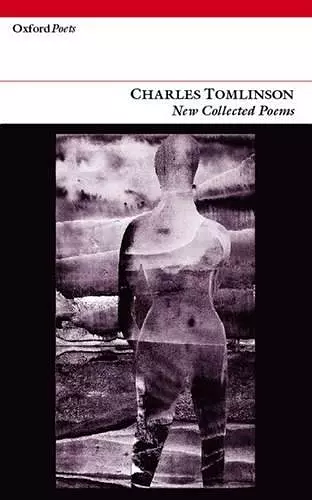
Charles Tomlinson’s New Collected Poems gathers a lifetime’s work, from the 1950s to 2006. A poet deeply responsive to English landscape, grounded in the poetry of Wordsworth and Coleridge, Tomlinson is also a writer of international renown, with wide-ranging interests in European and American poets, many of whom he has edited and translated. Collected Poems is an enriching journey across continents and literatures, friendships, collaborations and experiments, always with an eye keen for new places and possibilities. Tomlinson’s poetry is witty and luminous, marked by precise observation and language, alert to surfaces and depths, to the local and the universal.
Cover image: Janus Figure by Charles Tomlinson. Cover design by StephenRaw.com
Spring 2010
A poetry that is so profoundly English because of its international outreach; a poetry that continually opens up the varieties of a time-and-place world never seen by the closed mind [...] his kind of mastery sets him completely apart from his English contemporaries in the post-war era. No other poet, except for Basil Bunting, can be said to have opened up so many 'kingdoms of possibilities' in verse, and to have created the space where we can move with athletic awareness inside the tangible universe and the elements, yet stay discriminatingly wide awake.By this fact, indeed, he is the poet of today. As the New Collected Poems constantly shows, his great service is to have recaptured for consciousness the ground that has been so environmentally smudged, warped or put out of sight. This is his way of seeing into the heart of things, while giving us, again and again, the terms by which we also touch the textures, currents and solidities of a multitudinous world.
'The Atlantic', the poem which opens Seeing is Believing, the book that established Charles Tomlinson's reputation, enacts the surge of a sea wave as it unravels into 'netted ripple' over sand; but its conclusion concerns the human need for 'replenishment' from 'all that we are not'. The poem gives an almost physical pleasure in the accuracy of its diction, in its dynamic syntax and daring enjambment: the Atlantic
Launched into an opposing wind, hangs
Grappled beneath the onrush,
And there, lifts, curling in spume,
Unlocks, drops from that hold
Over and shoreward.
It is characteristic in the way the poet seems entirely taken up in an action simultaneous with its own description. Throughout the New Collected Poems, the reader is present as clouds moving across the sky dissipate or enlarge their bulk, as sunrise and sunset develop in shifting lights that reveal landscapes and townscapes that are themselves changing, and as water dashes down the brook at the end of Brook Cottage garden. Snow is a favourite subject, transforming familiar woods and hillsides and marked by the tracks of animals and men. Many of these poems were composed as the poet was out walking; the gradual changes of viewpoint and horizon are sometimes their subject matter, but are always reflected in their form. The dynamic of Tomlinson's poetry recreates the Romantic sense of a living universe in terms of a modern sensibility.
This poetry engages with far more than the natural world, however. Tomlinson is deeply interested in human behaviour, represented as a kind of dance in which the created world is partner. The comings and goings of 'The Plaza' take place as a Mexican afternoon turns to night; the poem creates a space equivalent to the plaza itself, a sort of dance floor where there is already a band playing. The dancers include the four Indians who cross it carrying a bed, 'as if they intended to sleep here', 'the child in a torn dress / selling artificial flowers, / mouthing softly in English, 'Flowerrs' ', and 'the shopkeepers, the governor's sons, / the man who is selling balloons / in the shape of octopuses', all of whom have disappeared on their own mysterious occasions by the end of the poem. They are not treated as though the poet owns them. It has to do with style. Tomlinson has said: 'in my poems you must begin with the question of tone'. Tone is a matter of address. The scene on the plaza is addressed with openness to to the unpredictable; and a cherishing of what is actually there; the poem is addressed to the reader with a tacit recommendation of the attitude it embodies. Beyond the ecology and the ideas, which have been well expounded by Michael Edwards and Michael Kirkham, what matters in these poems is the way they are written, the way they express an attitude.
The new collection, which includes all the volumes to date since The Necklace (1953), makes visible Tomlinson's development in both style and attitude. Discussions of his work have too often depicted it as all of a piece, once The Necklace has been put on one side. Now it is evident that the last three books, from The Vineyard above the Sea on, are a culmination of a life's work, and much more than a tailpiece.
The progress to such assured ease has certainly not been easy. Tomlinson was the child of working people, born in Stoke, where the family house looked out onto 'The biggest gasometer in England'. A good grammar school education and an enlightened tutor at Cambridge (Donald Davie) made possible his escape to a wider world. As though the poet could hardly believe in his own release, the early poems insist on the strangeness of what we see and the reality of the things-in-themselves that we do see. The idea that seeing is a form of encounter is there very early on, but at first fits uncomfortably with Tomlinson's poetic doctrine - The Necklace has as its epigraph a quotation from Wallace Stevens's 'The necklace is a carving not a kiss'. In a letter to William Carlos Williams, Tomlinson compares the writing of a poem to the building of a drystone wall stone by stone. This early emphasis on the poem as created thing is not surprising in someone who thought for a while that he might be primarily a painter. It took time for the poet to adjust his focus on change and the dynamic world to the demand that the poem have the definition of a carving.
The poems in succeeding volumes become more at ease with their own discipline of attentiveness, and take on the characteristic form of movement, sometimes easy, sometimes difficult, through space and time. Things are still things-in-themselves, but they are also subject to change and to a changing point of view. 'Night Transfigured', from The Way of a World (1969), marks a kind of halfway point; night is transfigured when a torch beam is directed downward among nettles in a patch, to reveal them as 'An immense, shifting crystal / Latticed by shadow . . . Each leaf, lodged blade above blade / In serated dazzling divisions'. Although the scrupulously nervous diction in which the moment is described is enough, the poem goes on to construct an obscure and portentous argument about it. In later poems, syntax is more fluid, and argument less explicit. The aim becomes the the last poems that of not allowing us to 'run ahead / Of the heartbeat', which means that the poet is similarly restrained, for example in his wish to point an explicit moral.
What he has learned from American poetry has been of the greatest importance in shaping Tomlinson's style. Geoffrey Hill and Roy Fisher, both from the Midlands, both from backgrounds like Tomlinson's, also had to learn from America in order to create styles adequate to their own way of seeing, though they learned different lessons from Tomlinson's.He went to Marianne Moore ( 'ready to accord to objects and to animals a life of their own'), William Carlos Williams ( 'No ideas but in things') and the Objectivists, George Oppen and Louis Zukofsky. They taught a more direct contact with things-in-themselves. But that was not all. Tomlinson found in Oppen a 'desire to reject 'style' and also the sort of pose where the poet's work seeks merely to present the psychodrama of a poet's egotism'. Oppen confirmed his commitment to an impersonal form of poetry, but also encouraged him in the developnment of a style that is no 'style'. Already in A Peopled Landscape (1963), there is a palpable sense of liberation in the poems written in shortline free verse indebted to Williams, even when the subject matter is English: 'Swans. I watch them / come unsteadying / the dusty, green / and curving arm / of water . . . '.
It is a form that Tomlinson uses continually thereafter and with great success. He has spoken of a 'civic' intention in his poetry, directed towards community and respect; to be at ease in one's place is also a civic aspiration. That is what makes 'The Plaza' a great poem. Ease is implicit in the glance that moves democratically from people to insects ( 'the ants at our feet / who are removing - some / by its feelers, some / supporting it on their backs - / a dead moth / as large as a bird' ) and back again - the drama of a world rather than of an ego.
To renounce the ego is to renounce ideas of total control. Tomlinson's graphic works are based on chance procedures, and chance is at the heart of his poetry too. Early on he was interested in Andre Breton, to whom the collaborative sequence Renga (not included in the new volume) was dedicated. The chances of rhyme figure largely. There are many poems about mistakes (including 'The Accident', a fine poem whose omission is much to be regretted). Many poems, like 'The Plaza', have the unpredictable successiveness of events as their subject. Tomlinson's friend, Octavio Paz, observed of Tomlinson's relation to the Surrealists that, unlike them, he 'does not wish to alter reality but to achieve a modus vivendi with it. He is not certain that the function of the imagination is to transform reality; he is certain, on the other hand, that it can make it more real'. Openness to what cannot be predicted, to what exceeds expectation, coexists in his work with a delight in what is; and that in turn has to do with the 'replenishment' he seeks to offer in his poems.
Although Tomlinson is consistent throughout his work in rejecting any display of personality, there is feeling in abundance and variety. Davie perhaps did his friend and former pupil a disservice when, meaning to praise, in 'To a Brother in the Mystery', he wrote of ' fine-drawn / Severity that is tenderness' and found ' A sort of coldness . . . A sort of cruelty' at the heart of his 'peculiar mastery'. We have been told forever since of Tomlinson's coldness and austerity. But the way his poems return again and again to ideas of Eden hardly suggests that. One poem begins 'I have seen eden', but it is not just a matter of seeing. He says of an Edenic vision of clouds, ' Mares' tails riding past mountainous anvils', that ' what it came to was a lingering / At the edge of time, a perfect neighbouring'. That 'neighbouring' speaks of community and warmth.
Yet Davie was not making things up. There is a side to this poet that wants to be tough, to bring things to aphoristic conclusion, as in ' extremity hates a given good / Or a good gained'. There is another side ( in the same poem , 'Against Extremity') that contemplates the moon, and life itself, with ease, as ' A possession that is not to be possessed'. There was aggression in the philosophical aestheticism of The Necklace, however; and 'Assassin' could hardly have been written without some kind of empathy as well as abhorrence for its subject, Trotsky's murder. The dark side of the world, and of the personality, is represented in 'The Cavern', as ' the self's unnameable and shaping home', a home of ' veils and scales, fins / and flakes of the forming / leprous rock'. The poem asks ' how should these / inhuman, turn / human with such chill affinities?', and there is a doubt whether the chillness is part of the human or the inhuman.
Tomlinson's work is not simple, and it does not present a single face to the world. Something of his stature may be suggested by a comparison with Eugenio Montale. Tomlinson taught himself Italian by reading Montale's poems, admiring them, but in the end, rejecting the 'sheer weight' of Montale's 'introversion' - 'and then the mysticism and worship of an absent ideal'. Montale's world, in Ossi di seppia, is one that 'barely holds up' ('si regge appena'); behind 'the usual illusion' of 'trees house hills', he says, there is 'nothing at my back, the void / behind me'. The ' immense, shifting crystal / Latticed by shadow' which the English poet's torch beam discovers is an answer to the void behind Montale's very different 'poetry of the object'.
ISBN: 9781903039946
Dimensions: 216mm x 135mm x 36mm
Weight: 816g
768 pages