Library of Wales: A Rope of Vines - Journal from a Greek Island
Journal from a Greek Island
Brenda Chamberlain author Dai Smith editor
Format:Paperback
Publisher:Parthian Books
Published:23rd Feb '09
Should be back in stock very soon
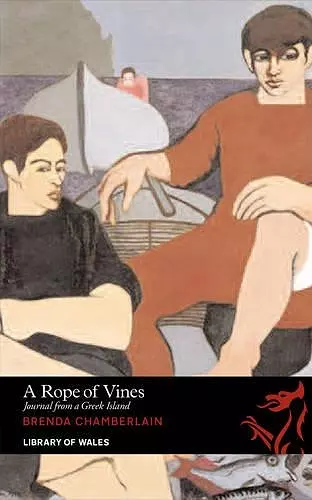
A Rope of Vines - Journal from a Greek Island is a beautiful and personal account of the time spent by Brenda Chamberlain on the Greek Island of Ydra in the early 1960s. Sea and harbour, mountain and monastery, her neighbours and friends are unforgettably pictured. Joy and woe are woven fine in this record.
A Rope of Vines Journal from a Greek Island is a beautiful and personal account of the time spent by Brenda Chamberlain on the Greek Island of Ydra in the early 1960’s.
Sea and harbour, mountain and monastery, her neighbours and friends are unforgettably pictured; these were the reality outside herself while within there was a conflict of emotion and warring desires. Joy and woe are woven fine in this record: the delight of a multitude of fresh experiences thronging to the senses, the suffering from which she emerges with new understanding of herself and human existence.
Both in the intensity and force of the writing and the eloquent island drawings, A Rope of Vines Journal from a Greek Island is a distinguished achievement. -- Publisher: Parthian Books
‘We invent our own lives, but there remains reality outside oneself, and these enduring boats, laden with melons and water pots, green peppers, and cattle, point the way to life through abundant dying.’ An invaluable addition to the Library of Wales series, A Rope of Vines is a haunting and compelling account of the six years Brenda Chamberlain spent on the Greek island of Ydra. From the opening lines it is clear that behind the exuberance of the light, colours and smells of the island, there is a continual, lurking sense of violence: ‘I have returned to the good mothers of Efpraxia while my friend Leonidas serves sentence for manslaughter of an English tourist in the port of Ydra.’ Later on she writes, ‘This is what life is, too, violent encounters, inexplicable withdrawals.’ She experiences her own anguish after the imprisonment of Leonidas as an inner violence, ‘How much further can I bend before I break, how much salt water covers my head before I drown?’ It is a violence mirrored in the threat of an earthquake, the build-up to a taverna brawl, and the policemen looming with guns during the elections and voting. Chamberlain retreats to the mountain monastery after Leonidas’s imprisonment to pray for him. Her retreat is also a necessity for her to withdraw from the world something that island life, both on Ynys Enlli (the subject of Tide Race) and Ydra, can provide. She needs solitude ‘to hear the earth breathing’. We have a sense that she never dwells happily for too long either in the ‘non-world’ of retreat or in the noisy human world of the market place, but must oscillate between the two. The journal is accompanied by black-and-white line drawings of the buildings, people and creatures on the island drawings with bold lines and vast space within them which seem to conduct the heat and the light of the island and draw the reader in. There is a hypnotic, meditative quality to the drawings and the text an elusive moving backwards and forwards between belonging to the world and retreating from it. What is certain is that Chamberlain seeks to explore and express all that points the ‘way to life’. She rejects what she describes as ‘almost-living’: ‘On this island . . . one can forget the souls who wander in the miserable gulf of almost-living, those who are unable to work out the difference between monotony and rhythm. They act under compulsion, at the dictates of a machine-driven existence, when they could know a meaningful pattern of behaviour ordered by the nature of their surroundings.’ The ‘way to life’ may bring with it suffering, but suffering, she concludes, is a source of greater wisdom and clarity of vision: ‘And disaster when it overtakes causes clarity of vision as if one were lifted high above the earth to see life in its perspective in a moment. The problem is to remember the revelation, and not to be lost in the complicated cities of the plain. It is imperative to transform the dismal world and to turn the vision into a kind of sacrament.’ -- Jane MacNamee @ www.gwales.com
ISBN: 9781905762866
Dimensions: unknown
Weight: unknown
156 pages