Red House
Format:Paperback
Publisher:Carcanet Press Ltd
Published:25th Aug '11
Should be back in stock very soon
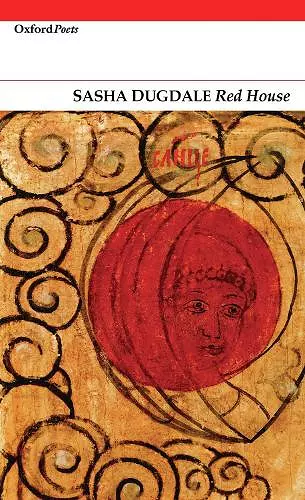
In Red House, her third collection, Sasha Dugdale evokes the ghosts and presences that flit about on the margins of our lives. She finds them at the edge of towns where superstores and allotments blur an older landscape, in Europe where emigrants leave their gods, their neighbours, their memories 'jettisoned like old clothes'; and across the chalk Downs of her native Sussex. She traces the shapes that they leave through folk song, lament and lyric poetry.
Haunted by history, confronted by primal brutalities, the poems in Red House proclaim the fierce, bright authenticity that is 'all the proof we need that we're alive'.
'My favourite collection this year is Sasha Dugdale's Red House (Carcanet Oxford Poets). I like how she has infused her British sensibility with the passion and abandon of Russian poets like Anna Akhmatova and Marina Tssvetaeva, whom she has previously translated.'
Kathryn Maris, Timeout Magazine Best of 2011
The original article can be seen on the Guardian website. Click here.
'The red house lies without the parish of the soul' is not an opening line I can imagine any of Sasha Dugdale's contemporaries risking; but then, Dugdale is one of the most original poets of her generation. Red House is her third collection. In the title sequence, the red house is a living, pulsing place: 'The smell of you is homely and nauseating / Like the smell of all humankind.' It is variously a scene of everyday desolation (the silence of a house suddenly bereft of children), surreal visitations (a man brings a bear cub home as a love-gift), and more sinister encounters (a rape, or a rape fantasy, takes place). The speaker is mysteriously trapped:
I could be happy and gainful without the red house
But it draws me to its mineral seam like home
When I am without the red house, I am without
And when I am within, I am undone.
Characteristically, the occasionally archaic diction, and the formality of certain turns of phrase, give Dugdale's lines a unique texture, while the light punctuation, often using a line break in place of a full stop, pitches them somewhere between speech and writing. The overall effect is haunting.
"Dugdale is one of the most
original poets of her generation."
Red House is also the title of a painting by Kazimir Malevich. Dugdale lived in Russia for five years and is a highly-regarded translator of Russian poetry and plays. Although she claims that 'no-man's-land might be an honest place', her poems more often exist in two places at once, as though a trick of the light might reveal the chalk Downs of Dugdale's Sussex to be the Russian Steppe after all. For example, 'Dawn Chorus' closes with this image of pre-dawn songbirds:
How they sing: as if each had pecked up a smouldering coal
Their throats singed and swollen with song
In dissonance as befits the dark world
Where only travellers and the sleepless belong
Quatrains, full rhyme, and pastoral subject matter are quintessentially English, but the tonal palette is quite different and the image is complicated by that smouldering coal, which comes from Pushkin's 'A Prophet'. Edward Thomas has been drawn into conversation with Marina Tsvetaeva.
The prophetic note sounds more clearly in 'Ten Moons', which imagines a world where night has been banished 'So fruit might ripen faster and tree flourish higher / And forced photosynthesis green all the land.' To be permanently exposed to society's demands would be an especial nightmare to this poet: her poems speak to us from stolen moments of reprieve, and there is a pervasive sense in Red House of the more violent forces of history pressing up against the door. 'Maldon' ends with another prophecy: 'And when the sun rises, it will seem to our ancestors that a new race / Has come up out of the sea, dripping with gold, crueller than the last.'
Many of Dugdale's speakers would seek succour in faith but are not deluded by the promises on offer: 'There is no addressing the Lord / For we are plain beyond that.' Nevertheless, the cadences of the King James Bible that inform her music are far from ornamental. One beautiful untitled lyric begins 'I can only be who I am / Said the storm as it drew its crow wings about the tree.' The tree has learned 'godlessness, which is next to survival', although this does not help it survive the storm. The poem ends: 'Remember we walked its grey trunk/ Over the fluent stream / It gave us passage, but no word of what lay beyond.'
This concern with what lies beyond, spiritually or in terms of artistic ambition, distinguishes Dugdale's work. While her earlier books tended to segregate the domestic and the elemental, these areas now seethe through one another with full-throated, full-blooded confidence. Red House marks a thrilling advance and is an exceptional book.
Paul Batchelor's The Sinking Road is published by Bloodaxe.
The original article can be seen on the Guardian website. Click here.
Sasha Dugdale's imagination runs away with her. In Red House, the title poem describes a place in which a series of events of different kinds takes place. 'Once a man brought home a bear to the red house'. As a way of winning a woman's affections, he teaches the bear to dance:
In an endless manbeast cha-cha, the paws clattering, feet slapping
His humming succour from the stairwell.
The bear they took on the third day; it went well enough back into the
light.
The man threw himself from the window, and he was lamed for life.
This isn't simply surrealism, because it is contained within an aithoritative structure. When she takes control back from her inventions, Dugdale is clearer, but I suspect her most serious work is as yet the most impenetrable, Her energy and wit suggest that this is a way-point towards more considerable achievement. I look forward to her next book.
Dugdale is a librettist who creates decorous and stylish poetry, and in this collection in particular she draws on Anna Akhmatova and Marina Tsvetaeva. To create the dark, vital world of the 'red house,' Dugdale draws on the startling imagination of these Russian poets. She also maintains a vivid sense of history, moving between time periods to interrogate legends - real or mythical - of violence, cruelty and civilization. The title poem explains that the house is 'made of wasp-thought and saliva.' If the red house was a church it has long since been abandoned, but Dugdale ironically employs sacred imagery to describe a godless community. 'On Beauty' for example, is a litany that pleads for a haven from violation, poverty and imperialism:
Lord, give me the strength to protect these children
From the soldiers, ex-soldiers, arse fuckers, shitmongers
The unclean, unwashed, the simple, the hopeless, the West
With its bulbous self-determination.
The speaker laments with parental concern, but some of the threats listed are ambiguous. When the voice denounces 'arse fuckers', is this the voice of bigot deriding alternative sexualities? How trustworthy is the storyteller who presents this myth? It is difficult to ascertain the speaker's reliability, but, like Paul Kingsnorth, Dugdale emphasises the lack of certainty in Western ideologies. There is anxiety too that the current status quo might be overturned to be replaced by something worse. In 'Maldon', Dugdale references the Battle of Maldon in Essex, England when the Vikings defeated the Anglo-Saxons. The narrator describes how 'a new race / Has come up out of the sea, dripping with gold, crueller than the last.' Dugdale's poems reel with horror at the violence of the world and express this horror in mythical terms. In 'Asylum', Penelope describes the state of things after Odysseus's return home, and the carnage after his homecoming merely continues the cycle of destruction and violence:
The prostitutes hang from a beam like mice.
The suitors are piled unburied in the yard,
And some say that it is now much better
And others, that it is worse.
The world of the mythical red house is one of discord, hence Dugdale's 'A Ballad without Rhyme'. The subject of this dissonant ballad, however, is a courageous woman, who remains standing 'wrathful, impossible to behold.' Drawing on history and myth, Dugdale creates an imperfect domain for her poems where violence is neverending, though women and poets might stand against it.
Sasha Dugdale could have avoided mystifying her readers with her cryptically titled Red House had she put the Malevich painting, to which it refers, on the cover (rather than a completely different 'red' work of art). His child-like painting of a 'generic' red house harmonises well with Dugdale's 'Red House' sequence on the drudgery of life in Soviet communal flats where, with brutal intimacy, she explains that: '...it draws me to its mineral seam like home' and how 'The smell of you is homely and nauseating / like the smell of all humankind'. There is a powerful sense of danger in the stairwells: 'All the world is beyond the padded door of the flat' with one victim of such violence trained to her role: '...playing the part assigned to her / with a blade's gesture'. And these same flats are shown frequently cluttered up with possessions from a pre-Revolutionary past: '...the historical sweat / The ancient hairgrease of its inhabitants / Who have sloughed off desperate times.' She continues with other reminders of Soviet Russia such as the Stalinist repression of its poets, as in the untitled poem 'Perhaps Akhmatova was right': '...how iambs are measured best / Where it hurts' or in 'Poetry of Earth' with its opening line: 'The poetry of earth is mostly suppressed'. Dugdale thus provides us with civic poetry that is both dark and deeply empathetic in its portrayal of those caught in the crossfireof European twentieth-century turmoil, particularly as experienced by those in totalitarian states.
Occasionally, Dugdale's poetry falters were she relies on writing exercises such as rewrites of Audens poems or 'The Alphabet of Emigration'. This said, 'Annunciation' relies on a clever device to harrowing effect. It is dedicated to Irena Sendler who saved children from the Warsaw Ghetto under the guise of checking the sanitation. Dugdale cleverly explores the language of Sendler's job to provide heartbreaking images of loss: 'Death is your mother, slipping you mercury in her breast milk / Letting the gold from her finger drown in the toilet bowl / Wrenching you from her heart with an iron bar.'
There is also something very modern about her work: her ideas are often complex and traditional forms are given a contemporary slant such as 'A Ballad without Rhyme', and she has many images negating the traditional cycle of the seasons. In this she follows in the footsteps of T.S. Eliot's in The Waste Land, as in her poem 'Dawn Chorus': 'How they sing: as if each had pecked a smouldering coal / their throats singed and swollen with song', or in the permanent light of 'Ten Moons' where '...the day knew no beginning / And has no end'. What is most distinctive about Dugdale's voice, though, is her achievement of a coldness of tone. This is evident in the strange distancing effect of the following lines from 'Laughter': '...there was a sound coming from us / And it was laughter.' The same is true of 'Late winter, like the tide retreating' where the following lines are typical of the power she can generate through a stark discipline: 'And history, happening like the seasons, / Spring is righteousness upon despair / And with a thousand pretty reasons / Trusses winter, beats it, shaves its hair.'
Dugdale's view of the world is cold and dark, but her attachment to it is clear and pl
ISBN: 9781906188023
Dimensions: 216mm x 135mm x 5mm
Weight: 82g
180 pages