Vernon Watkins on Dylan Thomas and Other Poets and Poetry
Vernon Watkins author Gwen Watkins editor Jeff Towns editor
Format:Paperback
Publisher:Parthian Books
Published:15th Apr '15
Should be back in stock very soon
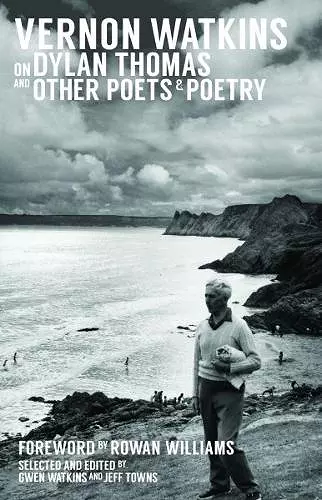
A collection of previously non-published essays on Dylan Thomas, other poets and poetry in general written by the perceptive critic Vernon Watkins, with a foreword by Rowan Williams.
Vernon Watkins on Dylan Thomas is an essential read in the Dylan Thomas centenary year. This rich volume largely focuses on the life and work of Wales’s enfant terrible, Dylan Thomas. Watkins knew Thomas personally and so his analyses and appreciation of Thomas’s work come from an intimate space of landscapes and beers shared. Rowan Williams poses a central question in his introduction to the book: ‘why haven’t we heard of Vernon Watkins?’ Well, Watkins, as it is explained, although a practising poet, prioritised the work of others and, in doing so, has suffered a blow to his own contemporary currency. This book reminds us of his own importance. He was much more than a literary critic. He corresponded with those we would regard as ‘iconic’ and made suggestions that strongly impacted their work. Indeed, Thomas was resigned to leaving ‘And Death Shall Have No Dominion’ out of Twenty-Five Poems, but it was Watkins who encouraged him to keep it in! Watkins is also the dispenser of warm anecdote and trivia (apparently, the Finnish reaction to ‘Under Milk Wood’ was a proposal to send missionaries to Wales to rescue the villages from ‘primitive horror’), and he facilitates seeing the person behind the art. Throughout the selected essays and interviews, you get a strong sense of Watkins’s attempts to deconstruct literature in a sensitive and admiring manner, a manner that differs markedly from the approach of the conventional reviewer. His own summary of his approach chimes with this: ‘there can be no great criticism without love, and that the very nature and habit of most critics makes them incapable of an act of love’. Watkins’s responses to Thomas’s work are unstintingly positive: ‘he [Thomas] had published his first book, 18 Poems, and this had created a sensation ... They were intricate poems, packed with sexual imagery. They were musical and symmetrical’. He’s equally magnanimous about the man: ‘the entertainer and the intellectual alike were slightly ashamed after meeting him as he could beat them both at their own game’. Watkins’s personal friendship with Thomas informs much of the tone, but this foundation is also a well of information. He is able to describe the poet’s ‘jackdaw eye’, his frustrated attempts to write when in exile, and mistakes that would later be erased (‘in the poem, I notice, on copying out, that I have made October trees bare. I’ll alter later’). The sections regarding Thomas’s unease at the prospect of impending fatherhood is especially moving, given the skein of delicate understanding that Watkins had of his subject. He recognised that Thomas’s journey to fatherhood coincided with the birth of war, providing a glaze of death to a psyche that should have been bent on beginnings. His use of a choice line to support a subjective description of some facet of Thomas’s personality is sharp too. When describing how Thomas held everything at once – childhood, death, the universe – he qualifies it with the devastating line, ‘The ball I threw while playing in the park/has not yet reached the ground’. This is much more than a ‘Dylan Thomas Book’, as Watkins also left behind a number of entertaining essays on the nature of art and poetry. His advice for young poets is amusing, ranging as it does from practical monetary guidance to assistance in dealing with philistines. He also attempts to answer some big questions such as ‘For Whom Does a Poet Write?’ There is an additional section of criticism and memoire regarding other writers whom Watkins either admired or met (or both). D. H. Lawrence, he writes, ‘is a man in conflict’; of T. S. Eliot, ‘you could not imagine a more sympathetic and responsive person. He knew all about despair’, and Auden he describes as ‘capable of almost anything’. Watkins is the reviewer every poet would love to have. His appreciation of the artistic process and his generosity of spirit is clear. In his own words, ‘I am convinced that the foundation of art is joy’, and the result is a book that is joyful to read. -- Jemma L. King @ www.gwales.com
ISBN: 9781909844056
Dimensions: unknown
Weight: unknown
272 pages