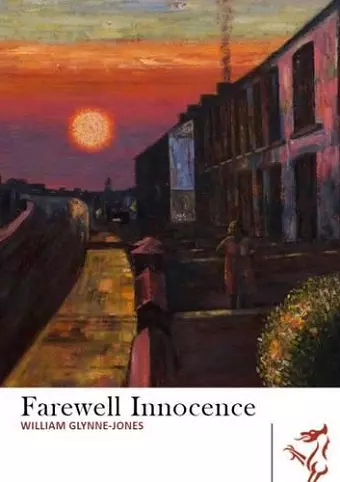
Library of Wales: Farewell Innocence
William Glynne-Jones author Jon Gower editor
Format:Paperback
Publisher:Parthian Books
Published:12th Oct '16
Currently unavailable, and unfortunately no date known when it will be back
The book launch will take place in Llanelli library with Jon Gower, Huw Lawrence and Dai Smith.
Written with a deep authenticity born from bitter experience, William Glynne-Jones depicts life in the fictional town of Abermor and especially the daily grind of foundry life, in a workplace fraught with dangers. Farewell Innocence is a heartfelt and affecting account of a young man's rites of passage in hard times.Written with a deep authenticity born from bitter experience, William Glynne-Jones depicts life in the fictional town of Abermor and especially the daily grind of foundry life, in a workplace fraught with dangers. Farewell Innocence is a heartfelt and affecting account of a young man's rites of passage in hard times.
Farewell Innocence is a recent addition to the ambitious Library of Wales series, which offers contemporary readers an eclectic mix of previously out-of-print books by major figures in Welsh literature. Perhaps inevitably for what is largely a Welsh writing in English imprint (Kate Roberts’s Feet in Chains is the only example to date of translations from the Welsh), the series is dominated by writers from the south Wales industrial heartlands. Llanelli-born William Glynne-Jones can be placed firmly in this category. Unlike most ‘industrial’ novels of the time – those by Glyn Jones and Gwyn Jones, for instance – Farewell Innocence is not written from the perspective of the upwardly mobile son or daughter. With a protagonist who works as a foundry apprentice, it is instead immersed in what Ron Berry calls ‘the muck and the mire’ of heavy industry. The blinding heat and spectacle of the steel-moulding process – a sight which both fascinates and appals the book’s impressionable young hero – is described throughout in visceral detail: ‘A river of white hot metal raced madly down the clay-lined trough. Ieuan stepped back and shielded his eyes. He felt his cheeks burning with the fierce heat. The first burst of liquid steel plunged into the ladle with a loud, ominous thud that shook the girders. A white sheet of flame shot into the air and flashed out over the ladle rim.’ Set in the 1920s in Abermôr (a thinly disguised Llanelli), Farewell Innocence is a bildungsroman which centres on the growing pains of Ieuan, a young aspiring writer and intellectual, who is bullied and cajoled by his mother into abandoning his beloved grammar school for an apprenticeship at the local foundry - a career for which he is profoundly unsuited. There is no trace of either sentiment or nostalgia to soften the author’s almost hyper-realistic account of the torments of foundry life. There is little too in the way of comradeship or filial love to compensate. The fire and sweat of the foundry forges hard, brutalised men who in turn direct their rage at those weaker than themselves. And what more likely a target for their regime of relentless bullying than the bookish and naïve young Ieuan? There is also precious little respite for Ieuan at home, where he is starved of affection by his hard-nosed mother and where his father, although more sympathetic towards his son’s ambitions, is too ground down to fight for them. Ieuan’s manipulative mother makes a notable counter to that familiar trope of the selfless, doting Welsh mam. As with Ieuan’s tormentors at Bevan’s Foundry, she is brutalised by a hard environment and so represents a threat against which he must be constantly vigilant: ‘To put his arms around [his mother] would reveal his weakness, and once he showed that he was sorry for her and ready to forgive, she would regard it as a triumph. Then her domination of him would increase.’ Farewell Innocence is a compelling and sometimes painful read. The odd purple passage and occasional (over-)lengthy dialogue do little to detract from the story’s powerful momentum. Although a work of fiction, it is almost impossible not to read it – in part at least – as a thinly disguised memoir. In real life, Glynne-Jones was to spend more than twenty years at the foundry before he left for London, a career in journalism and a life more like the one he should have had. In the novel’s sequel, Ride a White Stallion (also recently published as part of the Library of Wales series), Ieuan’s life is to follow a similar trajectory. I am keeping my fingers crossed that happier times lie ahead. -- Liz Jones @ www.gwales.com
ISBN: 9781910901304
Dimensions: unknown
Weight: unknown
288 pages