Flowers of War
Llŷr Gwyn Lewis author Katie Gramich translator
Format:Paperback
Publisher:Parthian Books
Published:2nd Jul '21
Should be back in stock very soon
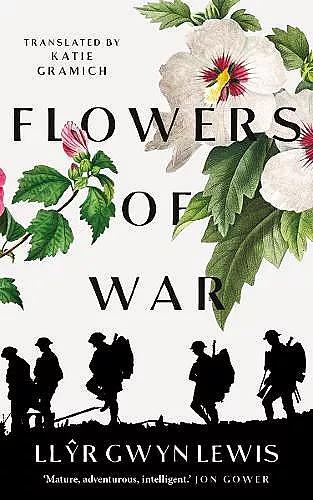
Pan gaiff yr awdur becyn bychan o lythyrau a phapurau yn ymwneud â brawd ei daid, a laddwyd yn Syria yn ystod yr Ail Ryfel Byd, caiff ei arwain ar daith bersonol estynedig. Dyma archwiliad o hanes, dychymyg a'r cof, sy'n symud yn llyfn o hunangofiant i lyfr taith, o lythyrau a dyddiaduron i gofnodion swyddogol. Addasiad Saesneg gan Katie Gramich o Rhyw Flodau Rhyfel.
This is a difficult book to categorize. Ostensibly, it is an account of Llŷr Gwyn Lewis’s attempt to discover the truth about his father’s brother, John, an artilleryman who was killed in Syria in 1941, fighting not the Germans but the Vichy French. He was 24 years old. It begins when the author’s grandfather gives him a package containing a few letters home from John, a photograph, a last letter from John’s mother (returned to sender, addressee deceased), and a couple of obituaries from local papers – all the material remnants of John’s short life – which prompts the author to try to find out more about this long-dead uncle he never knew. Yet it is also partly a travelogue, an account of Llŷr Gwyn Lewis’s travels as a student backpacker, visiting Italy, Russia, Poland, Holland, riding the great international trains of Europe, often with his friend, Cynon. As such, it is a typical young man’s tale of cheap hostels, heavy drinking, partying, absorbing superficial impressions of too many European cities. Despite the ‘good times’ element, though, war and its horrors are never far away. The author had been to the First World War graveyards of Flanders with his parents as a boy, and visits them again now, hoping to find the grave of Hedd Wyn. Staying in Cracow, he and Cynon make a detour to Auschwitz. Amsterdam leads to Anne Frank’s house; a visit to London to the Imperial War Museum’s ‘Trench Experience’ and ‘Blitz Experience’ exhibitions. (For someone interested, even obsessed with war, the author as a young traveller can seem uninformed. Sitting in a pleasant square in Warsaw, he is surprised to learn later that it has been rebuilt from ruins, seemingly unaware that the city was utterly destroyed by the Germans during the Warsaw Uprising of 1944.) The book’s title is taken from a poem by Guto’r Glyn, the fifteenth-century soldier-poet, referring to his fellow soldiers as ‘some flowers of war’. John was one such flower, and at times the youthful Llŷr feels envy for those who fought, who achieved significant action in their lives even when it led to death. A more mature Llŷr Gwyn Lewis knows that this is romantic posturing: if war is such a forger of character, how come so many veterans of Afghanistan and Iraq kill themselves on their return, as the author acknowledges. At one point, he plans to write a novel about John’s life, but abandons it, realizing that John, dying so young and so far away, is really unknowable. Far better to cherish the living, like his much-loved grandmother and grandfather. The original Welsh edition, Rhyw Flodau Rhyfel, won the Creative Non-Fiction prize at the Wales Book of the Year awards in 2015. Ably translated by Katie Gramich, it is now available to English-language readers in Parthian’s excellent Translations series. -- John Barnie @ www.gwales.com
- Winner of Wales Book of the Year Award Creative non-fiction 2015
ISBN: 9781912681259
Dimensions: unknown
Weight: unknown
256 pages