Windfalls
Format:Paperback
Publisher:Parthian Books
Published:1st May '21
Currently unavailable, our supplier has not provided us a restock date
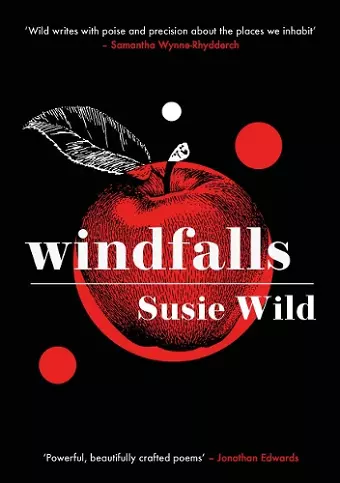
‘Powerful, beautifully crafted poems... there’s nothing like poetry to cut down the spaces between us, to leap across gaps, make a friend of a stranger.’ – Jonathan Edwards; 'Wild comes across as the poetic equivalent of Jean Rhys: wry, arch, a little world weary but, unlike Rhys, with a sparkling glint of humour... A very affecting collection of poems indeed.' – Buzz Magazine; 'This latest collection by Susie Wild is substantial, touching, entertaining and very fresh; [...] love and life fall and decay but also one finds strange, unexpected gifts.' – Gwales ; ‘Windfalls is excellent poetry: Wild is an excellent poet … For well crafted and enjoyable poetry, you could not do much better.’ – the welsh agenda
In Windfalls , Wild writes of fruit blown down by the wind, of unexpected and unearned gains which renew the beauty and joy of life.In Windfalls, Wild writes of fruit blown down by the wind, of unexpected and unearned gains which renew the beauty and joy of life. Here flying trampolines disrupt trains, apples carpet gardens, the Balloon Girl rises and the red moon sinks. In a city of ups and downs the Handkerchief Tree rare-blooms, fists and knickers are flung, crestfallen angels consider dates, carnivores go hungry, wedding vows are made and a pandemic honeymoon is cancelled. These are also stories of heroines who fall or jump from pedestals, taking risks in a world that is often dangerous for women, but refusing to settle for the conventional. Wild continues to bring us her refreshingly slant world view, whether unpicking the domestic, the political or the environmental.
'Powerful, beautifully crafted poems... there's nothing like poetry to cut down the spaces between us, to leap across gaps, make a friend of a stranger.' - Jonathan Edwards Windfall: 1 : something (such as a tree or fruit) blown down by the wind 2 : an unexpected, unearned, or sudden gain or advantage It is the night my driver's door opens at the traffic-jam-junction, the stalled red lights. The click as the door in front unlocks. His sudden lunge forward, the fast words, a swung fist at the other driver, caught cold, and I watch–– - From 'In this battle, there won't be many hugs', 2nd prize winner in the Welshpool Poetry Festival Competition 2020 In Windfalls, Wild writes of fruit blown down by the wind, of unexpected and unearned gains which renew the beauty and joy of life. Here flying trampolines disrupt trains, apples carpet gardens, the Balloon Girl rises and the red moon sinks. In a city of ups and downs the Handkerchief Tree rare-blooms, fists and knickers are flung, crestfallen angels consider dates, carnivores go hungry, wedding vows are made and a pandemic honeymoon is cancelled. These are also stories of heroines who fall or jump from pedestals, taking risks in a world that is often dangerous for women, but refusing to settle for the conventional. Wild continues to bring us her refreshingly slant world view, whether unpicking the domestic, the political or the environmental. Praise for Better Houses: 'Susie Wild writes with poise and precision about the places we inhabit, casting a benevolent spell over her reader.' – Samantha Wynne-Rhydderch 'These poems are spells whose words bewitch the ordinary and transform the objects and routines of our human world with their word-magic.' – Gillian Clarke -- Publisher: Parthian Books
This latest collection by Susie Wild is substantial, touching, entertaining and very fresh; it is also a handsome production. Susie Wild is known for her live readings and the poems have an immediacy and accessibility which suggest this. The collection is in two parts: ‘The Carnivore Boyfriends’ and ‘Windfalls’. While the title poem of the first section is generally humorous, the last line suggests a history of bad experiences which is certainly born out in some of the later poems. Some are tender remembrances of early days, like ‘Brockley Cross’ or Wild’s hymn to her childhood bicycles, but ‘This Is Why We Can’t’ and ‘Traumatic Language’ evoke a seriously over-controlling partner, and ‘Newly Single’ the threat of rape or worse. The indirect language of this poem captures the small steps, doubts and excuses which end with ‘[p]erhaps you should / have pressed charges. Spoken to someone. / But you didn’t.’ There are some brilliant portraits here of men, like ‘Burton’s Boy’ (‘a fucked fairy tale … You Vogue in drainpipes, / Slide down them at dawn.’) or the lover in ‘He didn’t bring me flowers’, who brought exotic vegetables instead (‘an aubergine … the exact shade / of my changing hair’), but who then ‘came spilling sunflowers … seeded promises to break.’ The more tentative lover of ‘Eye Contact’ suggests a better future. In the later poems we are given more of the story. ‘Heavyweight’ links the period of the controlling partner with a later group on boxing and testifies to the support of ‘local’ friends when she is ‘sheltering from an emptied life’. In ‘Mr and Mrs Smith’, the new couple encounter her ‘ex’ and ‘[a] limp girl shrank into his shadow. Familiar / as a puddle.’ But Mrs Smith feels at once the huge ‘tectonic’ shift between them and ‘of finally stepping away’. The power and precision of this poem is typical of Wild’s ability to express deep significance through details of the mundane. ‘Windfalls’, the longer section, has plenty more reflections on love and marriage, including the very topical ‘The Cancelled Honeymoon’ and ‘The Key Worker’s Wife’. The ‘Windfalls’ title poem gives a picture of abundance and waste, tinged with humour and unease. The later poem, ‘All I have’, recalls the windfalls, still rotting; the garden is overgrown but ‘crows visit us like / an ark’ and the poet stands ‘and take[s] in all I have – despite everything.’ It is a very recognisable state but also one which runs through many of the earlier poems – of endurance, wry humour and appreciation of life as it is. The epigraph of the section reminds us that ‘windfall’ may refer to fallen fruit or ‘an unexpected, unearned or sudden gain’. The poems certainly chart both senses as love and life fall and decay but also one finds strange, unexpected gifts. -- Caroline Clark @ www.gwales.com
ISBN: 9781912681754
Dimensions: unknown
Weight: unknown
80 pages