Just So You Know
Essays of Experience
Hanan Issa editor Durre Shahwar editor Özgür Uyanık editor
Format:Paperback
Publisher:Parthian Books
Published:1st Aug '20
Should be back in stock very soon
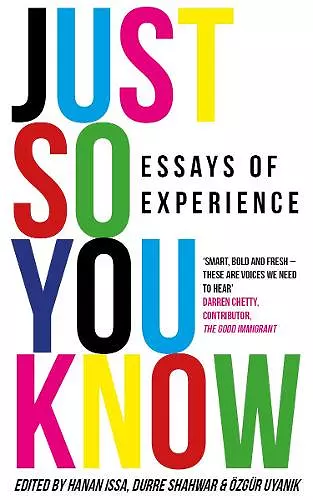
Edited by Hanan Issa, Durre Shahwar and OEzgur Uyanik. "I felt the city in my muscles, my saliva. I wanted to be changed. I wanted to be in love." A young woman weaves her experience of abuse into the folklore of her ancestors. A student addresses his OCD by writing letters. A Paralympic medallist reflects upon his journey into a challenging new lifestyle. From language politics to neurodivergence, cultural heritage to sexual identity, from immigration to race, these are insights shared with great care, sincerity, and often humour. Featuring an unbound range of writers; united by their connection to Wales, but reaching freely across continents. This collection is an open invitation. It is a bringing together of previously untold perspectives: creative essays with no hard lines or prescriptive margins. No normative spotlights, only an open space to speak, and be heard. These are stories told on their own terms.
Dipping into some of the innermost thoughts of fifteen Welsh authors who bring their eclectic, diverse thoughts on a variety of subjects and situations to this collection of essays, readers are given the chance to widen their understanding and appreciation of different lives and perspectives. Just So You Know has been sensitively edited and provides a unique opportunity for the chosen authors to express themselves in an open essay form, some creative and some more formal, to explore their experiences of being on the edge or margins of mainstream life. Kate Cleaver writes of her childhood, lost in the undiagnosed shadows of autism, dyspraxia and dyslexia, unable to ride a bike, make eye contact or friends, feeling wrong and utterly isolated. But a diagnosis brings understanding and freedom, from being wrong to being different, to being able to accept that difference and find strategies for dealing with life within that framework, including getting an adult tricycle. Ranjit Saimbi explores the reluctance his younger self experienced at having to be part of his parents’ Sikh culture and religion. He was busy being a British kid, playing out in the neighbourhood with his friends, doing the usual things. The contrast of this urban freedom with the controlled and ritualised expectations of Sunday-morning worship brought out a deep and undying resistance in the young boy. He could see the importance of the old ways to his parents: his father had been driven from his life of prosperity and security in Uganda by Amin in the 1970s, and had had to come to terms with the cold indifference of Britain. The importance of shared heritage and the support of family, friends and religion was enormous for that generation, but not for Ranjit Saimbi. He would find his identity by himself, without the need of such a safety net. In her essay, ‘The Other Side’, Ruqaya Izzidien recounts a pivotal experience whilst at school which allowed her to escape, if only temporarily, from the fixed identity her ‘otherness’ forced upon her. For a short time she became more than the Iraqi Muslim girl with the headscarf. She became more than the good girl who worked quietly and dutifully at her studies. She was no longer ‘exotic’ and different but part of something much greater. She led her fellow students out of school into the yard in a mass breakout in protest at the Iraq War. She led them, hurtling down corridors, past a cordon of teachers, out to the railings where they put up placards and tied themselves to each other or to the railings, defying the flustered teachers. And she was not separate, but integral and unified with those around her. For a while. These essays have given me glimpses and openings into worlds and perspectives I had not perceived before. There is a generosity in the authors’ very act of sharing their viewpoints and experiences that allows everyone who reads them to be given a deeper understanding of the diversity of lives going on, often invisibly, around them. This is a beautiful collection of essays in which the individual voices make a tapestry of diverse colours, textures and patterns of the unexpected. -- Lucy Walter @ www.gwales.com
ISBN: 9781912681822
Dimensions: unknown
Weight: unknown
200 pages