Looking Out
Welsh painting, social class and international context
Format:Hardback
Publisher:Parthian Books
Published:1st Nov '20
£40.00
Available to order, but very limited on stock - if we have issues obtaining a copy, we will let you know.
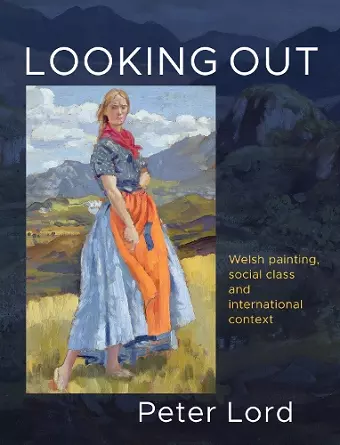
'Over the last twenty five years, almost single-handedly, Peter Lord has transformed a collection of poorly understood evidence of art created in Wales, and lazy theoretical assumptions about it, into a discipline in its own right, equipped with analytical frameworks and supported by an accumulating body of knowledge.' -Andrew Green, Wales Arts Review (on The Tradition) The six sequential essays in this collection provide a narrative of a century and a half of Welsh painting, written with an emphasis on issues of social class and national identity. Through his earlier writing, Peter Lord has contributed to the establishment of an historical tradition of Welsh painting, but because it does not feature in the wider story of western art history as presently told, the work revealed continues to be perceived as marginal, existing in isolation from ideas and movements in other countries. These essays break new ground by discussing the concerns of Welsh painters not only in domestic terms but also in the context of the ways in which artists in other parts of Europe and in the United States reacted to the common underlying causes of those concerns. The author challenges the idea that the work of Welsh painters is relevant only to the evolution of their own communities and, through confident and detailed analysis, validates their pictures also in terms of the arts of other western cultures.
Peter Lord has long been recognized as our foremost and indeed most prolific historian of Welsh art. His perceptive and eminently readable analyses in his substantial publications have transformed our understanding of the development of art in modern Wales. Looking Out comprises six scholarly essays focussing on the evolution of Welsh art, predominantly painting, from about 1870 onwards. The author’s primary aim throughout is to move away from the traditional interpretation of Welsh art history as something inherently marginal and peripheral, largely isolated from contemporary trends in other European countries. Here Peter Lord dissects the common elements, and there were indeed many, which Welsh painters shared with kindred souls on the Continent and also in the USA. Issues of social class and national identity are considered in all these essays. A brief, personal introductory section entitled ‘A.B. And me’, tells us of the author's long-term absorption with the novels, and indeed the life story, of one of his favourite authors, namely Arnold Bennett. It then proceeds to outline his own background and education where the art room at grammar school provided some respite from the rigours of the metalwork hut and the playing field which he totally disliked. The first contribution here takes as its theme the artistic output of Rev. Evan Williams of Caernarfon, well known as a painter of both portraits and landscapes, and one whose work was strengthened by his role as a local ordained minister. Among his creations was a celebrated oil painting of Ieuan Gwyllt completed in 1878. The second article examines the enduring contribution of three artists – Albin Roberts Burt, William Jones Chapman and John Cambrian Rowland – who inaugurated the practice of itinerant painting in Wales at various periods during the nineteenth century. Chapter 3 is devoted to the work of Edgar Herbert Thomas of Cardiff who painted several acclaimed works between about 1885 and the period of the First World War after which his work largely dried up right through until his death in 1936 by which time he was, sadly, a largely forgotten man. But in 1908, when at the height of his powers and influence, he was described as ‘a well known and strikingly original native artist and teacher’. The most substantial essay in this collection comes next and evaluates the flamboyant pageants and exhibitions of paintings sponsored by the dominant figure of Lord Howard de Walden, and to a lesser extent by his wife Lady Margot, notably at Chirk and Harlech. Central to their success were the paintings of Augustus John several of which are reproduced here. Chapter 5 meanwhile looks at the artistic output of Mildred Elsi Eldridge, who was responsible for illustrating a large number of attractive publications and was also a published author. The last essay published here is notably wider in its scope, providing an over-arching, masterly dissection of the art scene in Wales from the mid nineteenth century to about the middle of the twentieth, and discussing the myriad influences which guided and moulded developments. Many of the individuals discussed in the previous essays also resurface here. The volume has been produced to an exceptionally high standard, and is a credit to Parthian Press. The wide range of photographs and illustrations reproduced here is uniformly impressive. The scholarly essays published all carry full and helpful footnote references, which also include extra snippets of fascinating information, and there is a meticulously prepared index to both the main text and the footnote references. All those interested in art history in Wales will cherish having this volume on their bookshelves and will appreciate its extensively researched contents and re-evaluation. -- J. Graham Jones @ www.gwales.com
ISBN: 9781912681976
Dimensions: unknown
Weight: unknown
300 pages