Conversations with the Soul
A Psychiatrist Reflects - Essays on Life, Death and Beyond
Format:Paperback
Publisher:Aeon Books Ltd
Published:31st Jan '18
Currently unavailable, and unfortunately no date known when it will be back
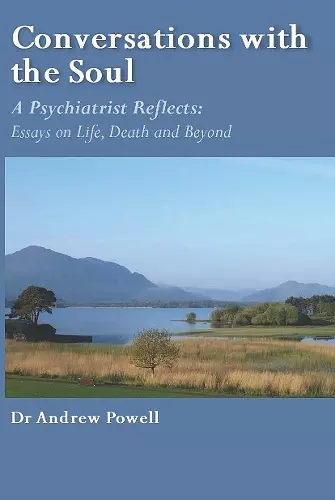
A wide-ranging exploration of the place of spirituality in mental healthcare.
Clinical papers are interspersed with reflections by the author on his many years of therapeutic practice and exploration of the inner life. The present climate of materialist science has led to an unremitting search for the biological causation of mental disorders, accompanied by heavy reliance on prescription drugs.
Andrew Powell offers a vision of health and wholeness that goes beyond the limitations of the physical sciences, drawing attention to an ever-present spiritual reality that accompanies us through life, and shows how in times of pain and confusion the wisdom of the soul can be called upon to bring clarity, purpose and renewed hope.
"This second volume of Andrew’s papers comes a year after the first (The Ways of the Soul) and is just as insightful, wise and compassionate. The foreword by Anne Baring highlights the contemporary catastrophic loss of soul and sense of the sacred, which both she and Andrew feel is at the root of today’s epidemic of mental health challenges in a materialistic and consumerist society - one that has no room for this dimension of life and which leaves us feeling alienated and disconnected. Surveys now show that one in six of UK adults are experiencing a common mental health problem in any given week, so Andrew asks the question: ’could it be that modernity, with its incessant materialistic and secular pursuits, is estranging people from their spiritual core and the innate values of truth, beauty and goodness?’ In my view, the answer is indeed yes, which makes this such an important volume in terms of spiritual care.
A flow chart on p. 49 gives an overview of current mainstream psychiatry, dominated as it is by biological and pharmaceutical treatments with an emergence of mindfulness and CBT into the mix. A third strand Andrew highlights is analytical psychology derived from Jung, who had a personal encounter with, and understanding of, the spiritual and the sacred and whose work is reflected in transpersonal therapies, including many featured here such as spirit release, past life memories and soul-centred psychotherapy. If the ego has an important role during the first half of life, the soul sets the agenda for the second. Jung himself observed that all his patients in the second half of life were seeking a spiritual outlook (as Andrew remarks in one paper, ‘while the ego seeks to be loved, the soul’s desire is to love’). This search is underpinned by a quest for healing and wholeness, which Andrew addresses in a number of these essays. Nor does he lose sight of the human condition, asking how much of our suffering is intrinsic and how much self-created. We come to appreciate this in some of the many case histories recounted. This is expressed beautifully at the end of an essay on recovery and well-being: ‘As the soul does not pass judgement, our patients will not feel judged. Because the soul is compassionate, our patients will be helped to forgive themselves and others. And, because the soul knows only love, our patients are helped to heal.’ (p. 121)
Pioneers like Andrew require moral courage in order to take a stand against the prevailing materialistic outlook. This is apparent in what he has to say about healing, past life memories and spirit release. These last two areas imply survival and reincarnation, neither of which is possible within a mainstream view. Andrew’s own account of his past life memories makes fascinating reading, including the perceived experience of leaving the body at the moment of death – something that research into NDEs have shown to be pretty much universal. For the practicing clinician, what matters more than the literal truth or otherwise of the episode is the therapeutic insight gained.
If the vocation of doctors is under stress, so is the health system as a whole. Andrew presents an interesting analysis of the NHS in terms of Maslow’s hierarchy of needs, showing how at every level - physiological, safety, love/belonging, esteem and self-actualisation - these needs are unmet, with a corresponding demoralisation within the system and general undermining of trust. He also observes that, ‘from an archetypal perspective, Western medicine is a triumph of the analytical masculine mind’ has thereby created a corresponding imbalance, as the cultural work of Iain McGilchrist highlights. It remains to be seen whether the higher proportion of women medical students coming into the system creates a radical shift or whether these women will feel coerced into adopting their own masculine aspect.
Andrew is deeply concerned by what he calls ‘techno-pathology’, mediated by screens and video games as well as the hazards of social media. Prescriptions of Ritalin for ADHD increased from 325,000 in 2011 to nearly 1 million in 2015. The statistics he quotes are alarming as children grow up in a world of things rather than people, undermining the development of their social skills in the process. Andrew also identifies a breakdown of trust in terms of disinformation, citing the cover-up of geo-engineering projects in climate manipulation as an example. Many mainstream sources would ascribe this to conspiracy theory, and I can identify with Andrew when he writes that he finds himself caught between the conflicting perspectives of healthy scepticism and those who claim to speak truth to power.
For me, the take-home message of the book as a whole is the importance of widening the scientific and medical view to embrace the soul and spirituality, both as a reality and as a significant factor in therapeutic interventions. Andrew’s life work has been devoted to this cause as the contents of this inspiring book amply demonstrate. It will hopefully encourage other psychiatrists and physicians to follow in his footsteps and take up the torch."
David Lorimer, Director of the Scientific and Medical Network, Editor of Paradigm Explorer, Author of A Quest for Wisdom
"This book is a collection of 17 papers and talks given by Andrew between 2006 and 2017, several of them at conferences organised by the Spirituality and Psychiatry group. It is a welcome sequel to “Ways of the Soul” which included papers from the previous decade. Both collections draw richly on Andrew’s experience of working clinically as a psychiatrist and psychotherapist, as well as his understanding of psychoanalytic and Jungian psychology, quantum physics, anthropology and comparative religion. Each paper is complete in itself and although many of them were originally addressed to clinical audiences, they are refreshingly jargon-free and so are accessible to anyone interested in the subject matter.
The overall focus of the book is the question of what it means to be human and the challenges we all face both on a personal and collective level. Indeed, one of the chapters is the transcript of a dialogue addressing this very question. Andrew brings a broad bio-psycho-social-spiritual perspective to his reflections on being human. He sees our bodies as providing a vehicle and opportunity for an evolving partnership between the ego and the soul. The ego helps individuals to grow and survive in the physical world. The soul co-habits with the ego for the purpose of gaining experience and so must share in the ego’s experience of pain. The soul is seen as the particular manifestation of the all-encompassing Spirit (which may be called “God” or “Supreme Consciousness”) in an individual form. Both ego and soul need each other and when working in partnership can become the perfect instrument for creating heaven on earth. However, the ego’s innate tendency to separate and divide and see the world through its own lens, means that it is often unaware of and disconnected from the soul.
At an individual level, Andrew sees the disconnection between ego and soul as a key factor in mental health problems. At a collective level this disconnection has led to a profound sense of alienation and has led to untold destruction of our fellow human beings and Nature. Helping individuals and groups to re-establish a healthy connection between ego and soul has been Andrew’s life work.
The more clinically orientated chapters describe ways of helping others listen to and converse with their soul. With the help of remarkable anecdotes and case stories, Andrew provides glimpses both of his own journey and those of the patients he has supported. He offers examples of ways in which a clinician can invite the patient to go deeper, such as using a question like: “What would your heart say if it could speak?” He also devotes significant passages to the importance of forgiveness, which is ultimately seen as a quality of the soul which balances the ego’s tendency to retaliation. From this perspective, forgiveness does not need to be forced or pushed. Helping someone connect with their soul brings forth the quality of forgiveness naturally.
The chapters examining our collective human situation give a particular emphasis on how, over the last 300 years, especially in so-called Western culture, humanity has become increasingly enthralled by scientism. This is an ideology which particularly appeals to the ego with its explanatory and technological power. Whilst science has brought extraordinary benefits to humanity, scientism has led to a narrow materialistic worldview with little room or respect for spiritual perspectives. Consequently, many in today’s world have a deep prejudice towards matters of the soul. Inevitably, modern mental health care has been shaped by a similar prejudice. Andrew draws on some of the findings of quantum physics and transpersonal psychology to address this narrow worldview and to show that it is no longer in step with modern scientific and psychological research. Fittingly, the final chapter of the book is entitled: “Prejudice – can we live without it?” The chapter and book ends with Andrew’s answer to his own question which is “yes, we must, if there is to be a future for humanity.”
My overall response to this book is one of warmth and hope. Having worked in the same field, I was struck by the courage in Andrew’s professional work in exploring ways to help people connect with their soul which would have been frowned upon by some colleagues - a pathway to healing that not many psychiatrists have trodden. It is worth remembering that the origin of the word “courage” is from the French word for heart “coeur” and this book does indeed have plenty of heart. This heart-centredness is blended with clarity of thought which many readers will value, whether or not they are clinicians.
The book is also a timely exposition of the centrality of love and its importance in any situation in which one is in a position to help another human being. Andrew reminds us that in the face of inevitable suffering, we always have at our disposal “the best medicine known to humankind – the healing power of love."
Andrew Clark
"Andrew Powell’s two volumes of collected essays, of which this is the second, span the last twenty years of his work as a psychiatrist. Persuaded by personal and clinical experiences that could not be explained by neuroscientific reductionism (the traditional basis of medical practice), Andrew began to explore other ways to understand the work of psychiatry by looking into the intersection of psychiatry and spirituality. His interest in group process and his awareness of the importance of collaboration with others opened the way to starting the Spirituality and Psychiatry Special Interest group of the Royal College of Psychiatrists in 1999. His subsequent papers give an account of the evolution of a new way of understanding reality that challenges the medicalisation of human anguish.
In essence, Andrew was attempting to move beyond the limitations of a physicalist and materialist view of reality towards an Idealist world view – an ontology that validates each person’s view of the world from their own perspective. The exploration of that perspective from the inside, and the description of it from the outside, is central to the concept of soul. As he puts it, ‘Eventually I traded the ‘bottom up’ perspective of psychoanalysis for the’ top down’ vision of a spiritual universe, a re-visioning that better answered the kind of questions I was asking. In time I came to appreciate that ‘top down’ and ‘bottom up’ are two sides of the same coin. Nevertheless, one side or the other will usually appeal to a person more, for how we look at the world is highly subjective. “We don’t see things as they are; we see them as we are”’ (p.62).
If it is true that we see things as we are, then this review would best illustrate the style of the author as well as his ideas. I will therefore endeavour to convey his voice so that we may capture a glimpse of soul in this work. In the course of reading through these essays we can see a path of development. The Jungians would call this his individuation. In the process, the author discovers his soul and finds himself connecting more intimately with the souls of others, in particular with those struggling with their mental health. It is Andrew’s inquiry into the mystery of soul that I find most valuable about his work. In his words: ‘At first I hesitated to use the word soul in clinical practice. Yet what else should I call the innate wisdom that can be brought to bear on the trials and tribulations of the ego while remaining untouched by the storms of life - and with a depth of insight that goes even beyond personhood?’ (p.120). Andrew writes ‘My preferred view of soul is not that in any way it should be fixed, but rather that it continually evolves as we journey through a multiplicity of virtual realities. There is a paradox here, but not, I think, one that deters. Within domains of space time, the universe is free to evolve and yet beyond all time and space, there can be no form, no movement and therefore nothing to evolve!’ (p.66). Elsewhere: ‘Psychotherapy for the personality is important; a person will be all the better for knowing more about themselves. Yet when we converse with the soul, we experience our true nature, what I believe to be our divinity. Once we are shown what the best in us can be, we can set about becoming that person - no matter that it takes a lifetime’ (p.108).
I am reminded that in ‘The Principles of Psychology’ (1890), William James, the American philosopher and psychologist wrote, “Seek out that particular mental attribute which makes you feel most deeply and vitally alive, along with which comes the inner voice which says, 'This is the real me,' and when you have found that attitude, follow it.”
Andrew speaks about the transformation that a psychotherapist undergoes as they move into a world view that o?ers a larger perspective. ‘Psychodrama brought home to me the awareness of how much we are all fellow travellers in life, sharing in the same challenges, struggles and growing pains that beset every human being. Moreover, I saw something else that impressed me deeply - that when a person takes on the role of someone they perceive as good and wise, they find themselves speaking from within that role with wisdom beyond their experience and years. How had I missed seeing that before? The most likely answer is that psychiatry does not expect patients to have the wherewithal, for the patient is taken to be unwell and the psychiatrist is there to diagnose and treat’ (p.119).
About therapies such as ‘past life r
ISBN: 9781913274498
Dimensions: unknown
Weight: unknown
256 pages