The Welsh Way
Essays on Neoliberalism and Devolution
Daniel Evans editor Huw Williams editor Kieron Smith editor
Format:Paperback
Publisher:Parthian Books
Published:1st Sep '21
Should be back in stock very soon
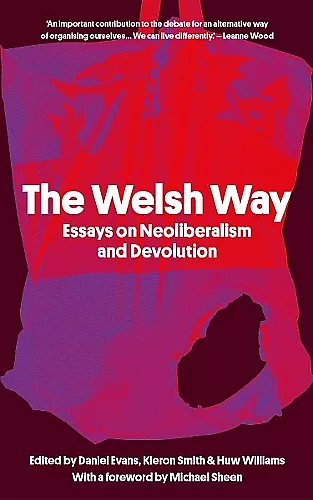
EDITED BY DANIEL EVANS, KIERON SMITH & HUW WILLIAMS With a foreword by Michael Sheen
This book argues for a new Welsh Way, one that is truly radical and transformational. A call for a political engagement that will create real opportunity for change.Neoliberalism has firmly taken hold in Wales. The 'clear red water' is darkening. The wounds of poverty, inequality, and disengagement, far from being healed, have worsened. Child poverty has reached epidemic levels: the worst in the UK. Educational attainment remains stubbornly low, particularly in deprived communities. Prison population rates are among the highest in Europe. Unemployment remains stubbornly high. House prices are rising, with the private rented sector lining the pockets of an ever-increasing number of private landlords. Minority groups are consistently marginalised. All this is not to mention the devastatingly disproportionate impact of the coronavirus pandemic on working class communities. The Welsh Way interrogates neoliberalism's grasp on Welsh life. It challenges the lazy claims about the 'successes' of devolution, fabricated by Welsh politicians and regurgitated within a tepid, attenuated public sphere. These wide-ranging essays examine the manifold ways in which neoliberalism now permeates all areas of Welsh culture, politics and society. They also look to a wider world, to the global trends and tendencies that have given shape to Welsh life today. Together, they encourage us to imagine, and demand, another Welsh future.
With a foreword by Michael Sheen. This book argues for a new Welsh Way, one that is truly radical and transformational. A call for a political engagement that will create real opportunity for change. Neoliberalism has firmly taken hold in Wales. The ‘clear red water’ is darkening. The wounds of poverty, inequality, and disengagement, far from being healed, have worsened. Child poverty has reached epidemic levels: the worst in the UK. Educational attainment remains stubbornly low, particularly in deprived communities. Prison population rates are among the highest in Europe. Unemployment remains stubbornly high. House prices are rising, with the private rented sector lining the pockets of an ever-increasing number of private landlords. Minority groups are consistently marginalised. All this is not to mention the devastatingly disproportionate impact of the coronavirus pandemic on working class communities. The Welsh Way interrogates neoliberalism’s grasp on Welsh life. It challenges the lazy claims about the ‘successes’ of devolution, fabricated by Welsh politicians and regurgitated within a tepid, attenuated public sphere. These wide-ranging essays examine the manifold ways in which neoliberalism now permeates all areas of Welsh culture, politics and society. They also look to a wider world, to the global trends and tendencies that have given shape to Welsh life today. Together, they encourage us to imagine, and demand, another Welsh future. -- Publisher: Parthian Books
This is a collection of essays by twenty-two contributors who examine almost every aspect of Welsh politics and society from a distinctly left-oriented position. The editors stress that these are not the usual suspects, but a younger generation who challenge the complacent view of Wales promoted by successive Welsh Labour governments. The much-touted ‘clear red sea’ between Wales and England, they argue, is a delusion. In fact, every aspect of society has been deeply penetrated by neoliberal ideology, despite Mark Drakeford’s claim that Wales is different, in that it aims at increasing equality, unlike England where the neoliberal consensus deepens inequality. Essay after essay proves that what Welsh Labour – the only party that has held power since 1999 – claims is not true. Neoliberal inroads into education, for example, find universities serving the so-called ‘knowledge economy’ and economic growth. They have become ‘businesses’ while students, who pay through the nose for the privilege, have become ‘customers’. The customer, as is known, is always right, so grade inflation has become the order of the day (though many academics will deny this). At the same time job security for academic staff has declined while the average salary for a vice chancellor is £200,000 per annum. Everywhere you look in Wales there are signs of decline and neglect. Child poverty has increased; there is a serious decline in social housing and a corresponding increase in private rental; Wales has the highest rate of incarceration in Europe, prisons are over-crowded, and privatization is well underway with HMS Parc, Bridgend, built through PFI and run by G4S (formerly Securicor). ‘The problem with the Welsh public sphere is that there is no Welsh public sphere,’ begins Dafydd Huw Rees, reminding us of the fragility of Welsh media outlets, reflected in the depressing fact that The Daily Mail is the most widely read newspaper here. The Welsh government’s plans to avert climate change and the destruction of nature are unworkable, according to Calvin Jones. This is undoubtedly true, but it is true of every nation which claims to take climate change seriously. Just as it is true that no nation, that I am aware of, has managed to break free from the stranglehold of neoliberal ideology. If this is so, one has to ask: What chance is there for a small nation like Wales, still governed in important policy areas from Westminster, to break free? One further query: Contributors write with the expectation that current political and social structures will continue into the future. What is needed is the will to challenge the neoliberal consensus and channel politics in a truly egalitarian direction. The problem is that humanity is facing the greatest catastrophe in our 200,000-year history – not only climate change which everyone is fixated on, but the mass extinction of species we have set in motion, deforestation, desertification, pollution of the oceans, all of which are aspects of the biggest problem of all, human overpopulation (1930: 2 billion; 1961: 3 billion; 2008: 6.5 billion; 2021: 7.9 billion; 2050: an estimated 10 billion). In the light of this, it is entirely possible that the democratic structures and processes we have come to accept as axiomatic will not survive. The question is: What then? Having said that, The Welsh Way, with its bitterly ironic title, is a very important challenge to the often smug way we look upon ourselves. It is a book everyone concerned with the future of Wales should read, and it ought to make us angry. -- John Barnie @ www.gwales.com
ISBN: 9781914595028
Dimensions: unknown
Weight: unknown
200 pages