Fury of Past Time
A Life of Gwyn Thomas
Format:Hardback
Publisher:Parthian Books
Published:1st Oct '22
Should be back in stock very soon
This hardback is available in another edition too:
- Paperback£15.99(9781913640101)
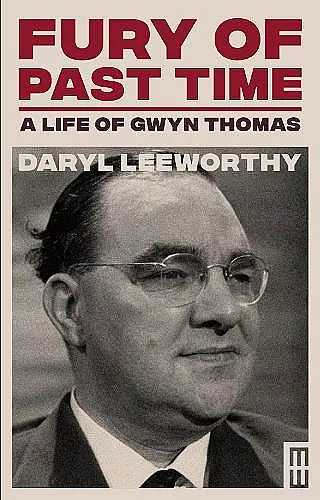
Gwyn Thomas was born, the last of twelve children, into a Rhondda mining family in 1913. After a childhood marked by the strikes of the 1920s, he went off to study Spanish at Oxford University and in Madrid, where he met the poet Federico Garcia Lorca and witnessed the turmoil which would lead to the Spanish Civil War. On his return, amidst the economic mire of the 1930s and his own burgeoning teaching career in Barry in the 1940s, he picked up his pen and began to write. For more than forty years, until his death in 1981, as novelist, screenwriter, master of the short story, and prizewinning playwright, Gwyn Thomas delivered compelling and comedic portraits of his world of South Wales. His creative genius earned enduring fame on both sides of the Atlantic and on both sides of the European Cold War divide. As a provocative and insightful broadcaster, he embraced the possibilities of radio and television, whilst leaving his hosts and guests alike in fits of knowing laughter. This landmark biography, enriched with unrivalled access to private papers and international archives, tells the remarkable story of one of modern Wales's greatest literary voices.
Not so long ago, academics were queuing up to declare the ‘death of the author’, in the wake of an influential essay by Roland Barthes. What an author believed, thought or felt about his or her work was irrelevant: it was the isolated ‘text’ that counted, for the academic critic to analyse and regurgitate in soulless prose. I wonder how many students had their enthusiasm for fiction and poetry diminished by such turgidity? For nothing could be further from the truth: literature is intimately bound up with its creator, and biography is the best means of entry into the world of a writer’s poems or stories. If proof were needed, we have Daryl Leeworthy’s new biography of Gwyn Thomas, novelist, short-story writer, playwright, columnist, raconteur and, in later years, TV personality. Gwyn Thomas (1913–81) was a dominant figure in Welsh writing in English, publishing a string of novels and short-story collections beginning with his debut novel, The Dark Philosophers (1946). He was particularly productive in the 1940s and ’50s, with novels like The World Cannot Hear You (1951) and short-story collections such as Gazooka and Other Stories (1957). As a child growing up in the Rhondda in the 1920s, he experienced the harsh conditions experienced by the Valleys mining communities both before and during the Depression, but also the fierce resilience of the people, often expressed through an inventive, challenging sense of humour. This experience formed Gwyn Thomas as an individual and gave him the subject matter for his substantial body of fiction, for the mining communities of Rhondda were, and always remained, the inexhaustible source of his creativity. This was confirmed for him by three unhappy years spent at St Edmund’s Hall, Oxford, studying Spanish and French in the early ’30s – a Welsh working-class fish well out of water. ‘This house prefers Germans to Welshmen’, was one topic discussed by the St Edmund’s Hall debating society. Back in Wales, Gwyn Thomas turned his hand to teaching, like so many Welsh writers, teaching at Barry Grammar School and writing when he could snatch the time, furthering the literary career which was always his true vocation, as was his lifelong commitment to socialism and sympathy for communism, though he never joined the party. This brought him into contact with prominent members of the American left like Norman Rosten and Howard Fast, who were early admirers of Thomas’s fiction and helped to promote it in the US. When he finally broke with teaching, Gwyn Thomas turned increasingly to journalism, writing a regular column for Punch and contributing to newspapers like The Empire News and magazines such as Lilliput. He was soon in demand on radio and television as well, making appearances on Question Time, The Brains Trust and Tonight which gave him a wide audience which he understandably relished. He had a fluent, sharp wit which is one of the hallmarks of his fiction and which he was able to adapt for a TV audience. Television is a treacherous medium for a writer, however. I am old enough to remember his appearances and feeling uncomfortable at times by the ease with which he could fall into the role of stage Welshman for a predominantly English audience. Daryl Leeworthy has a long and fascinating chapter on Gwyn Thomas’s print and TV journalism, something which is inherently ephemeral but which formed an important part of Thomas’s career, especially in the 1960s. Gwyn Thomas was very much a product of his time and place. His living through the hardships of the Valleys in the 1920s and ’30s turned him into an unwavering socialist all his life. It also formed in him a virulent antagonism to the Welsh language, to cultural institutions like the National Eisteddfod, and to the cultural-political aspirations of his exact contemporary, Gwynfor Evans. His hostility was constant and frequently nasty. Daryl Leeworth has an excellent chapter on this in which he explores sensitively the complexity of Thomas’s family vis-à-vis the language and the changing linguistic situation in the Valleys when Thomas was growing up. Gwyn Thomas was not alone of his generation in holding such views, but he was a writer with a great deal of media exposure, and he expressed them forcefully. Times have changed and Wales has moved on. It is Gwyn Thomas’s universal socialism that has withered and died at the hands of consumer culture and the onslaught of the Reagan-Thatcherite neo-capitalist counter-revolution, whereas there has been a revival of interest in the Welsh language and a resurgence and redefining of Welsh nationalism. Fury of Past Time is a model of its kind. An immense amount of research has gone into this biography, which will be the standard work on Gwyn Thomas for many years to come. It deserves to be read by those who already admire the fiction and will be an invaluable introduction for anyone coming to his writing for the first time. -- John Barnie @ www.gwales.com
ISBN: 9781914595196
Dimensions: unknown
Weight: unknown
250 pages