Wild Cherry
Selected Poems
Format:Paperback
Publisher:Parthian Books
Published:1st Nov '23
Should be back in stock very soon
'He became the unacknowledged national poet of his generation, an open hearted soul whose poems embodied much of what our nation is today-diverse, passionate, tender and unafraid to take a hard look at its political and cultural complexity.' - Menna Elfyn 'Nigel Jenkins has a staggering presence in the literature of Wales. His poetry was both political and beautiful, deeply human, wonderfully cosmological and often scathingly humorous. Swansea's most amiable bard and, undoubtedly, it's most popular poet since Dylan Thomas.' - Topher Mills 'This selection of Nigel's work reminds us that a fine poet's voice need never be silenced.' - Gillian Clarke 'Peace, praise & revolution. Jenkins felt these were the true poet's pursuit. And he exemplified this in his own life. A lyrical and political idealist, he saw the writer's role as a necessary thorn in the side of any state or official agency. As excellent in describing snowdrops as he was acerbic about the world's smothered histories, including that of Wales, Nigel Jenkins remains a formidable and radical writer and satirist. His death at 64 was a profound shock to all those who loved his writings and music, both tender and tendentious.' - Robert Minhinnick
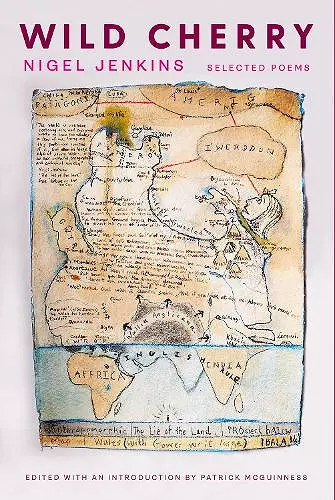
One of Wales's leading writers, this posthumous volume brings together a selection of Jenkins' poetry from across his career. Selected and introduced by Wales Book of the Year winner Patrick McGuinness.Nigel Jenkins's body of work is remarkable not just for the range of its forms and occasions, but for the variety of its literary, cultural and political commitments. He campaigned for Welsh devolution and international solidarity with the same sense of purpose as he campaigned against nuclear power, militarism and racism. A politically- and culturally committed poet he was unafraid to be satirical, or epic, or polemical, or to be simply and frankly angry. This book contains love poems and poems of desire, lyric poems and public poems for public spaces, occasional poems that transcend their occasions, merciless satires, and poems that borrow epic voices, whether of bravado or lament, and retool them for today's challenges. There are poems written in the spirit of high-intellectual play and urgent poems about environmental degradation, militarism, nuclear folly, imperialism and capitalism. There is beauty and precision, outrage and indignation, savage wit and deep empathy. The book also contains a number of Jenkins's translations from the Welsh - a reflection of his commitment to the bilingualism and biculturalism of his country, and to the idea of a community of poets. A sense of history underpins Nigel Jenkins's writing, but it is the present that propels it. In that sense, his poetry and prose are part of a single, albeit various, oeuvre. They are the work of a writer who believed that poetry has a duty to engage with the world as it is, while holding out the imaginative possibilities of what it can be.
In his poem, ‘Where poems come from’, Nigel Jenkins describes his early boyhood perception of poetry: ‘[poems] came, I supposed, from London.’ They were ‘paper and they were words, books of them yellowed in the classroom cupboard – the place that poems truly came from.’ Not a million miles away from many people’s first sense of poetry: loaded with a sense of otherness, coming from a remote elsewhere, and delivered as part of a statutory education. As the poem goes on, however, he describes an awakening to words and the realisation that poetry was everywhere. ‘It was in the laughter of dogs… I could smell it in freshly painted rooms.’ He goes on, ‘I discovered its emptying joy and wanted, afraid, to share it.’ This openness and enthusiasm for sharing poetry is an approach that poet, novelist and friend of Jenkins, Patrick McGuinness, describes in his introduction to Wild Cherry, this newly published posthumous selection of Jenkins’s work. He quotes a speech made by Jenkins in which he says, ‘Poetry should be out and about, doing a job in the world, ambushing people, not hiding in classroom cupboards and magazines nobody reads.’ Jenkins’s poems do exactly that, and this is an excellent selection of poems, curated chronologically by McGuinness to great effect, creating a sense of a lifetime’s work and displaying the breadth of Jenkins’s talents. A sense of place seems ever-present in Jenkins’s work, and it starts early with the immediate locale of his birth and home. In extracts from his first selection of poems, 1990’s Acts of Union, Jenkins shares where he comes from and the realities of life on a rural farm. He doesn’t hold back from the visceral bloody reality of farm life. ‘Pig-Killing Day’ and ‘First Calving’ are graphic, with bones and blood, birth and death. ‘St Govan’s Chapel’ gives an early sense of wider Welsh pride, and the conflict of language and identity that recurs throughout the rest of this collection. ‘Cofen or Cobhan? Govan or Gawaine?’ he asks. In ‘Land of Song’, he begins to tease at frustrations of language and perceptions of Wales amongst outsiders: ‘England expects – my hen laid a haddock’, in reference to the phonetic English-sounding words of the national anthem of Wales, Hen Wlad Fy Nhadau. Jenkins’s sense of Welsh identity and frustration with the English are a constant throughout this collection, veering from frustration at pettiness to outright anger at injustice. It can, of course, be both, with Jenkins laughing at times (as in ‘The Creation’, with its pub-like joke punchline at the expense of the English) and raging at others (in ‘The Ballad of Cwm Tryweryn’ about the injustice of the damming of the Tryweryn). This is a brilliant collection for anyone looking to see how poetry – often an inward-looking and personal art form – can be political, social and challenging. As a proud Welsh poet, ‘The Gallo-Saxon Muse’ is another tongue-in-cheek/vicious jibe at the English. Jenkins explores the concept of being a ‘Wales-based writer’ when actually born in Purley, and the idea of adopting identities in order to make generic writers appear more exotic or niche. ‘So glide aboard the Taffy-train, become a Wales-based writer: Wales and Welsh writing belong to us, the future couldn’t look brighter.’ There is more to Jenkins’s work than his Welsh identity though. He is at his most powerful at times when he’s at his most personal. The ‘Wild Cherry’ that gives this collection its name is gorgeous. However, it is ‘Forty-Eight and a Half’ that pulls hardest on the heart strings. Named in relation to Jenkins reaching the age his father was when he died, this is a powerful reflection on family, aging, the cycle of life and grief. In the context of this collection – curated chronologically, and with this poem appearing way past the middle – the already powerful sense of the passing of time is heightened. Jenkins was just 64 when he died. Wild Cherry is a collection that does justice to a man respected, loved, and revered for his poetry, teaching, and friendship. With McGuinness’s introduction, editing and notes, the selection here serves to direct readers to Jenkins’s wider work. It is a collection destined to become a bookcase staple within the world of Welsh poetry. -- Liam Nolan @ www.gwales.com
ISBN: 9781914595226
Dimensions: unknown
Weight: unknown
190 pages