Eric Doyle OFM on the Place of Christ in Teilhard de Chardin and John Duns Scotus
Format:Paperback
Publisher:The Franciscan Publishing Company
Published:8th Apr '26
Should be back in stock very soon
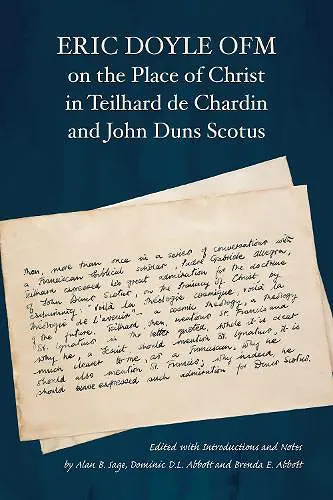
This volume presents an edited version of the many talks, dated 1967 to c. 1972, that Eric Doyle OFM delivered on Teilhard de Chardin, together with some of his published articles on John Duns Scotus. Here, the seeming incongruity between the Franciscan and Jesuit thinkers comes together in Doyle’s thought and writing, providing an insight into his unique understanding of their respective Christologies, despite the six centuries which separate them.
Doyle was one of the first British Catholic theologians to introduce the thinking of the French priest and scientist, Pierre Teilhard de Chardin SJ, to an English speaking audience. His interest in Teilhard stemmed from his emphasis on the evolutionary, dynamic character of modern life and also the cosmic aspect of salvation. Doyle’s unique insight of the 1960s was the similarity he saw in both Teilhard and Scotus on the place of Christ in the universe. Whilst Scotus’ Weltanschauung was that of a static universe and that of Teilhard a dynamic evolving universe, they both saw Christ as the central point of creation. Christ would have become incarnate even without the Fall. Much of Doyle’s writing is considered to be ahead of its time and his Franciscan vision has an urgent and contemporary relevance both for the Church and the wider world; the lectures presented here are no exception, making them not only apposite but also seminal, even prescient.
Pierre Teilhard de Chardin’s contributions to our understanding of Christian faith and its relationship to science are as important now as ever. After the Jesuit geologist’s death in 1955, however, his posthumously published works, though widely read, were often misunderstood, as is still the case. Happily, the present book introduces readers to one of Teilhard’s most reliable and insightful early interpreters, the Franciscan priest Eric Doyle. Cleverly arranged by theologian Brenda Abbott, the book offers four distinct levels of theological content, placing Teilhard’s understanding of the person and work of Christ in a tradition of Christology too often overlooked. At one level, the book succinctly summarizes the theology of the 13th century Franciscan theologian Duns Scotus, featuring his famous proposal that God would have become incarnate in Christ even if there had been no original sin. Second, keeping its eye on Scotus, the book keeps recalling how Teilhard similarly took the person of Christ to be the goal of creation rather than simply expiation for a prehistoric human fault. Third, this synthesis introduces readers to the neglected work of Eric Doyle and his insightful theological comparison of Teilhard’s thoughts about Christ with the creative vision of Duns Scotus. At a fourth level the volume exhibits the scholarship of its editor who has produced here a richly layered work of historical theology. I am happy to endorse it.
John F. Haught, Georgetown University, Emeritus, author of The Cosmic Vision of Teilhard de Chardin
Few Teilhardians would expect to encounter a study of the Jesuit scientist by a Franciscan priest. So for them this collection of talks by Fr Eric Doyle ofm will come as a revelation: for example, he discusses in depth Teilhard’s theology, Christology, the Eucharist, the problem of evil, and above all his concept of the Cosmic Christ, as expounded in Paul’s letters to the Colossians and Ephesians. Even more unexpected would be the chapters on Duns Scotus, whom most people know only as the mediaeval theologian who inspired the poet Gerard Manley Hopkins with his concept of haecceitas or ‘thisness’. But Doyle examines the links between Scotus and Teilhard; for instance, the Franciscan’s belief that the Absolute Primacy of Christ means that He is the crown of both the natural and the supernatural worlds, which accords well with Teilhard’s belief that Christ is the origin of the cosmos and the driving force within evolution and its ultimate goal, the Omega Point. This superbly edited book is a valuable and unusual addition to Teilhard studies.
Paul R. Bentley, Editor, British Teilhard Network
In this remarkable book Franciscan priest Eric Doyle is concerned with a theologian/ philosopher and a scientist/mystic, both of whom were not accepted by most of the academic scholars in their respective subjects in their own day. John Duns Scotus OFM (1266–1308) met with opposition to his theological vision, so much so that his thought was virtually hidden from the academic world till the twentieth century. Six centuries later Pierre Teilhard de Chardin SJ (1881–1955) was forbidden by the Vatican authorities to publish any of his theological/spiritual work. His writings on these subjects were published only after his death. It was the destiny of Doyle to introduce these two thinkers to the English-speaking world in the twentieth century. Unfortunately, Doyle died at the tender age of forty-six but his legacy is being forwarded today by The Franciscan Publishing Company.
Doyle was one of the first to see the connection between the fourteenth century Duns Scotus and the twentieth century Teilhard de Chardin, particularly in their writings on the central place of Christ in the universe. This is usually referred to as the Absolute Primacy of Christ. Doyle shows how the theologian and the scientist, from their totally different world views, came to the same conclusion: Christ is the centre of the universe. The Thomistic view, which had been taught for centuries in seminaries and found its way into catechisms worldwide, is that Christ was born in order to redeem fallen humanity. The question can then be asked: if Adam had not sinned, would Christ have been born? Yes, say Scotus and Teilhard, because Christ is the purpose of the universe; it was created with him, for him and in him. Thomistic theology is based on Paul’s teaching in his letter to the Romans. Both Scotus and Teilhard interpret the more developed Christology of Paul which is to be found in the first chapters of Colossians and Ephesians. They do so in a similar way and conclude that creation is inconceivable without Christ and that he is the universe’s crowning point and completion.
As the editors summarise, ‘God intends Christ before all else and with, in and through him, the whole of creation.’ This is spelled out by Teilhard in his essay ‘The Christic’ which he wrote two months before his death. We find the same teaching in the first chapter of John’s gospel: ‘The Word was with God in the beginning. Through him all things came to be, not one thing had its being but through him’ (Jn 1: 3–4). Doyle is not concerned with theological debates in the past but with the concerns of today. Thus, the teaching of Scotus and Teilhard has implications for contemporary issues such as the motive for the incarnation, the meaning of human life, ecumenical dialogue, cosmology and ecology.
Teilhard has been positively referred to by Popes John Paul II, Benedict XVI and Francis. In the first major papal statement in almost four decades, Pope John Paul specifically focused on the substantive and constructive relationship between theology and science. In it the Pope calls for theologians to take science with extreme seriousness, and to integrate the results into their own theological programmes. He stressed the relationship between the natural sciences and religious belief. In an address to the Pontifical Academy of Science, he said, ‘Science can purify religion from error and superstition. Religion can purify science from idolatry and false absolutes. Each can draw the other into a wider world, a world in which both can flourish.’
It is important to note that the three editors contribute immensely to the subject of the book. The essay in chapter one and the introductory notes to Doyle’s fourteen lectures could form a book on its own. The copious, and sometimes lengthy, footnotes add very much to the book, often clarifying the author’s views and also situating his presentations in their historical setting.
I sat through Eric Doyle’s lectures for four years. His enthusiasm for his subject carries into this book. This is a book worth reading and its contents need to be disseminated far and wide.
Dr Anselm Laurence Prior OFM
ISBN: 9781915198310
Dimensions: unknown
Weight: unknown
260 pages