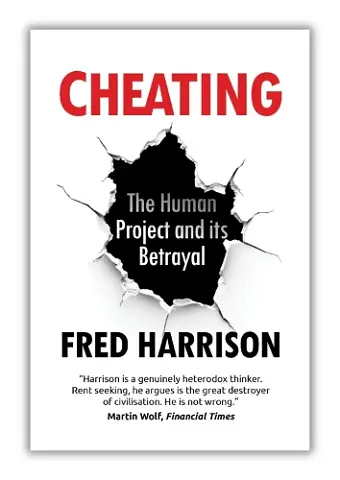
Cheating
The Human Project and its Betrayal
Format:Paperback
Publisher:Shepheard-Walwyn (Publishers) Ltd
Publishing:11th Aug '26
£20.00
This title is due to be published on 11th August, and will be despatched as soon as possible.
This paperback is available in another edition too:
- Hardback£30.00(9781916517233)
Key selling points:
- Proven forecasting record — Harrison predicted the 2008 financial crash years in advance using the 18-year land cycle, and identifies 2028 as the next reckoning.
- Urgent and timely — Five existential crises, including the rise of AI, are converging. Harrison argues that a five-year window (2025–2030) exists for voluntary reform.
- Devastating human evidence — An 18-year gap in healthy life expectancy between UK postcodes; Scotland’s drug death crisis; 125,000 preventable British deaths annually — all traced to one fiscal mechanism.
A genuine solution — One World Rent is not utopian; it has precedents in Denmark, Taiwan, and Botswana, and is modelled to deliver a 46% above-trend GDP increase over 80 years (Kumhof, IMF).
Five thousand years ago, elites seized a surplus that belonged to everyone. Fred Harrison argues we never stopped paying for it — in poverty, inequality, and shortened lives. He predicted the 2008 crash and warns 2028 is next. Sharing the rent from land and nature, he says, could finally break the cycle for good.
Five thousand years ago, humanity made a huge mistake. The income from shared land - economic rent - was seized by chiefs and priests rather than used for everyone’s benefit. Every unfair tax, every preventable death from poverty, and every financial crash since can be traced back to that betrayal.
Fred Harrison reveals the “culture of cheating” built into the foundations of modern society: how mainstream economics removed the idea of rent, and how taxing wages instead of land harms prosperity and shortens lives. With five major crises - political gridlock, environmental collapse, mass migration, authoritarianism, and uncontrolled AI - converging around 2028, he makes an evidence-based case for replacing taxes on labour with Annual Ground Rents and sharing rents between nations to resolve conflicts from Gaza to the climate crisis.
Economist Fred Harrison reveals how a 5,000-year-old fraud — the private capture of land rent — drives poverty, inequality, and boom-bust cycles. His solution: replace taxes with land value charges to share nature's wealth and heal a broken world.
Fred Harrison, one of the most insightful British economists, has produced another landmark work with Cheating: The Human Project and Its Betrayal, which follows his earlier groundbreaking book, The Power in the Land (Harrison, 1983).
Cheating traces the root cause of our impending collapse as a species to a single issue—the diversion of rent from the commons. Harrison carefully examines the repercussions of this problem and presents a compelling alternative path toward a just ecological political economy. Unfortunately, he argues that neither scholars nor the general public, positioned to effect change, will heed his call because they are both paralysed by and beneficiaries of the very same problem: cheating.
- Franklin Obeng-Odoom, University of Helsinki, Helsinki, Finland
Fred Harrison’s Cheating: The Human Project and Its Betrayal is as provocative as it is illuminating—a book that doesn’t let the reader off the hook easily. With striking clarity, Harrison shows how mainstream economics has quietly edged the classical concept of economic rent out of view—conveniently leaving us with a system that taxes work and productivity, while largely sparing unearned gains from land. He argues, with characteristic sharpness, that this shift lies at the heart of recurring crises and persistent structural imbalances.
His case is further strengthened by decades of work on property cycles. Harrison is among the few economists who not only identified the recurring dynamics of land and real estate markets but also had the conviction to point to their crisis potential ahead of time. The fact that this perspective has proven remarkably prescient lends additional weight to his current analysis.
Yet Cheating is not merely diagnostic. Harrison sketches a bold and original reform perspective: the systematic capture of land and resource rents—conceived even at a global level—opens up new ways of thinking about economic stability, distributional justice, and even geopolitical tensions. The economic potential implied by such a reordering is substantial, and at the very least challenges deeply entrenched assumptions.
There is also a palpable sense of urgency running through the book. Harrison makes it clear that the window for meaningful reform may be limited. His argument that the opportunity for voluntary adjustment will not remain open indefinitely adds a certain tension to the reading experience—as if, alongside the analysis, a quiet countdown were ticking in the background.
Cheating is therefore far more than another contribution to economic debate. It is a thoughtful, incisive, and at times refreshingly uncomfortable intervention into the question of why our economies repeatedly falter—and what it might take to finally set them on a more stable footing.
- Dirk Löhr is an economist at Trier University of Applied Sciences and a leading advocate of the land value tax, which he helped to introduce in Baden-Württemberg, Germany.
'The proposal in this book to shift the bulk of taxation from incomes and profits to a Land Valuation Tax, or more broadly to a fiscal charge on society's net income, or rent, as the author would put it, is absolutely correct, and has now become necessary in order to deal with the parlous state of fiscal policy. But that leaves open the question of how far this reform can of itself lead to a diminution of the pursuit of power and other forms of social 'Cheating'.'
- Charles Goodhart, Emeritus Professor of Banking and Finance, London School of Economics
Fred Harrison is right. We have developed a culture of cheating. If people grapple with the questions that Fred Harrison addresses, they may realize that the only path to a peaceful and prosperous world lies in sharing the Earth’s rent, so that all people are accorded equal rights to the natural opportunities provided by the Earth.
-Nicolaus Tideman, Professor of Economics, Virginia Tech
Harrison exposes a flaw in our system that enables Cheaters to demand tribute for access to the resources we all need to survive. Harrison’s hope is that by spreading awareness of the difference between the value of socially shared Rent and privatized Rent, we will be able to prevent the next predicted collapse. In Harrison’s words, nothing less is at stake than assuring “…our place on Planet Earth.”
-Dr Heather Remoff, Anthropologist, Heather Remoff, author, What's Sex Got to Do with It? Darwin, Love, Lust, and the Anthropocene
Harrison’s wide-ranging book traces how the evolutionary human project has been periodically interrupted by a culture of cheating opposed to the maxim: “Keep what you make; pay for what you take.” This requires trade at prices that reflect relative labour costs. Land qua land, unlike man-made improvements, has no labour cost yet owners command vastly different rents dependent on the surrounding infrastructure largely financed through the taxation of earned incomes rather than unearned rents. Harrison explains why radical fiscal reform can expunge the fundamental injustice at the heart of global territorial conflicts that today threaten civilisation.
- Roger Sandilands, Emeritus Professor of Economics, Strathclyde University
Fred Harrison's Cheating: The Human Project and Its Betrayal sets forth a bold claim: that the sharing of economic rents - the surplus, or net income, arising from cooperative activity - distinguished humanity from other hominids and was vital to its evolution as a species. This was our "human project".
Sharing the rents, once humanity's defining social principle, was fatally undermined millennia ago as elites expropriated society's net income. The result: vast swathes of people cheated out of their common heritage to suffer within cultures of extraction that have corrupted and brought low every civilisation ever since.
Harrison, long known for his prescient analysis of boom-and-bust cycles, issues a stark warning: our civilisation has now reached a tipping point; continue on the present path and face systemic collapse, or reclaim the human project and chart a fairer and more prosperous future.
The question is whether we possess the collective will to act in time.
This ambitious work is the culmination of a lifetime dedicated to advancing the human project. Its arguments are fertile ground for further scholarship, and its challenge is clear: a new generation must take up and advance the cause so fiercely championed by Harrison for so long.
- Akhil Patel, author of The Secret Wealth Advantage
Students of English history may remember the survey ordered in 1086 by William the Conqueror to determine the value of the kingdom’s land and all castles, homes, barns, crops, livestock, mills and woodlands (excepting London, Winchester and parts of the north). The findings were detailed in two volumes eventually referred to as the Doomesday books. William needed revenue to govern the country, and he knew that those who held property were unlikely to honestly self-report the value of their holdings for purposes of taxation. Well, not much has changed since the eleventh century, as detailed by author Fred Harrison in his new book, Cheating: The Human Project and its Betrayal.
I leave it to Fred Harrison to explain to you what he means by “One World Rent is the binding glue.” Order the book. Study it closely. Discuss it with friends and colleagues. There is no time to lose.
- Edward J. Dodson, M.L.A.
Harrison masterfully uses insightful historical analysis to show that the current fiscal system is not only not "normal" and inevitable, but also why it is not normal: rent seekers have managed to divert socially owned economic Rent to their private pockets through privatisation.
Since something must and will change, Harrison's book is the vehicle through which informed conversations can direct initiatives towards those that are both fair and economically sound. He explains how fairness and economic efficiency - Zero Deadweight losses - can be achieved by the simple pricing system of "keep what you create, pay for what you receive".
-Jean-Pierre Zigrand, Co-director of the Systemic Risk Centre, and Associate Professor of Finance, London School of Economics
ISBN: 9781916517219
Dimensions: 229mm x 152mm x 21mm
Weight: unknown
298 pages