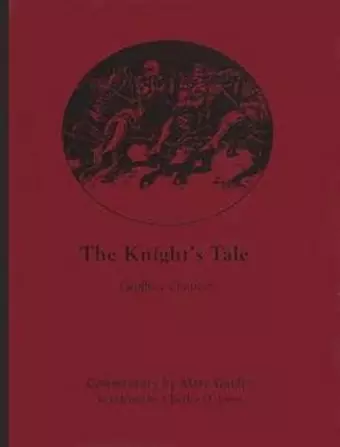
The Knight's Tale
Format:Hardback
Publisher:Stephen F. Austin State University Press
Published:15th May '11
Currently unavailable, and unfortunately no date known when it will be back
Chaucer's
Knight's Tale breaks boundaries. It uncovers the dark heart of chivalric idealism, injects the political seriousness of epic into the timeless summer of romance, insists on a pagan outlook within a Christian culture, and draws compassion for female suffering from a man's world. Along with the exquisite anonymous poem Sir Gawain and the Green Knight, the Knight's Tale is the most intricately structured and stylistically pleasing of medieval English romances. For these reasons, it is worthy of its own edition, but what makes it particularly suitable to an illustrated edition is how its narration works by condensing actions and their effects into powerful images and figures. The Knight's Tale has, in fact, been illustrated many times, but never so thoroughly as in the current edition. Moreover, past illustrations have tended to romanticize or sentimentalize the story, eschewing its most violent and disturbing images. The illustrations in this edition attempt to recapture Chaucer's mature vision of the noble life, which refuses to deny the tragic aspects of the chivalric equation of love with war and war with honor. Past illustrations have also tended to adopt a Gothic idiom. The illustrations in our edition adopt a Classical Greek idiom drawn from the Parthenon frieze, Attic black- and red-figure pottery, and ancient Greek sculpture - an idiom suitable to the setting of the tale in legendary Athens and Thebes as well as to Chaucer's humanist impusle.
The
If considering Theseus's prosecution of war as a civilizing force, one can point to the fact that he puts an end to Creon's "tirannye" (941), restoring the bodies of the desecrated dead to the Argive widows. However, if his objective in attacking Thebes is to avenge the widows on Creon, why does he destroy the city after he has already killed him and routed the Theban army, tearing down "wall, and sparre and rafter" (line 990)? The motive is hardly humanitarian, nor even strategic in the military sense since the Theban forces have already been defeated. Its only objective is pillage - to pay off the Athenian troops - and, of course, it is while ransacking the dead that they find Palamon and Arcite still alive among a pile of corpses, a detail unique to Chaucer's text. While...
ISBN: 9781936205233
Dimensions: 304mm x 233mm x 22mm
Weight: 1140g
140 pages