Regional Romanticism
Literature and Southwest Scotland, c.1770–1830
Format:Hardback
Publisher:Springer International Publishing AG
Published:23rd Oct '24
Currently unavailable, and unfortunately no date known when it will be back
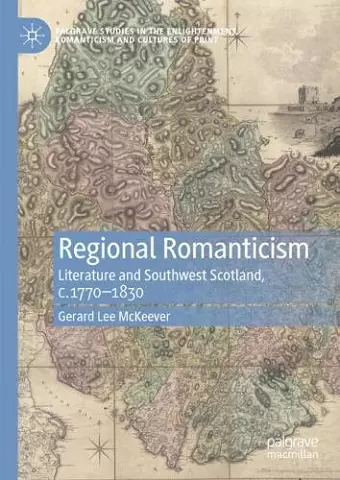
This book tracks the rise of modern cultural regionalism across the turn of the nineteenth century. Attending specifically to literature and literary culture, it examines how a particular region—southwest Scotland—was reimagined between 1770 and 1830. Regionalisms were a vital, emergent force in this period, in dialogue with the local, the national, the transnational and the imperial. In the case of southwest Scotland, the literary inscription of the region was generated in a blossoming periodical press; by visitors like Dorothy Wordsworth and John Keats; by resident icon Robert Burns; by homesick emigrants such as Allan Cunningham; by adventurers, colonialists and pirates looking back from within and beyond the formal limits of empire; by the unprecedented success of Walter Scott; and by many others navigating the opportunities presented by rapidly evolving economic, environmental and infrastructural conditions. Regional Romanticism illuminates a neglected aspect of anglophone literary history, acknowledging regions and regionalism as a primary frame of reference in late eighteenth and early nineteenth-century culture.
“Gerard Lee McKeever’s Regional Romanticism: Literature and Southwest Scotland, c.1770–1830 offers a fascinating cultural and literary history of the southwest of Scotland. The book devotes itself to a specific region, Dumfriesshire and Galloway, on the Solway Firth, just northwest of England’s Lake District and south of Ayrshire and the Highlands to the north. … McKeever argues that the area was by the late eighteenth century recognized as a distinct entity, albeit one that was enmeshed within larger geographies.” (Saree Makdisi, SEL Studies in English Literature 1500-1900, Vol. 64 (3), 2026)
“McKeever moves skilfully over the generic landscape, and this genre-based methodology is the perfect lens through which to view the subject of regionalism. … ‘Regional cultures’, as McKeever argues, ‘were not merely a subsidiary feature of [nationhood]; in fact, they often formed the primary lexicon of cultural identity’ … . Regional Romanticism provides compelling impetus for, as well as a powerful example of, such a re-examination of the literary landscape and of the landscapes of literature.” (David O’Hanlon-Alexandra, The Review of English Studies, Vol. 77 (328), 2026)
“McKeever is an accomplished book historian, and his weaving of that field’s concern with textual publication, reception, and circulation into the wider environmental orientation of the project is perhaps the most significant achievement of this book … . The remaining chapters are a tour de force of archival scholarship, organized by genre (travel writing, poetry, romance, and science) … . The nuanced delineation of sovereignty … marks a significant turning point in Scottish Romantic criticism.” (Alexander Dick, European Romantic Review, Vol. 37 (3), 2026)
“McKeever’s major achievement with Regional Romanticism is its archival reach and careful attention to the interaction between place and text. He moves deftly from macro-scale spatial circuits to micro-scale folklore and print networks, broadening the archive of Romantic studies. … his sustained focus on lesser-known authors and genres offers scholars of literary geography and Scottish Romanticism a critical resource — complete with exceptional footnotes — that shows how place, space, and regional identity were actively constructed through literature.” (Dana Graham Lai, Studies in Hogg and his World, Issue 31-32, 2026)
“McKeever’s description and analysis of this eccentric work is a tour de force, giving an engaging sense of the sheer inventiveness and exuberance of the content as well as making a compelling case for the significance of the book … . this book offers a compelling demonstration of how an engagement with the local, the minor, and the overlooked can enlarge our understanding of Scottish Romanticism as a whole.” (Pam Perkins, Eighteenth-Century Scotland, Vol. 39, 2025)
ISBN: 9783031613241
Dimensions: unknown
Weight: unknown
304 pages
2024 ed.