Internet Vulgarities in China
Cultures, Governance and Politics
Jian Xu editor Dino Ge Zhang editor
Format:Hardback
Publisher:Pallas Publications
Published:18th Mar '26
Currently unavailable, and unfortunately no date known when it will be back
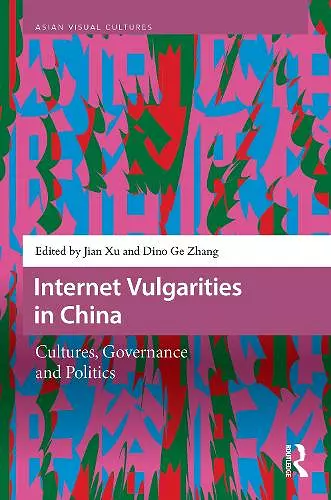
Internet Vulgarities in China is the first comprehensive study to critically examine the cultures, governance and politics of internet vulgarities in Chinese society. Comprising twelve chapters, the authors present empirically rich case studies to explore the nature, regulation and evolution of the internet cultural products, vernacular internet cultures and subcultural online communities which have been officially deemed ‘vulgar’ by the state, official media and policy documents.
From ‘vulgar’ online music, internet literature, memes, web dramas, influencers, video games to online fandoms, this timely book demonstrates that the disciplinary power of China’s ‘anti-vulgarity’ campaigns stems from the state’s strategic use of the ambiguous concept of ‘vulgarity’ to judge and regulate the aesthetic and ethical dimensions of popular digital media cultures. This process of turning language into law—a form of linguistification of rule—functions as a key technique of digital and cultural governance, ensuring that these cultures evolve in accordance with the ideological, moral and cultural values of the party-state.
Internet Vulgarities in China will make a significant contribution to the fields of China’s digital media studies, popular culture studies, internet and cultural governance. It is an essential resource for scholars, researchers and students seeking a critical understanding of China’s digital media cultures and its governance and politics.
The book dives deep into China’s puzzling ‘anti-vulgarity’ campaigns. This ground-breaking volume reveals how the government uses the ambiguous and often arbitrary label of ‘vulgarity’ as a tool for media and cultural governance. From web novels and online music to e’gao spoofs and fan circle cultures, the diverse chapters delve into all manners of ‘internet vulgarities’ and their regulation across China’s evolving digital landscape. This makes the book an indispensable guide for understanding the complex interplay between cultural production, state control, and the paradoxical nature of Chinese market socialism. It is a must-read for anyone hoping to truly grasp the oftentimes baffling dynamics of digital media, cultural policies, and governance in post-socialist China.
Florian Schneider, Chair Professor of Modern China, Leiden University
The book puts together twelve thought-provoking chapters that analyse previously often-overlooked, so-called ‘vulgar’ corners of Chinese internet culture. The contributors collectively challenge the dominant narratives of Western-dominated frameworks in cultural studies and internet studies by illustrating the sociopolitical significance of vulgarity in Chinese digital cultures. A must-read book for scholars and students interested in understanding the politics and governance of Chinese digital media cultures.
Matthew Ming Tak Chew, Associate Professor, Lingnan University, Hong Kong
What makes this volume especially significant is its insight into the politics of naming and the aesthetics of ‘vulgarity’ as forms of governance. Reflecting Wittgenstein’s view of language games as mirroring reality, the chapters collectively show that ‘vulgarity’ is not merely descriptive, but a performative category that structures the rules of cultural and political life. The Chinese case demonstrates how language games themselves provide the fundamental logic of social governance. This is an essential contribution for scholars of media, digital culture, and politics in China and beyond, and a rich resource for understanding how aesthetics, ideology, and power intersect in the digital age.
Professor Haiqing Yu, RMIT University, Australia
Amidst all the glowing stories of the high-tech blitz in China, this book presents an urgent intervention. It opens up the space for the everyday, vernacular uses of new technologies and cheerfully and rightfully embraces vulgarity. It shows how, against all odds, the internet continues to allow for a sense of futurity, hope, and play – fostering multiple rather than singular dreams. It is essential reading for anyone wanting to understand the politics and social implications of internet culture in China today.
Professor Jeroen de Kloet, University of Amsterdam
ISBN: 9789048563586
Dimensions: unknown
Weight: 630g
246 pages