Studies in the Latin Literature and Epigraphy in Italian Fascism
Valerio Sanzotta editor Han Lamers editor Bettina Reitz-Joosse editor
Format:Paperback
Publisher:Leuven University Press
Published:18th Jun '20
Currently unavailable, and unfortunately no date known when it will be back
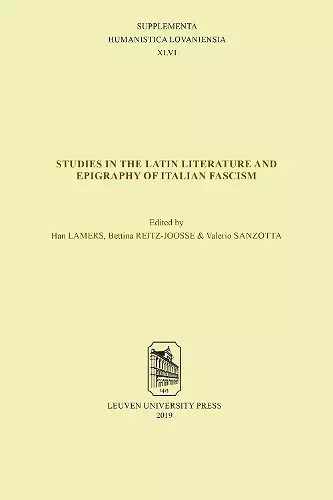
This book deals with the use of Latin as a literary and epigraphic language under Italian Fascism (1922-1943). The myth of Rome lay at the heart of Italian Fascist ideology, and the ancient language of Rome, too, played an important role in the regime's cultural politics. This collection deepens our understanding of 'Fascist Latinity', presents a range of previously little-known material, and opens up a number of new avenues of research. The chapters explore the pivotal role of Latin in constructing a link between ancient Rome and Fascist Italy; the different social and cultural contexts in which Latin texts functioned in the ventennio fascista; and the way in which 'Fascist Latinity' relied on, and manipulated, the 'myth of Rome' of late nineteenth- and early twentieth-century Italy. Contributors: William Barton (Ludwig Boltzmann Institute for Neo-Latin Studies), Xavier van Binnebeke (KU Leuven), Paolo Fedeli (Universita degli Studi di Bari Aldo Moro), Han Lamers (University of Oslo), Johanna Luggin (Ludwig Boltzmann Institute for Neo-Latin Studies), Antonino Nastasi (Rome), Bettina Reitz-Joosse (University of Groningen), Dirk Sacre (KU Leuven), Valerio Sanzotta (Ludwig Boltzmann Institute for Neo-Latin Studies), Wolfgang Strobl (Toblach)
This is a well prepared and well executed collection that belongs on the bookshelves of anyone who feels the need to explain the relevance of Neo-Latin studies in the modern period.
Craig Kallendorf, Neo-Latin News, Vol. 69, Nos. 1 & 2., 2021
Latijnse teksten hielpen Mussolini zijn fascistische gedachtegoed te verankeren
Lofdichten op het fascisme, in het Latijn. Toespraken van Mussolini, vertaald in het Latijn. Inscripties op gevels van gebouwen, in het Latijn. Voor classici Bettina Reitz-Joosse, een Duitse universitair hoofddocent aan de Rijksuniversiteit Groningen, en Han Lamers, een Nederlandse hoogleraar klassieke talen aan de Universiteit van Oslo, is het duidelijk: „Het alom aanwezige Latijn heeft geholpen bij het verankeren van het fascistische gedachtegoed in Italië in het ventennio, de periode van 1922 tot 1943.” Theo Toebosch, nrc.nl, 8 september 2020
ISBN: 9789462702073
Dimensions: 234mm x 156mm x 20mm
Weight: 595g
374 pages