Behind Office Doors
Use and Users in the History of Office Buildings
Format:Paperback
Publisher:Leuven University Press
Published:15th Jan '26
Currently unavailable, our supplier has not provided us a restock date
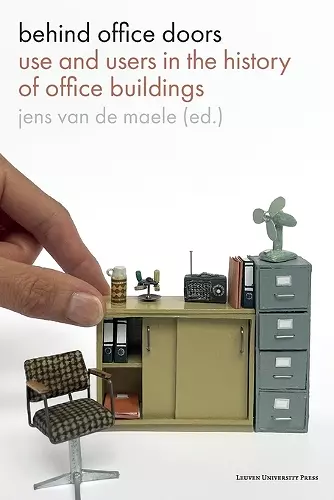
A transdisciplinary history of the 20th-century office, exploring how its spatial forms, technological systems and managerial ideologies were constructed, challenged and lived with.
Throughout the twentieth century, office buildings became central to the organisation of societies – yet what went on inside them has remained remarkably understudied. Behind Office Doors explores this history by focusing on users and everyday practices. It examines how office spaces were conceived by architects, designers and managers, and how they were inhabited, experienced and contested by workers. From filing cabinets and air conditioning to EU offices and colonial bureaucracies, the chapters trace how design, technology and organisational thinking shaped office life. Alongside case studies on Europe, North America, Asia and colonial Africa, the contributions reflect on how the office has been approached in historiography. Drawing on cross-disciplinary research, this book argues for the development of historical office studies, showing how the design and management of offices have shaped cultures of work.
Devoted to the role of uses and users in the configuration and appropriation of the space of administrative work, this book opens up a new perspective on the history of the office, inviting us to move away from linear narratives based on the analysis of the architectural canon and on a reductionist vision of the dynamics of power and control that have often marked the historiographical tradition on the office. - Gianenrico Bernasconi, Université de Neuchâtel
Behind Office Doors brings welcome attention to the often overlooked inhabitants of architectural history: users. This interdisciplinary collection shows how office inhabitants across many contexts, from Japanese corporations to European bureaucracies to Congolese colonial administrations, navigated their environments. Each chapter opens another door on the unwritten rules, hierarchies, and adaptations that defined office life. Like the flexible workspaces it examines, the collection offers varied perspectives that together illuminate the rich terrain between architectural intention and practical adaptation that defined twentieth-century professional life. - Joseph L. Clarke, University of Toronto
ISBN: 9789462704992
Dimensions: unknown
Weight: 907g
360 pages