Economics, Religion And Public Policy (In 3 Volumes)
Nirvikar Singh editor Vladimir Maltsev editor
Format:Hardback
Publisher:World Scientific Publishing Co Pte Ltd
Published:20th Jun '26
Currently unavailable, and unfortunately no date known when it will be back
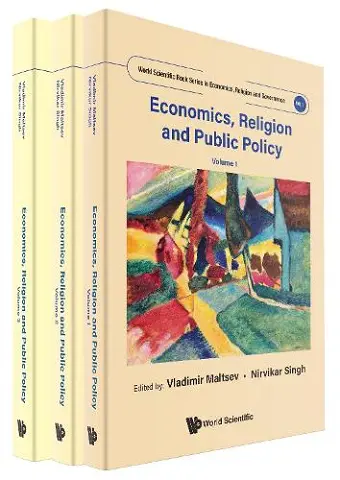
Economics, Religion and Public Policy is a three-volume exploration of religious beliefs and their persistent impact on economic life. Each volume in the set employs an eclectic mix of economics, politics, sociology and history to rigorously study how religion influences individual well-being, social harmony, governance and economic development. Each volume contains contributions by individual authors which critically examine specific cases from both Western and non-Western experience.Volume 1 lays some intellectual groundwork for the series as a whole, illustrating foundational concepts, influences and inner tensions within the economics of religion. The chapters in the volume demonstrate diverse approaches to "doing" the economics of religion, applying economic reasoning to a range of issues, from examining one's identity and the sources of overall human flourishing to studying the impact of religion on criminal organizations and events such as the tragedy of Jonestown. The contributions highlight that religion has been important throughout human history, and that any carefully constructed socioeconomic policy must be sensitive to the religious roots that often still exert seen and unseen influences on institutions, culture, and life in general.Volume 2 deepens the exploration of religion pertaining to matters of human cooperation and governance. Drawing on evolutionary, institutional and political-economy frameworks, it examines the complex processes of how religion becomes intertwined with societal norms, law, authority and the state itself. The volume presents a wide range of economics-based perspectives on religion and governance, from the positive influence of religion on collective action, to its role in the formation of more extractive forms of government such as theocracies. The volume illustrates these findings through a series of rich historical and empirical studies, which include the economic analysis of monotheism, the Catholic Church, Calvinist Protestantism, Islamic revivalism, the Roma people's social norms, and more. Altogether, the book underscores the complexity of religion as a factor in shaping individual behavior and social outcomes across time and different cultural contexts.Volume 3 extends the intellectual path charted by the preceding volumes. While continuing to explore the interconnections between religion, economic life and governance, it emphasizes the tensions and conflicts that religion can generate within and between communities. The chapters tackle difficult issues of ethnicity, demographic change, nationalism and environmental pressures, demonstrating how religion has the potential to both mitigate and exacerbate...
ISBN: 9789819819775
Dimensions: unknown
Weight: unknown
860 pages