Secular Sufism and the Politics of Difference
Caste, Aesthetics, and Political Theology in Sindh, Pakistan
Format:Hardback
Publisher:Bloomsbury Publishing PLC
Publishing:1st Apr '27
£85.00
This title is due to be published on 1st April, and will be despatched as soon as possible.
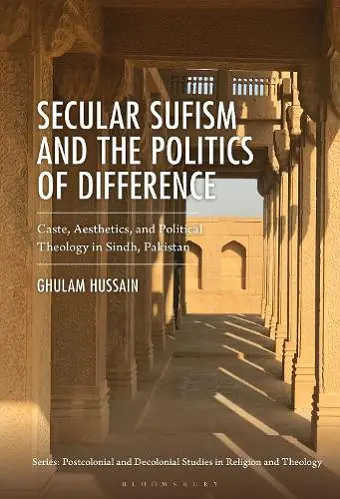
Ghulam Hussain offers a radical rethinking of caste, religion, and nationalism in contemporary Pakistan.
Drawing on more than a decade of ethnographic research, archival investigation, literary analysis, and engagement with Dalit and Pasmanda perspectives, Hussain challenges the widespread assumption that Sindh’s celebrated traditions of Sufism, pluralism, and coexistence exist outside the logic of caste. This book develops a critique of transreligious politics, demonstrating how caste operates across ostensibly religious and secular domains, including heterodox forms of secular Sufism. Through an examination of secular-Sufi nationalism, literary canon formation, and the symbolic afterlives of figures such as Shah Abdul Latif Bhittai and Raja Dahir, Hussain shows how caste is repeatedly displaced into the languages of humanity, culture, spirituality, and civilizational belonging. Bringing together critical caste studies, political anthropology, historiography, and religious studies, this book reveals how narratives of tolerance and pluralism can simultaneously challenge some forms of domination whilst obscuring others.
Seamlessly woven around the intersectionality of theorization of secular Sufism as political theology and articulation of caste as a trans-religious formation, this innovative studypresents a fine blend of subjective reality and critical revelation of the dormant phenomenon of caste within Pakistan. This pithily argued ethnographic study would not only initiate a new research agenda in the domain of South Asian socio-religious investigation but also open a new window to reflect on the so far hidden structures of Islamic social discrimination and deprivation. * Ronki Ram, Institute for Development & Communication, Chandigarh *
A persuasive and pathbreaking intervention, this book unsettles romanticized images of Sindh as Sufi, plural, and caste-transcending. By conceptualizing caste as a transreligious political theology, Ghulam Hussain reveals how the moral vocabulary of secular Sufism mystifies and reproduces social hierarchies through idioms of tolerance, spirituality, and peaceful coexistence. Ethnographically grounded and theoretically incisive, the book makes a vital contribution to Critical Caste Studies, Pasmanda Studies, and the sociology of religion in South Asia. * Gaurav J. Pathania, Eastern Mennonite University *
The Orientalist, secular, and seemingly progressive-Muslim portrayal of the wise, intellectual, egalitarian, and omnist Sufi figure shatters into a million pieces in Ghulam Hussain’s book. There is no refuge possible for those in Sindh, or elsewhere in many countries in South Asia, who claim that they do not believe in or practice caste. Hussain places the organized-through-caste figure of the Sindhi Sufi within a Critical Pasmanda Studies framework, also offering us incisive strategies and pedagogy for teaching about caste, Islam, and Pakistan. Anybody who has ever claimed there is no caste in (Muslim) Pakistan needs to read this book, and immediately. * Shaista Aziz Patel, UC San Diego *
South Asian scholarship has been embarrassed to engage with the persistence of caste hierarchy that compromises the postcolonial promise of equality. This pioneering monograph on caste in the Sindh region of Pakistan is a brilliant departure and a new model that thinks religion, caste, and democratic pluralism simultaneously. Hussain’s argument that Sufism, by positing insaniyat, or becoming-human, as the horizon for thought, provides a regulatory framework for politics, the self, and the community, is both highly original and daring. A timely, provocative work that will stand the test of time * Dilip M. Menon, University of Witwatersrand *
This book presents a radical and brilliant immanent critique of the moral, political and intellectual foundations of an inclusive Sindhi identity by reminding us of the persistence and political non-recognition of caste as a social fact. Theoretically rigorous, the book is a must read for understanding the politics of how caste is structurally embedded and discursively homogenized in progressive-nationalist discourses in Sindh. In times marked by dominant majoritarianism, this book compels us to question hegemonic cultural projects as sites of normative authority. * Farhan Hanif Siddiqi, Institute of Business Administration, Karachi *
This is a courageous book, provocative yet well-argued. Grounded in multiple research methods and the author’s personal and experiential understanding, Dr Ghulam Hussain offers multi-layered insights that provide a rich critique of the ruling ideological regimes in Sindh, Pakistan. His arguments, particularly those relating to caste and the historical convergence of orientalist frames and nationalist imaginings, have much wider significance for studies of contemporary South Asia. * Surinder S. Jodhka, formerly with JNU, New Delhi *
ISBN: 9798216484714
Dimensions: unknown
Weight: unknown
320 pages