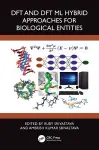
DFT and DFT ML Hybrid Approaches for Biological Entities
2 authors - Hardback
£124.99
Find out more
Dr. Ruby Srivastava is currently serving as a Principal Investigator at the Indian Institute of Technology, Mumbai, India under the DST/WIDUSHI-B/CS/2024/35 scheme. Following a fifteen-year teaching career, she embarked on her PhD in 2010 and has since established an independent research trajectory, successfully completing three DST-WOSA projects. She has an impressive record of solo-authored publications, including review articles and nineteen book chapters, and has independently edited multiple books. Additionally, she has authored two books and co-authored another. Several of her works have received international recognition. Dr. Srivastava is a reviewer for leading academic publishers and serves as a review and guest editor for several journals. Her research expertise spans computational studies in both Material Sciences, and Biological Sciences. Her current research interests lie in exploring the role of artificial intelligence in drug discovery and disease analysis, as well as conducting immunoinformatics studies on mRNA vaccines targeting infectious diseases and cancer.
Dr. Ambrish Kumar Srivastava is an Assistant Professor in the Department of Physics at D.D.U. Gorakhpur University, Gorakhpur. He obtained his Ph.D. in Physics from the University of Lucknow. His research interests span theoretical condensed matter physics, atomic and superatomic clusters, nanostructures, cluster-assembled materials, and biophysics. His work primarily focuses on computational investigations of superatoms as fundamental building blocks for advanced functional materials, with particular emphasis on superhalogens, superalkalis, and hydrogen storage materials. Dr. Ambrish Srivastava has established an impressive research profile with 146 peer-reviewed publications, 10 books, an h-index of 28, an i10-index of 82, and more than 2,500 citations. His research has been published in almost all the leading international journals. He also serves as an Associate Editor of Frontiers in Physics and is a member of the editorial boards of Current Chinese Science and the Journal of Computational Methods in Molecular Design. He has successfully completed several externally funded research projects supported by UGC and SERB, focusing on superatomic clusters and computational hydrogen storage. His contributions have been recognized through the NASI Young Scientist Platinum Jubilee Award (2022), selection as an Associate of the Indian Academy of Sciences (2024–2027), inclusion in the Stanford–Elsevier Top 2% Scientists List (2023 and 2025), and the Outstanding Research Award from D.D.U. Gorakhpur University (2024 and 2025). He is also a life member of several professional scientific societies and an affiliate of the Royal Society of Chemistry and the American Chemical Society.