Dissent on the Margins
How Soviet Jehovah's Witnesses Defied Communism and Lived to Preach About It
Format:Paperback
Publisher:Oxford University Press Inc
Published:28th Apr '16
Currently unavailable, and unfortunately no date known when it will be back
This paperback is available in another edition too:
- Hardback£120.00(9780199945535)
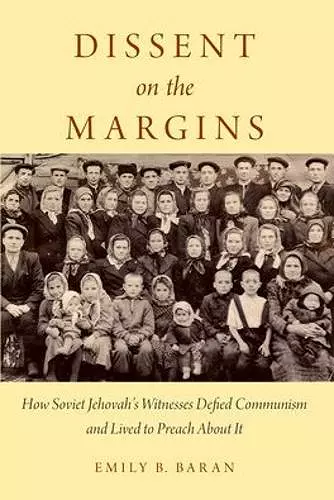
Emily B. Baran offers a gripping history of how a small, American-based religious community, the Jehovah's Witnesses, found its way into the Soviet Union after World War II, survived decades of brutal persecution, and emerged as one of the region's fastest growing religions after the Soviet Union's collapse in 1991. In telling the story of this often misunderstood faith, Baran explores the shifting boundaries of religious dissent, non-conformity, and human rights in the Soviet Union and its successor states. Soviet Jehovah's Witnesses are a fascinating case study of dissent beyond urban, intellectual nonconformists. Witnesses, who were generally rural, poorly educated, and utterly marginalized from society, resisted state pressure to conform. They instead constructed alternative communities based on adherence to religious principles established by the Witnesses' international center in Brooklyn, New York. The Soviet state considered Witnesses to be the most reactionary of all underground religious movements, and used extraordinary measures to try to eliminate this threat. Yet Witnesses survived, while the Soviet system did not. After 1991, they faced continuing challenges to their right to practice their faith in post-Soviet states, as these states struggled to reconcile the proper limits on freedom of conscience with European norms and domestic concerns. Dissent on the Margins provides a new and important perspective on one of America's most understudied religious movements.
Dissent on the Margins is an amazing piece of research and analysis: sophisticated in its conceptualization, exhaustive in its research (in hitherto-secret state, party, and even police archives), this study shows how a small religious group survived decades of Soviet repression, won legalization in 1991, and has since expanded its flock to several hundred thousand adherents. A must-read for historians, political scientists, and sociologists of religion. * Gregory L. Freeze, Victor and Gwendolyn Beinfield Professor of History, Brandeis University *
This thoughtful and skillfully researched monograph tells the history of the Jehovah's Witness in the Soviet Union and three of its successor states. It recounts the troubled relationship between state and 'sect,' arguing that the survival of Witness communities shows the limits of state power even in a repressive country like the USSR. The historical sections draw on an impressive, and carefully referenced, body of archival material but Baran also takes her story forward into the first decade of the twenty-first century. It will appeal not only to students of Soviet history but also to all those following the religious situation in the post-Soviet space today. * Miriam Dobson, author of Khrushchev's Cold Summer: Gulag Returnees, Crime, and the Fate of Reform after Stalin *
Dissent on the Margins offers an excellent contribution to religious studies and serves as a welcome new resource for those interested in the history of lived religion in the Soviet Union. * Kathleen Hiatt, Journal of Church and State *
This impressive book makes an important contribution to a number of bodies of scholarship, including Soviet dissent, religious history in the ussr * Zoe Knox, Soviet and Post-Soviet Review *
ISBN: 9780190495497
Dimensions: 231mm x 155mm x 28mm
Weight: 590g
402 pages