Voice, Slavery, and Race in Seventeenth-Century Florence
Format:Hardback
Publisher:Oxford University Press Inc
Published:22nd Mar '24
£60.00
Available to order, but very limited on stock - if we have issues obtaining a copy, we will let you know.
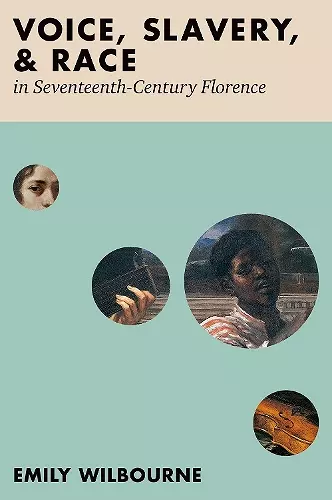
Grounded in new archival research documenting a significant presence of foreign and racially-marked individuals in Medici Florence, this book argues for the relevance of such individuals to the history of Western music and for the importance of sound-particularly musical and vocal sounds-to systems of racial and ethnic difference. Many of the individuals discussed in these pages were subject to enslavement or conditions of unfree labor; some labored at tasks that were explicitly musical or theatrical, while all intersected with sound and with practices of listening that afforded full personhood only to particular categories of people. Integrating historical detail alongside contemporary performances and musical conventions, this book makes the forceful claim that operatic musical techniques were-from their very inception-imbricated with racialized differences. Author Emily Wilbourne offers both a macro and micro approach to the content of this book. The first half of the volume draws upon a wide range of archival, theatrical and historical sources to articulate the theoretical interdependence of razza (lit. "race"), voice, and music in early modern Italy; the second half focuses on the life and work of a specific, racially-marked individual: the enslaved, Black, male soprano singer, Giovannino Buonaccorsi (fl.1651-1674). Voice, Slavery, and Race in Seventeenth-Century Florence reframes the place of racial difference in Western art music and provides a compelling pre-history to later racial formulations of the sonic.
Wilbourne offers an extensive and trail-brazing account of racialized voices in seventeenth-century Florence. Interdisciplinary in scope and meticulously researched, Wilbourne's incomparable work takes us on a tantalizing journey into the musical and performative worlds of early modern Italy's "unsung voices." This book will enthrall non-specialists and specialists alike, transforming our approaches to and understandings of enslavement, race, and the power of sound across the Mediterranean world. * Nicholas R. Jones, author of Staging Habla de Negros: Radical Performance of the African Diaspora in Early Modern Spain *
From one of the leading opera historians of her generation, Wilbourne's Voice, Slavery, and Race is a nuanced account of the reverberations between voice and race on the seventeenth-century stage. "Act I" reads the evidence of paintings, commedia dell'arte scenarios, libretti, and musical scores against a wealth of new documentation from Florentine archives, while "Act II" turns the spotlight on Giovannino Buonaccorsi, an enslaved Black soprano in the service of the Medici. In brilliant analyses that never skip a beat, Wilbourne pieces together a new and original history of racialized performances during the first century of Italian opera. * Kate van Orden, editor of Seachanges: Music in the Mediterranean and Atlantic Worlds, 1550-1800, I Tatti Research Series 2 *
The book, the product of careful study of archival materials on the Medici period of Florence, seeks to identify and unravel how "anachronistic scholarly assumptions about race have concealed the workings of the early modern imaginary". Wilbourne examines not only general archival documents but also scripts of Comedia del arte, librettos of period operas, and even music notation to exemplify ways in which class and foreignness were portrayed on stage. Her work broadens understanding of the mixed society that was Florence in the 17th century. Included is a substantial appendix that makes transparent the author's sources. Highly recommended. * Choice *
Voice, Slavery, and Race in Seventeenth-Century Florence reframes the place of racial difference in Western art music and provides a compelling pre-history to later racial formulations of the sonic. * New Books Network *
The richness of this study lies in the focus on the sonic dimension of Others and Otherness in early modern Florence-the voices of foreigners, the enslaved, and those who were racialized. At the end of the book, Wilbourne summarizesthe key findings as five axioms that can be used as a guide to future research and teaching. These alone are immensely useful. The huge appendix of archival references in Florentine sources to enslaved Moorish, "Turkish" (non-Christian) individuals will be valuable to any scholar working in Italian archives as it meticulously details the descriptive language used. The book is abundantly illustrated with color plates, line drawings, half-tone images, and music examples that support the documentary evidence. * Naomi J. Barker, Notes: the Quarterly Journal of the Music Library Association *
- Winner of Winner, RSA The Phyllis Goodhart Gordan Book Prize Winner, AMS Judy Tsou Critical Race Studies Award , work in the field of critical race and/or critical ethnic studies, American Musicological Society.
ISBN: 9780197646915
Dimensions: 168mm x 221mm x 64mm
Weight: 885g
520 pages