Energy and Power
Germany in the Age of Oil, Atoms, and Climate Change
Format:Hardback
Publisher:Oxford University Press Inc
Published:20th Jul '23
Should be back in stock very soon
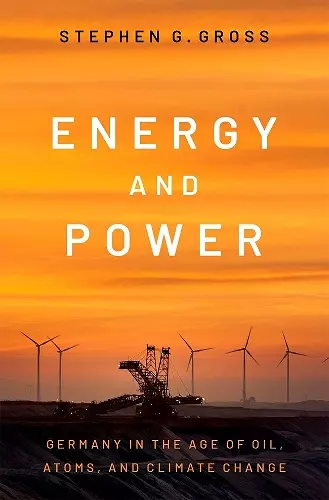
A novel exploration of the deeper political, economic, and geopolitical history behind Germany's daring campaign to restructure its energy system around green power. Since the 1990s, Germany has embarked on a daring campaign to restructure its energy system around renewable power, sparking a global revolution in solar and wind technology. But this pioneering energy transition has been plagued with problems. In Energy and Power, Stephen G. Gross explains the deeper origins of the Energiewende--Germany's transition to green energy--and offers the first comprehensive history of German energy and climate policy from World War II to the present. The book follows the Federal Republic as it passed through five energy transitions from the dramatic shift to oil that nearly wiped out the nation's hard coal sector, to the oil shocks and the rise of the Green movement in the 1970s and 1980s, the co-creation of a natural gas infrastructure with Russia, and the transition to renewable power today. He shows how debates over energy profoundly shaped the course of German history and influenced the landmark developments that define modern Europe. As Gross argues, the intense and early politicization of energy led the Federal Republic to diverge from the United States and rethink its fossil economy well before global warming became a public issue, building a green energy system in the name of many social goals. Yet Germany's experience also illustrates the difficulty, the political battles, and the unintended consequences that surround energy transitions. By combining economy theory with a study of interest groups, ideas, and political mobilization, Energy and Power offers a novel explanation for why energy transitions happen. Further, it provides a powerful lens to move beyond conventional debates on Germany's East-West divide, or its postwar engagement with the Holocaust, to explore how this nation has shaped the contemporary world in other important ways.
Stephen Gross has written a magnum opus that will stand as a landmark publication not only in postwar German history, but also at the intersection of global economic and environmental history. It offers a fascinating and persuasive account of how an intersection of idiosyncratic regulatory thinking, and a powerful anti-nuclear movement, set Germany on a peculiar path or Sonderweg in energy politics and trapped the country on Europe's economic and political fault-line. * Harold James, Professor of History and International Affairs, Princeton University *
The shift to renewables changes modern society's energy base, possibly the most foundational decision we will take. With a topic grabbed from today's headlines and given meticulous historical analysis as it unfolded in Germany—a nation in the energy avant-garde, yet also still enmired in (Russian-supplied) fossil fuels—Gross delivers a scholarly coup. * Peter Baldwin, Professor of History, University of California, Los Angeles *
Energy and Power shows that cheap oil and gas were not the only paths to a successful national economy. Instead, German leaders in the postwar era connected energy to security, social stability, and, intermittently, sustainability. In fascinating ways, Gross shows how a range of players—from green activists to unions to corporations— pursued Germany's ecological modernization. * Kate Brown, Thomas M. Siebel Distinguished Professor in the History of Science, Massachusetts Institute of Technology *
Perhaps the timeliest book of the year: Stephen G. Gross centers energy history to provide a compelling new interpretation of postwar Germany. In a brilliant sweep, he takes the reader through West Germany's energy crises and transitions from the 1950s into the new millennium. Whoever wants to understand Germany's past and current energy predicaments will find answers in this field-changing book. * Astrid M. Eckert, Emory University *
These excellent volumes demonstrate that understanding West Germany's past can provide useful insights into contemporary Germany's economic and political predicament, and its eventual choices for the future. * The Survival *
This is a remarkable, important, wonderfully researched book that beautifully elucidates energy politics at the highest levels and that should be read alongside studies that take a bottom-up approach to the subject. * Dolores L. Augustine, German Studies Review *
Gross uses energy history to reshape the way economic ideas are incorporated into the history of postwar western Europe. By dissecting energy debates, Gross reveals the importance of differences and developments within individual economic traditions; he also shows how politicians and advocates adopted and re purposed ideas and terminology from different schools of economic thought, hitching them to visions of the future that could form the basis for new political coalitions and drive social and economic change...Energy and Power will be a foundational work for scholars working in this vein. * Stephen Milder, EuropeNow *
For students and campaigners interested in energy transition today, one lesson to take away from this rich book is just how contested such transitions have been at any stage. Gross reveals the conflicts, negotiations, compromises, and concessions involved in energy policy. Energy transitions are rarely clear-cut or straightforward. Fuels co-exist. Germany may have erected many wind turbines and shut down its own hard coal mines, but it nonetheless continues to mine lignite and import hard coal from abroad. In the last decade, Germany'smuch lauded Energiewende has been ripe with contradictions. This book helps us understand why. * Frank Trentmann, The Economic History Review *
ISBN: 9780197667712
Dimensions: 162mm x 239mm x 32mm
Weight: 685g
416 pages