The Problem of Immigration in a Slaveholding Republic
Format:Paperback
Publisher:Oxford University Press Inc
Publishing:19th Jan '27
£11.99
This title is due to be published on 19th January, and will be despatched as soon as possible.
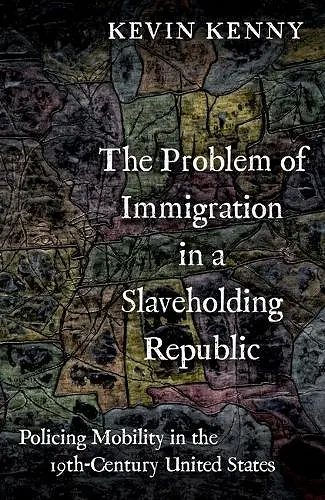
A powerful analysis of how regulation of the movement of enslaved and free black people produced a national immigration policy in the period between the American Revolution and the end of Reconstruction. Today the United States considers immigration a federal matter. Yet, despite America's reputation as a "nation of immigrants," the Constitution is silent on the admission, exclusion, and expulsion of foreigners. Before the Civil War, the federal government played virtually no role in regulating immigration, and states set their own terms for regulating the movement of immigrants, free blacks, and enslaved people. Insisting that it was their right and their obligation to protect the public health and safety, states passed their own laws prohibiting the arrival of foreign convicts, requiring shipmasters to post bonds or pay taxes for passengers who might become public charges, ordering the deportation of immigrant paupers, quarantining passengers who carried contagious diseases, excluding or expelling free blacks, and imprisoning colored seamen. To the extent that these laws affected foreigners, they comprised the immigration policy of the United States. Offering an original interpretation of nineteenth-century America, The Problem of Immigration in a Slaveholding Republic argues that the existence, abolition, and legacies of slavery were central to the emergence of a national immigration policy. In the century after the American Revolution, states controlled mobility within and across their borders and set their own rules for community membership. Throughout the antebellum era, defenders of slavery feared that, if Congress gained control over immigration, it could also regulate the movement of free black people and the interstate slave trade. The Civil War and the abolition of slavery removed the political and constitutional obstacles to a national immigration policy, which was first directed at Chinese immigrants. Admission remained the norm for Europeans, but Chinese laborers were excluded through techniques of registration, punishment, and deportation first used against free black people in the antebellum South. To justify these measures, the Supreme Court ruled that immigration authority was inherent in national sovereignty and required no constitutional justification. The federal government continues to control admissions and exclusions today, while some states monitor and punish immigrants, and others offer sanctuary and refuse to act as agents of federal law enforcement. By revealing the tangled origins of border control, incarceration,...
In this complex, rich work, Professor Kenny shines light on a tangled past and explains the anomalies of current U.S. immigrant policy. [...] Kenny reveals that today's policies are rooted in a patchwork of laws aimed at Native Americans and African Americans as well as immigrants. The committee found this beautifully written book an exciting intervention in the histories of citizenship, race, immigration, and mobility, one that makes plain their interconnectedness. * James A. Rawley Prize, Organization of American Historians *
The Problem of Immigration in a Slaveholding Republic makes an important contribution to immigration federalism scholarship. By showing how debates over slavery were intimately bound up with discussions over who to admit into the country, Kenny forces immigration historians to grapple with the issue of states' rights versus federal power. * Theodore Saloutos Book Award, Immigration and Ethnic History Society *
Kenny's book should become required reading for scholars and students of the nineteenth-century United States. His engaging prose and mastery of legislation, court cases, newspapers, and other sources creates a compelling work that never fails to fascinate. If you are a historian of American immigration and Kenny's work is not yet on your shelf, it should be. * Derek E. Everett, Journal of American History *
This excellent work surveys the changing roles of federal and state governments in regulating immigration in the century after the Revolution. [...] Kenny's work is entertaining and engaging and provides plenty of detailed evidence as well as convincing interpretations of a broad chronological history. It will be of interest to scholars of slavery and of immigration and crucially shows the interminable overlap of themes of race and labour in the history of the United States. * Catherine Armstrong, Slavery and Abolition *
Kenny makes an invaluable contribution to the study of immigration and racial formation in the nineteenth-century United States. His work is at the forefront of attempts to connect the history of slavery to the history of immigration, and its long narrative arc provides a useful framework for thinking about those histories, which have been pivotal to the United States. It simultaneously points to new areas for research that scholars should take up. [...] In these areas and more, scholars in many fields will find this work useful to build upon, refine, and think with for years to come. * Scott Heerman, Journal of Southern History *
Kevin Kenny's sweeping book The Problem of Immigration in a Slaveholding Republic shows how slavery shaped immigration policy in the United States across the long nineteenth century, as control over immigration moved from the states to the federal government. [...] By synthesizing a century's worth of debate about immigration policy, Kenny shows how slavery and abolition set the terms for later iterations of race-based exclusion. * Samantha Seeley, Journal of the Early Republic *
Through careful analysis of the antebellum and postbellum worlds, Kenny achieves his goal of examining European and Asian immigration in the same historical context as African American and Native American history. [...] Kenny has produced a truly excellent history of the Civil War era. It deserves to be widely assigned and read. * Cory James Young, Journal of the Civil War Era *
In this book that won the annual prize of the Immigration and Ethnic History Society, Kevin Kenny juxtaposes two subjects that are seldom treated in relationship to one another: immigration and slaveholding. It proves to be a revealing perspective. What Kenny documents is a near obsession on the part of Southerners and their allies with restricting the power of the federal government, granted under the commerce clause, to regulate migration or anything related to it, for fear that it might extend to regulating slavery or defending the rights of free blacks or black crewmen of foreign ships trading in Southern ports. * Walter D. Kamphoefner, Texas A&M University, EH.Net (Economic History Association) *
Kenny brings a fresh and insightful look at changing 19th-century immigration law in this crisp legal history... Based on a close reading of key immigration law cases and other primary sources, this erudite study sheds light on the long and complicated history of immigration law. * Library Journal *
One can't fully understand the origins of US immigration policy without knowing the history of slavery and Native American removal. In this beautifully written book, Kevin Kenny shows how these painful histories laid the groundwork for the barring, policing, detaining, and expelling of immigrants and shaped American understandings of federal plenary power, citizenship, and sovereignty. This book shows why Kenny is one of the most insightful historians of the nineteenth-century United States. * María Cristina García, author of State of Disaster: The Failure of US Migration Policy in an Age of Climate Change *
From Kevin Kenny, eminent scholar in immigration history, comes a timely reminder that slavery once touched every aspect of American life, including border control. He makes a powerful case that today's immigration policies still bear the scars of the slaveholding republic. * Beth Lew-Williams, author of The Chinese Must Go: Violence, Exclusion, and the Making of the Alien in America *
In a bold and sweeping reinterpretation, Kenny convincingly places slavery and its legacy at the heart of the US immigration history. The Problem of Immigration in a Slaveholding Republic is a must read for students of either field. * Sam Erman, author of Almost Citizens: Puerto Rico, the U.S. Constitution, and Empire *
The most comprehensive and penetrating analysis of nineteenth-century US immigration policy that I have read. Kevin Kenny's brilliant reconstruction of the intersecting efforts to police the movement of enslaved, immigrant, and indigenous populations will change the way we think about the history—and the current state—of America's immigration regime. * Gary Gerstle, University of Cambridge *
Kenny makes an invaluable contribution to the study of immigration and racial formation in the nineteenth-century United States. His work is at the forefront of attempts to connect the history of slavery to the history of immigration, and its long narrative arc provides a useful framework for thinking about those histories, which have been pivotal to the United States. It simultaneously points to new areas for research that scholars should take up. * Scott Heerman, Journal of Southern History *
Based on a close reading of archival sources and some of the landmark immigration law cases, this book makes for an exciting read. A crisp legal history, Kenny's erudite work throws light on the long and tangled history of American immigration laws. By unveiling the complicated origins of incarceration, border control, and deportation, Kenny seeks to remind his readers that slavery at one time touched every aspect of American life, including the mobility of immigrants. The book makes a strong case that the contemporary immigration policy still bears the scars of the slaveholding republic. Given that the book is written in a coherent manner, and for more than one type of audience, it will be of interest to the specialists of the subject as well as non-specialists. * Amol Saghar, World History Encyclopedia *
Kenny's insights are welcome because it is still all too easy to see slavery and immigration as separate areas of inquiry, divided temporally by the Civil War. In a standard survey of the field, slavery dominates before 1865 and federal immigration restrictions after it. ...the long arc of The Problem of Immigration connecting these conversations across the nineteenth century is an exciting intervention in the field. * Journal of the Early Republic *
ISBN: 9780197874097
Dimensions: 233mm x 157mm x 24mm
Weight: 449g
344 pages