Divided Power in Ancient Greece
Decision-Making and Institutions in the Classical and Hellenistic Polis
Format:Hardback
Publisher:Oxford University Press
Published:14th Mar '24
Currently unavailable, and unfortunately no date known when it will be back
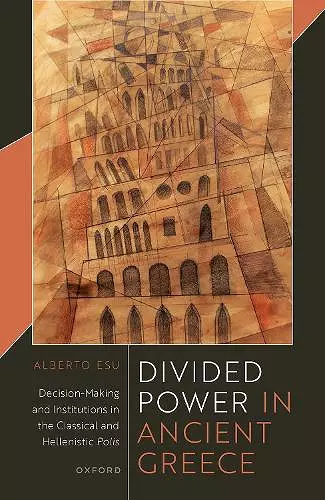
How did the division of power work in Ancient Greece? This groundbreaking study reveals Ancient Greek political decision-making to be a multi-layered system of delegation and legal control. Scholars have previously examined the nature and locus of sovereignty in the Classical and Hellenistic Greek poleis through institutional, rhetorical, or ideological approaches. By concentrating on the institutional design of decree-making, Alberto Esu moves beyond unitary and hierarchical understandings of sovereignty; he presents a new view of power as divided and horizontally organized between different decision-making institutions, each one with its own discourse and expertise. Greek political decision-making is thus seen through a new institutionalist perspective that rediscovers the normative importance of political institutions as factors shaping the collective behaviour of decision-makers. Part I explores how deliberative power in decree-making was delegated in Classical Athens, Mytilene, and Hellenistic Megalopolis. Part II examines procedures of legal control and judicial review in the Classical and Hellenistic periods. Divided power proves to be a feature of both democratic and non-democratic societies across the Ancient Greek world; Esu's analysis of its institutional manifestation transforms our understanding of political life--its discourses and norms--in the Ancient Greek city-states.
Esu focuses on two main issues of divided power: on the one hand, the delegation of power between various decision-making bodies; and, on the other, the institutions of legal control that checked the outcomes of decision-making bodies. Given the nature of the evidence, Esu relies to a significant extent on classical Athens; however, the value of the book is that it uses the evidence not in order to write an Athenocentric account, but to extend the approach to other classical andHellenistic Greek communities which offer relevant evidence: I found particularly illuminating the detailed discussions of Mytilene, Megalopolis, and Sparta. * Kostas Vlassopoulos, Greece and Rome *
Alberto Esu' book is an important, theoretically engaged contribution to the study of Greek political systems and institutions. As with every ground-breaking book, some elements in the argument will no doubt generate further debate, but "divided power" is henceforth a concept all Greek historians will need to take into consideration, and not only with reference to the Athenian democracy. * , Michele FaragunaBryn Mawr Classical Review *
It is no surprise that ancient Greece continues to inspire reflection on the nature and functioning of democracy. Alberto Esu has produced an excellent monograph that bridges the gap between traditional history and political science. * John Haberstroh, American Historical Review *
The work of A. Esu makes the very flexible notion of shared power the key to the functioning of Greek cities and gives cause to reflect on the complexity of decision-making. * Patrice Hamon, Sehepunkte *
Esu's spirited defense of an institutionalist approach is validated by his success in providing an alternative to sovereignty for understanding power in the ancient polis, in fully explicating the deliberative role of the Council in Classical Athens, and in demonstrating the widespread concept of divided power beyond Athens and democracy. * Naomi T. Campa, Polis, The Journal for Ancient Greek And Roman Political Thought *
ISBN: 9780198883951
Dimensions: 240mm x 160mm x 20mm
Weight: 574g
304 pages