'Gifted Children' in Britain and the World
Elitism and Equality since 1945
Format:Hardback
Publisher:Oxford University Press
Published:28th Feb '25
Currently unavailable, and unfortunately no date known when it will be back
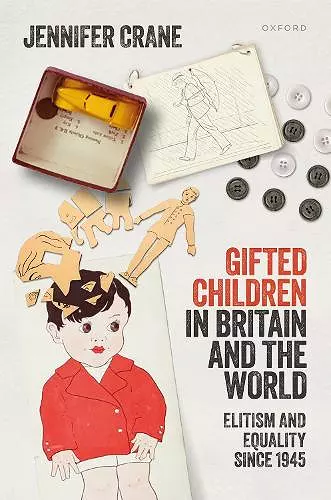
This is an open access title available under the terms of a CC BY-NC-ND 4.0 International licence. It is free to read on Oxford Academic and offered as a free PDF download from OUP and selected open access locations. The idea that a child is intellectually 'gifted' has a social and cultural history. This book analyses that social history at multiple scales, and makes the 'voices' of the 'gifted' young themselves central through examination of their poetry, letters, and life-writing. In daily encounters, those labelled 'gifted' sometimes loved this label, and felt special in comparison to peers at school and siblings at home. For others, 'gifted' was a silly or embarrassing label, and many questioned the idea of separating off young people in terms of intelligence, as well as the specific forms of testing being used. Ideas of the 'gifted' child also reshaped family lives -- parents dedicated time to providing special leisure spaces for those thought of as 'gifted', running them in their own homes and taking their children significant distances to spend time with others that were also 'gifted'. Voluntary organisations were critical here, as the network through which young people and adults encountered the term, 'gifted', and lived and created it relationally, through interactions with one another. Voluntary organisations, looking to gain attention and visibility, also critically shaped the idea that the 'gifted' young were elites of 'the future', central to answering challenges of economic decline, global warfare, or humanitarian aid. The hopes placed on 'gifted' children between the 1960s and the 1990s were often sky high -- yet many 'gifted' young still felt that the community 'wasted' their talents, and did not support them. This book, then, provides new perspectives on the tensions between elitism and equality in modern Britain. It also offers vivid stories of optimism, hope, disappointment, and criticism, in which young people themselves play a central role.
Crane asks what is at stake in these discussions around giftedness, both for the children themselves and the adult society of which they were part. Her ambitious answer encompasses discontent around the levelling tendencies of the British welfare state, the diplomacy of the Cold War, and an innovative reading of materials from the 'gifted' organizations themselves which allow Crane to give children their due recognition as historical actors and agents. * Andrew Burchell, History *
The persistence of giftedness though, despite or perhaps because of its internal contradictions across time and space, means that studies like Crane's bring important insights. The book can be brought into class discussions around child development, childhood, and education policy to broader discussions about democracy and hierarchy in Britain in the 20th century or in the context of global studies or world history. * Nate Sleeter, Journal of Family History *
The history of gifted children is a particularly rewarding topic, as it allows researchers to connect the history of childhood and education with social and political history as well as the history of social difference and (in)equality in exemplary ways. While general ideas of giftedness are much older, discourses on gifted children gained prominence with the popularisation of intelligence testing in the early twentieth century. Jennifer Crane has now written the first comprehensive history of giftedness in children in Great Britain since 1945, effectively illustrating the field's analytical potential. * Susanne Schregel, History of Education *
Gifted Children in Britain and the World makes a significant contribution to the history of childhood, education, politics, and disability. Its fine-grained chronology, attentive use of sources, and commitment to foregrounding children's perspectives offer a model for future work in the field. By tracing the shifting and often contradictory meanings of giftedness, Crane provides valuable insight into broader debates about equality, expertise, and the role of education in modern Britain. * Sasha Bergstrom-Katz, Social History of Medicine *
ISBN: 9780198928850
Dimensions: 240mm x 162mm x 18mm
Weight: 514g
240 pages