The Making of Medieval Antifraternalism
Polemic, Violence, Deviance, and Remembrance
Format:Hardback
Publisher:Oxford University Press
Published:5th Apr '12
Currently unavailable, and unfortunately no date known when it will be back
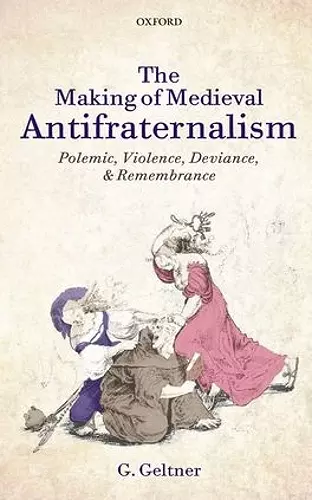
The mendicant orders-Augustinians, Carmelites, Dominicans, Franciscans, and several other groups-spread across Europe apace from the early thirteenth century, profoundly influencing numerous aspect of medieval life. But alongside their tremendous success, their members (friars) also encountered derision, scorn, and even violence. Such opposition, generally known as antifraternalism, is often seen as an ecclesiastical in-house affair or an ideological response to the brethren's laxity: both cases registering a moral decline symptomatic of a decadent church. Challenging the accuracy of these views, Geltner contends that the phenomenon exhibits a breadth of scope that on the one hand pushes it far beyond its accustomed boundaries, and on the other supports only tenuous links with Reformation or modern forms of anticlericalism. Drawing from numerous sources, from theological treatises to poetry and criminal court records, Guy Geltner shows that people from all walks of life lambasted and occasionally assaulted the brethren, orchestrating detailed scenes of urban violence in the process. Their myriad motivations and diverse goals preclude us from associating antifraternalism with any one ideology or agenda, let alone allow us to brand many of its proponents as religious reformers. At the same time, he demonstrates the friars' active role in forging a medieval antifraternal tradition, not only by deviating from their founders' paths to varying degrees, but also by chronicling their suffering inter fideles and thus incorporating it into the orders' identity as the vanguard of Christianity. In doing so, Geltner illuminates a major chapter in Europe's social, urban, and religious history.
...an important book. It provides us with a significant corrective to an over-reliance on evidence from literary and theological works in understanding criticisms of the friars in the Middle Ages, and Geltner's argument for the contribution of the friars' own historiography to the development of the antifraternal tradition offers a whole new perspective on that process. Most important, however, Geltner brings this material together in a call for a comprehensive revision of how we think about antifraternalism. * Geoffrey Dipple, The Catholic Historical Review *
Geltners finely crafted book is a significant contribution to the study of the medieval mendicant orders and their place in medieval Europe. * George Dameron, History *
This is an interesting short book that brings to life an aspect of literary history that has been deaf to the ideas and behaviour of real people. * Ian Forrest, English Historical Review *
Geltner effortlessly segues from analysis of texts and textual reception to social and quantitative methodologies ... will be most useful to fellow specialists or upper graduate level students. * Travis E. Ables, Journal of Ecclesiastical History *
Guy Geltner's book is an important contribution to the ongoing historiography of the mendicant orders in the Middle Ages. * C. H. Lawrence, Speculum *
this stimulating and innovative study is enriched by archival evidence that brings a fresh perspective to the analysis of the friars impact on the thirteenth and fourteenth centuries. * Michael Robson, Archivum Franciscanum Historicum *
Geltner's study is a compelling read (references to Erik the Viking are always welcome) based on an innovative interpretation of an impressively wide range of evidence, * Sean L. Field, Journal of Social History *
an important book ... it brings new lights and reflections on the phenomenon of antifraternalism (and anticlericalism). Geltner's research is wide and deep, and his presentation is clearly articulated. * Jean-Francois Godet-Calogeras, Sehepunkte *
This volume is a stimulating and innovative study that is enriched by archival evidence bringing a fresh perspective to the analysis of the friars' impact on the thirteenth and fourteenth centuries. * Michael Robson, Heythrop Journal *
ISBN: 9780199639458
Dimensions: 241mm x 160mm x 20mm
Weight: 476g
206 pages