Echo Chambers
How Partisan Communication Took Over Congress
Format:Paperback
Publisher:The University of Chicago Press
Publishing:8th Jan '27
£26.00
This title is due to be published on 8th January, and will be despatched as soon as possible.
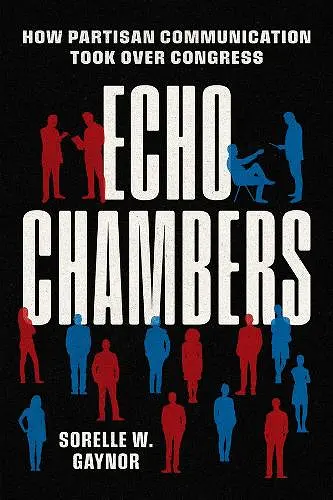
An incisive analysis of how congressional communication with constituents has changed and what this means for representation and polarization.
Members of Congress have a duty to talk to their constituents back home about what’s going on in Washington. But today, the average politician lacks the time, resources, and knowledge necessary to coherently explain the bills and legislative actions up for debate. Therefore, they turn to those who hold the keys to the chamber: party leaders.
Consequently, Congress is now more reliant than ever on its leaders’ partisan talking points, and constituents hear more about nationalized political battles rather than the local issues affecting their districts. Drawing on large-scale text analysis, campaign expenditures, and congressional district data, as well as in-depth interviews, Echo Chambers examines how partisan communication took over Congress, the key differences in that messaging across parties and chambers, and what these combined forces mean for US citizens today.
“Echo Chambers finds and tills new terrain in the study of the U.S. Congress. Rather than study the dynamics of the legislative process narrowly construed, Gaynor elevates the importance of legislators’ communications in explaining how the modern Congress works and how well legislators represent their constituents. Focusing on the rise of leadership-led partisan messaging (even on ostensibly bipartisan measures), Echo Chambers offers a new way to think about emerging challenges for today’s lawmakers."
-- Sarah Binder, George Washington University“Echo Chambers is the best kind of book on the modern Congress. Gaynor shows how party and committee leaders have turned constituent communication into a centralized and polarizing machine. When talking points trump policy, even the most bipartisan bills can get trapped in the polarization vortex. This dynamic swamps the narrative of congressional problem solving, leaving the problem solvers dismayed, the advocates for the partisan war thrilled, and the public disgusted. This book is a must read for anyone interested in how Congress became so dysfunctional.”
-- Sean Theriault, University of Texas at Austin“A combination of rich data and deep interview evidence—all built on Gaynor’s own experience working in Congress—makes this book an important new contribution to our understanding of what messages voters hear from their representatives, why the power to shape those messages increasingly sits with party leaders, and what this distribution of power means for representation.”
-- Molly Reynolds, The Brookings InstituISBN: 9780226855493
Dimensions: unknown
Weight: 454g
216 pages