Reading Galileo's Letters
Experiments in Friendship, Knowledge, and Community
Paula Findlen editor Hannah Marcus editor
Format:Paperback
Publisher:The University of Chicago Press
Publishing:15th Feb '27
£32.00
This title is due to be published on 15th February, and will be despatched as soon as possible.
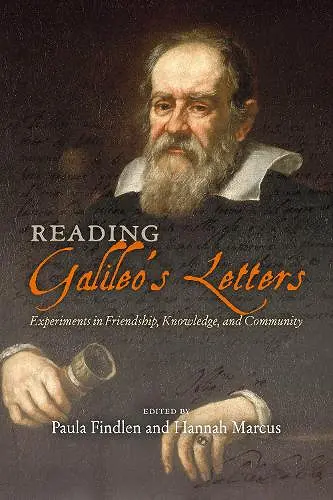
Essays by many of the foremost experts on Galileo offer an interdisciplinary approach to the legendary scientist’s correspondence.
The Tuscan mathematician, physicist, and astronomer Galileo Galilei (1564–1642) is one of history’s most iconic and controversial figures. Letters form the backbone of what one early Galileo scholar called the “private Galileo,” and his correspondence is indeed a record of his family and friendships; his intellectual evolution; his professional interactions with other scientific figures; and his relations with patrons, brokers, and publishers. Last, but hardly least, his letters are a unique cultural artifact of Galileo the writer and master of vernacular prose.
Galileo’s correspondence crossed Europe in public mail pouches, through diplomatic messengers, and was written in code. Today, there are 3,272 surviving letters to or from Galileo and his many friends, family members, disciples, and rivals across Europe. This volume examines these letters as an essential aspect of Galileo’s personal and scientific career. They are what the editors call his “experiments in friendship,” which enabled, abetted, and often served as early drafts of the theories in his published works. This collaborative volume brings together different approaches, case studies, and forms of expertise—historical and literary, intellectual and material, archival and digital. It is a must-read for all Galileo enthusiasts and anyone interested in how to make the most of a rich record of correspondence.
“Reading Galileo’s Letters is a highly original volume based on the soundest scholarship. The contributors treat these famous letters not simply as sources, but as a historical question. In asking how Galileo used his correspondence, they highlight the influence of rhetorical and epistolary models, the ways scribal and material aspects of the manuscripts inform our understanding of the social realities that shaped Galileo’s research, his strategies in publishing and curating the letters and his other works, and successive interventions to this archive after his death. It is not easy to write an original book on such a well-researched subject as Galileo, but the editors and authors have succeeded.”
-- Filippo de Vivo, author of “Information and Communication in Venice”“Reading Galileo’s Letters is a welcome contribution to Galileo scholarship. Treating Galileo’s correspondence not as a window onto his work but as a subject in its own right, the volume shows how letters served as tools of reputation, patronage, collaboration, and knowledge-making, and how the Galileo archive was shaped over centuries by Galileo, his heirs, and later editors. The contributors pay careful attention to overlooked correspondents and to the silences and gaps in the record, and draw on recent archival finds to rethink longstanding narratives. Together, these essays should be essential reading for Galileo specialists and for historians of science, of the book, and of early modern intellectual culture.”
-- Aviva Rothman, author of “The Dawn of Modern Cosmology: Copernicus to NewtoISBN: 9780226856025
Dimensions: unknown
Weight: 454g
368 pages