The Sources of Democratic Responsiveness in Mexico
Format:Paperback
Publisher:University of Notre Dame Press
Published:31st Mar '10
Should be back in stock very soon
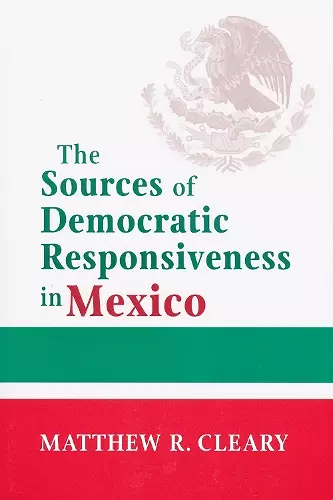
Matthew Cleary investigates the political sources of improved government responsiveness in contemporary Mexico. He draws on existing theoretical frameworks that explain responsiveness (the degree to which government output matches public preferences) as a function of electoral accountability mechanisms, direct participatory pressure, or a combination of the two. Cleary demonstrates that electoral competition is not the cause of improved responsiveness among Mexican municipal governments. Instead, he attributes responsiveness in the 1980s and 1990s to a prior qualitative shift in participatory politics that began in the 1970s and continues to this day. The inability of electoral competition to improve responsiveness is, Cleary argues, a function of Mexico's political institutions. The book demonstrates the implications of thinking broadly about the variety of strategies that citizens use, on a daily basis, to influence the behavior of politicians.
The Sources of Democratic Responsiveness in Mexico exposes serious flaws in conventional understandings of electoral competition in Mexico. Cleary's careful critique of electoral accountability theory and his theory of participatory responsiveness address broader theoretical and conceptual issues that extend beyond the Mexican situation. The book will interest students and scholars of comparative democracy, Mexican politics, and Latin American politics.
"Although the book is a single-country study, many of the subjects it treats may apply to political systems from other countries. Definitively, the book is a significant contribution to the study of democratic responsiveness, electoral competition, and participation in Mexican municipalities, and it certainly helps us understand the nature of democratic governance and institutions far beyond the borders of Mexico." —Latin American Politics and Society
"Using the case of Mexico, Matthew Cleary critically examines a key supposition to democratic theory: that elections produce good and responsive government. In a nicely crafted theoretical discussion, Cleary examines the problems linking elections to responsiveness. This is a superb case study that contributes, as case studies should, to both the broader discussion on democracy and the specifics of the case. Students of comparative politics can certainly benefit from the excellent review of debates centering on the pillars of democracy, and the struggles to create responsive and accountable government." —Political Science Quarterly
"Cleary analyzes municipal governments in Mexico to assess the broader theoretical assumption that electoral accountability leads to better government. The book is clearly written and detailed. The analysis uses thorough empirical data and statistics but also direct interviews with municipal politicians. The findings are interesting and certainly question the general assumption that electoral competition leads to democratic accountability." —Choice
"The author considers a broad range of theoretical approaches inclusive of using empirical evidence to evaluate them . . . he is hopeful that other researchers will apply his model to other countries, thus demonstrating that democratic responsiveness is an important and interesting object of study. This book is recommended to students of political science and history of Mexico and Latin America." —Colonial Latin American Historical Review
"This book does an excellent job of exposing the weaknesses of elections as mechanisms of democratic accountability, both in the abstract, and with regard to the specific features of the Mexican political system. Most scholars accept the electoral model as a given. Cleary makes it theoretically clear why this is deeply problematic, not by asserting that elections never perform an accountability function, but rather by showing they may not, and that we ignore this possibility at our peril." —Marcus Kurtz, Ohio State University
". . . an important contribution to the literature on problems of democracy in Latin America. Cleary offers a careful, nuanced analysis of the limits of electoral competition as a democratic instrument for improving the responsiveness of government to citizens in contemporary Mexico." —Richard Snyder, Brown University
ISBN: 9780268023010
Dimensions: 229mm x 152mm x 14mm
Weight: 349g
256 pages