The Emotions of Justice
Gender, Status, and Legal Performance in Choson Korea
Format:Hardback
Publisher:University of Washington Press
Published:1st Jan '16
Currently unavailable, and unfortunately no date known when it will be back
Its focus on gender and social status makes The Emotions of Justice a significant contribution to the study of Korean legal history. That women, even women slaves, were treated as legitimate legal subjects opens up fascinating tensions in our understanding of the highly stratified and status-conscious Choson society. -- Maram Epstein, author of Competing Discourses: Orthodoxy, Authenticity, and Engendered Meanings in Late-Imperial Chinese Fiction The Emotions of Justice is well written ... [and] provides an illuminating analysis of the relationship between the state and its subjects before the modern era. This is a sophisticated addition to our understanding of gender roles in Choson. -- Donald Baker, University of British Columbia
The Choson state (1392–1910) is typically portrayed as a rigid society because of its hereditary status system, slavery, and Confucian gender norms.
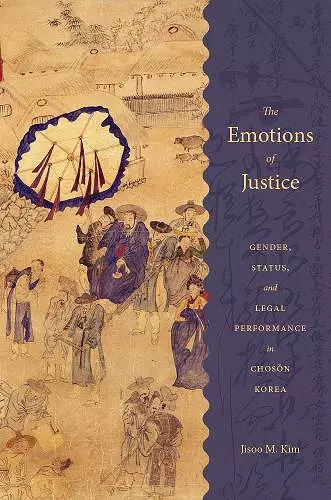
The Choson state (1392–1910) is typically portrayed as a rigid society because of its hereditary status system, slavery, and Confucian gender norms. However, The Emotions of Justice reveals a surprisingly complex picture of a judicial system that operated in a contradictory fashion by discriminating against subjects while simultaneously minimizing such discrimination. Jisoo Kim contends that the state’s recognition of won, or the sense of being wronged, permitted subjects of different genders or statuses to interact in the legal realm and in doing so illuminates the intersection of law, emotions, and gender in premodern Korea.
"In this original and thought-provoking study of Choson Korea’s legal practices, Jisoo M. Kim offers a multilayered analysis of petitions submitted by women of both elite and non-elite status throughout the dynasty. . . . The Emotions of Justice will be a crucial text when teaching this period in Korean history and should attract a wide interest also from scholars of cognate disciplines."
-- Anders Karlsson * Journal of Asian Studies *"[R]edefines the boundaries of law, emotions, and gender in premodern Korea by investigating historic legal documents. This thought-provoking work not only enlightens the reader with regard to the legal system during the Chosŏn era (1392–1910) but also elucidates how various legal subjects constituted their subjectivity in oral and textual space."
* Acta KoreaISBN: 9780295995038
Dimensions: unknown
Weight: 476g
224 pages