Thinking Historically
A Guide to Statecraft and Strategy
Format:Hardback
Publisher:Yale University Press
Published:6th Jan '26
Currently unavailable, our supplier has not provided us a restock date
This hardback is available in another edition too:
- Paperback£16.99(9780300312027)
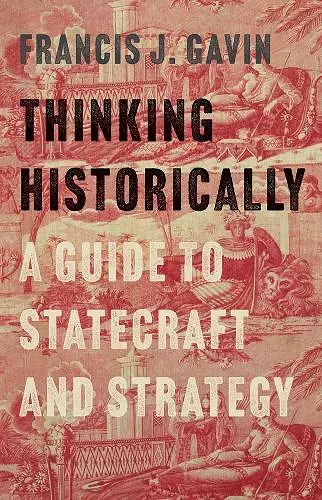
A compelling and insightful argument for historical study as a way to understand and navigate the complex, often confusing world of decision-making
Winner, 2026 Lionel Gelber Prize
“Gavin’s writing is nuanced and compelling. It’s also fun. . . . Churchill would have loved Gavin’s book and would have encouraged aspiring statespeople to study it carefully.”—John T. Shaw, Chicago Tribune
It seems obvious that we should use history to improve policy. If we have a good understanding of the past, it should enable better decisions in the present, especially in the extraordinarily consequential worlds of statecraft and strategy. But how do we gain that knowledge? How should history be used? Sadly, it is rarely done well, and historians and decision-makers seldom interact. But in this remarkable book, Francis J. Gavin explains the many ways historical knowledge can help us understand and navigate the complex, often confusing world around us.
Good historical work convincingly captures the challenges and complexities the decision-maker faces. At its most useful, history is less a narrowly defined field of study than a practice, a mental awareness, a discernment, and a responsiveness to the past and how it unfolded into our present world—a discipline in the best sense of the word. Gavin demonstrates how a historical sensibility helps us to appreciate the unexpected; complicates our assumptions; makes the unfamiliar familiar and the familiar unfamiliar; and requires us, without entirely suspending moral judgment, to try to understand others on their own terms. This book is a powerful argument for thinking historically as a way for readers to apply wisdom in encountering what is foreign to them.
“Gavin’s writing is nuanced and compelling. It’s also fun. . . . Churchill would have loved Gavin’s book and would have encouraged aspiring statespeople to study it carefully.”—John T. Shaw, Chicago Tribune
“Francis Gavin has written a profound work of philosophy of history that is at the same time eminently readable. He writes not about history but rather about historical sensibility, a way of understanding and thinking about the world with all its complexities and uncertainties. Historical sensibility creates discomfort with linear reasoning and single causes. It embraces complexity, multiple chains that intersect and connect, and a story that changes with the perspective of time. In one elegant chapter after another, Gavin walks the reader through these complexities and leaves us less sure, more empathic, and wiser. Thinking Historically is a more important book than E. H. Carr’s Twenty Years’ Crisis in helping us understand the crises of our times.”—Jury statement, Lionel Gelber Prize
“Makes clear just how far surface-level historical fluency is from genuine historical thinking. . . . Gavin [offers] something distinctive: a clear articulation of what ‘historical sensibility’ actually means, and a practical twelve-question checklist that translates that sensibility into disciplined inquiry.”—Whitney D. Zimmerman, Substack
Winner, 2026 Lionel Gelber Prize, sponsored by the Munk Centre for International Studies
“I devoured this book, and consider it essential reading for every policymaker on the front lines of statecraft and strategy, and for every student who aspires to a career in national security.”—Jake Sullivan, former National Security Advisor
“This is a remarkable and illuminating exploration of the value of an historical sensibility for policymakers, providing perspective and context, encouraging thoughts about causality and trends, and showing why it’s important to address the challenges of complexity, evidence, and bias.”—Lawrence Freedman, author of Strategy: A History
“A superb book on a question of great and enduring importance: what is a ‘historical sensibility,’ and how can political leaders—and the rest of us—go about acquiring it? Frank Gavin is one of our leading authorities on the subject, and he shows it on every page of this essential study.”—Fredrik Logevall, author of JFK: Coming of Age in the American Century, 1917–1956
“In today’s world, history is the daily weapon of national and international contests for power and authority. Frank Gavin shows how thinking historically can make a difference to statecraft and strategic decision-making. How do we not repeat the mistakes of the past? Here Gavin proves himself the best of allies for both IR and historical practitioners alike.”—Glenda Sluga, author of The Invention of International Order: Remaking Europe after Napoleon
ISBN: 9780300278361
Dimensions: unknown
Weight: unknown
256 pages