Literary Twinship from Shakespeare to the Age of Cloning
Format:Hardback
Publisher:Taylor & Francis Ltd
Published:14th Jan '20
Currently unavailable, and unfortunately no date known when it will be back
This hardback is available in another edition too:
- Paperback£45.99(9781032239019)
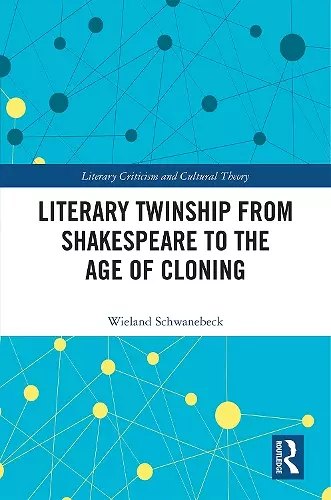
Unlike previous efforts that have only addressed literary twinship as a footnote to the doppelganger motif, this book makes a case for the complexity of literary twinship across the literary spectrum. Shortlisted for the ESSE Book Award 2022 (Literatures in the English Language), it shows how twins have been instrumental to the formation of comedies of mistaken identity, the detective genre, and dystopian science fiction. The individual chapters trace the development of the category of twinship over time, demonstrating how the twin was repeatedly (re-)invented as a cultural and pathological type when other discursive fields constituted themselves, and how its literary treatment served as the battleground for ideological disputes: by setting the stage for debates regarding kinship and reproduction, or by partaking in discussions of criminality, eugenic greatness, and ‘monstrous births’. The book addresses nearly 100 primary texts, including works of Mary Elizabeth Braddon, Wilkie Collins, Charles Dickens, Arthur Conan Doyle, Aldous Huxley, Christopher Priest, William Shakespeare, and Zadie Smith.
"A lively, consistently instructive guided tour of some of the most intriguing ways writers have presented twins and twinship over the past four centuries. Wieland Schwanebeck comes up with a remarkable range of different ways to think about twins—as the same yet different, as shadow selves, as clones, as our missing halves, as challenges to our personal identity—and an equally remarkable number of areas—Shakespearean comedy, Victorian detective fiction, literary adaptation, popular fictional genres, pornography, behaviorism, genetics, criminology, eugenics, ethnography, biopolitics, literary production and interpretation—that are illuminated by their handling of twins. Readers are certain to agree with him that ‘once you have grasped twinship, you can never not see it again’."
Prof. Thomas Leitch, University of Delaware
"a many-layered account […] that will prove an instructive yet diverting read for researchers from many different backgrounds, including those working at the intersection of science and literature, in adaptation studies or on specific genres, like farce, science and detective fiction"
-Sarah Frühwirth, English Studies 102.3 (2021)
"an unrivaled, comprehensive, and clear approach to the distinction and development of the twin motif, which highlights the co-dependence of current discourses and corresponding literary devices"
-Christopher Hansen, Anglistik 31.3 (2020)
"a very valuable contribution to the endeavour of mapping twins in their literary and cultural texts and contexts, which offers both newcomers to the field and those already familiar with it fascinating food for thought"
-Sarah Beyvers, Journal for the Study of British Cultures 28.2 (2021)
"A lively, consistently instructive guided tour of some of the most intriguing ways writers have presented twins and twinship over the past four centuries. Wieland Schwanebeck comes up with a remarkable range of different ways to think about twins—as the same yet different, as shadow selves, as clones, as our missing halves, as challenges to our personal identity—and an equally remarkable number of areas—Shakespearean comedy, Victorian detective fiction, literary adaptation, popular fictional genres, pornography, behaviorism, genetics, criminology, eugenics, ethnography, biopolitics, literary production and interpretation—that are illuminated by their handling of twins. Readers are certain to agree with him that ‘once you have grasped twinship, you can never not see it again’."
Prof. Thomas Leitch, University of Delaware
ISBN: 9780367437893
Dimensions: unknown
Weight: 453g
246 pages