Jefferson's Wolf
A Founding Father's Troubling Answer to the Problem of Slavery
Nicholas Guyatt author Christa Dierksheide author
Format:Hardback
Publisher:Harvard University Press
Published:29th May '26
Should be back in stock very soon
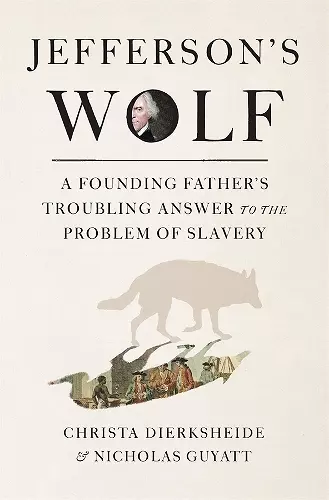
A decisive reassessment of Thomas Jefferson’s long-debated views on slavery, showing that his chief antislavery strategy was racial exclusion: the removal of emancipated Black people from the United States.
Toward the end of his life, Thomas Jefferson made his most famous statement about American slavery: “We have the wolf by the ear, and we can neither hold him, nor safely let him go.” Presenting abolition as both necessary and perilous, the remark has long been relied upon to explain an apparent paradox: despite publicly opposing slavery for four decades, Jefferson had made no progress toward Black freedom in his political career by the time he died in 1826. Nor had he done so in his expansive household, where he enslaved more than 600 people, including Sally Hemings and the four children he fathered with her.
Christa Dierksheide and Nicholas Guyatt argue that the key to understanding Jefferson’s antislavery position is his commitment to racial exclusion. Jefferson believed that the principal reason to abolish slavery was the threat of a massive slave revolt, but he viewed the presence of free Black people in the new nation as no less dangerous. To avert racial violence, Jefferson argued, the gradual abolition of slavery had to be paired with Black exile. Even when challenged by white and Black contemporaries with more expansive views of American belonging, Jefferson held fast to his vision for a white republic.
Neither an egalitarian antiracist nor a proslavery apologist, Jefferson became the most influential advocate for racial separation in the early United States. Charting the evolution of his thought across the nation’s formative decades, Jefferson’s Wolf is a surprising and provocative account of the problem of slavery in the founding era.
Continues the important work of restoring the full palette of Jefferson’s image, which for too long has been sketched in red, white, and blue. -- Ron Charles
Jefferson, Ms. Dierksheide and Mr. Guyatt argue, spent decades trying to imagine how the U.S. might safely release the beast [of slavery]. -- Richard Brookheiser * Wall Street Journal *
This nuanced reassessment of Jefferson’s antislavery rhetoric and commitment to Black exclusion will be a substantial addition to library collections on enslavement and American history. -- Chad Statler * Library Journal (starred review) *
A nuanced history of the giant mote in the eye of the great thinker and revolutionary. * Kirkus Reviews *
With insight, honesty, and eloquence, Christa Dierksheide and Nicholas Guyatt have given us an invaluable study of the troubling complexities of Thomas Jefferson's views on race and slavery. The story is neither simple nor heroic—but history, like human nature, is rarely simple or heroic. This is an important and illuminating account of forces that remain deeply relevant today: power, race, and the aspirations as well as the derelictions of American democracy. -- Jon Meacham, Pulitzer Prize–winning author of Thomas Jefferson: The Art of Power
A provocative and necessary book. The United States was founded in the period when modern European notions about race—shaped by the enslavement of Africans—were coalescing. Offering an insightful account of how the nation's third president viewed slavery, Jefferson's Wolf illuminates this era of American history in ways that still resonate today. -- Annette Gordon-Reed, Pulitzer Prize–winning author of The Hemingses of Monticello: An American Family
Perfectly timed for the nation’s 250th birthday, Jefferson’s Wolf helps us understand how the author of the famous phrase ‘All men are created equal’ could abide and enforce violent inequity in his own life. Dierksheide and Guyatt expertly trace Jefferson’s evolving ideas on slavery while also revealing their relationship to the broader political, cultural, and economic shifts that shaped the adolescent United States. -- Lindsay M. Chervinsky, author of Making the Presidency: John Adams and the Precedents That Forged the Republic
The most difficult Jeffersonian knot to untie, for us, is the relationship between his professed opposition to slavery and his racism. Dierksheide and Guyatt find the explanation in Jefferson's commitment to racial exclusion, revealing this to be fundamental to his vision for the nation’s future. By attending carefully to political contexts, they providebalancewithout invoking necessity or letting Jefferson off the hook. -- David Waldstreicher, author of The Odyssey of Phillis Wheatley
In their authoritative new study of Thomas Jefferson and the problem of slavery, Christa Dierksheide and Nicholas Guyatt persuasively characterize the author of the Declaration of Independence as an antislavery exclusionist. Deftly illuminating Jefferson’s position, they offer fresh perspectives on the man himself, the people he claimed to own, and the fragile federal union as it divided over slavery’s future. -- Peter S. Onuf, coauthor of “Most Blessed of the Patriarchs”: Thomas Jefferson and the Empire of the Imagination
ISBN: 9780674278325
Dimensions: 235mm x 156mm x 17mm
Weight: 555g
272 pages