The Promised Republic
Developmental Society and the Making of Modern Seoul, 1961–1979
Format:Hardback
Publisher:Harvard University, Asia Center
Publishing:26th Jun '26
£41.95
This title is due to be published on 26th June, and will be despatched as soon as possible.
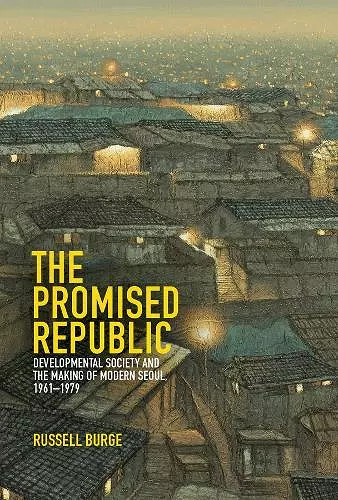
In The Promised Republic, Russell Burge offers a bold new history of South Korea’s rapid development. By focusing on the experience of rural-to-urban migrants who built and lived in Seoul’s shantytowns, Burge historicizes national development as a site of struggle with the urban poor at its center. What would a society of postcolonial abundance look like? Who was this society built for, and how would access to the city that formed its economic center be claimed and defended? These were the questions at stake in the urban struggles of the 1960s and 1970s, an era when authorities found themselves caught between a mandate to create well-disciplined cities and the promise of broad uplift that legitimated their leadership. Utilizing memoirs, interviews, newspapers, journals, photographs, literature, anthropological records, and critical as well as official sources, Burge reconstructs a not-altogether-vanished world and provides historical background of conflicts over urban access and inequality that continue to enrage and resonate to this day.
The Promised Republic tackles the forgotten issue of how South Korea's rapid industrialization and urbanization left a large number of rural-to-urban migrants living in extralegal shantytowns and how they struggled to find their place in South Korean society. With the judicious use of rich archival material from magazines, newspapers, government documents, ethnographic field notes, photographs, and films from the period, Russell Burge provides an intimate portrayal of the lives of shantytown residents—giving primacy to the voices of the shantytown residents themselves. * Namhee Lee, University of California Los Angeles *
The Promised Republic is a deeply researched examination of South Korea's developmental period under Park Chung Hee, focusing on complex political dynamics of urban development in Seoul. By challenging politicized and simplified narratives of top-down modernization or total resistance, the work presents a multi-layered analysis that is significant and relevant to modern Korean history and development literature. The combination of archival and ethnographic details with a strong analytical approach makes this work a significant scholarly contribution, relevant to broader discussions of state-society relations, the politics of dissent, social inequity, housing justice, and authoritarian regimes in East Asia. * Peter Banseok Kwon, University of Albany, State University of New York *
ISBN: 9780674304819
Dimensions: unknown
Weight: unknown
360 pages