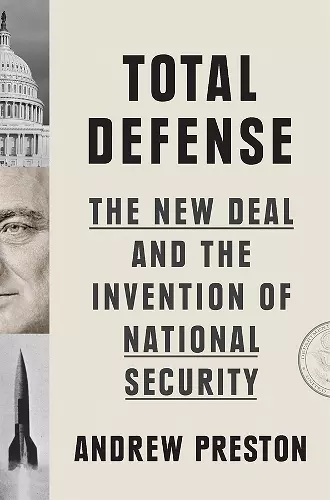
Total Defense
The New Deal and the Invention of National Security
Format:Hardback
Publisher:Harvard University Press
Published:30th May '25
Should be back in stock very soon
A New Yorker Best Book of the Year
“Total Defense is so impressive because Preston is the master of his craft; his clarity and sophistication are always buttressed by illuminating evidence and well-chosen quotations, bespeaking both a great expert’s depth and an expert writer’s talent.”
–Samuel Moyn, The New Republic
The story of how FDR and fellow New Dealers created the idea of national security, transforming the meaning of defense and vastly expanding the US government’s responsibilities.
National security may seem like a timeless notion. States have always sought to fortify themselves, and the modern state derives its legitimacy from protecting its population. Yet national security in fact has a very particular, very American, history—and a surprising one at that.
The concept of national security originates in the 1930s, as part of a White House campaign in response to the rise of fascism. Before then, national self-defense was defined in terms of protecting sovereign territory from invasion. But President Franklin D. Roosevelt and his circle worried that the US public, comforted by two vast oceans, did not take seriously the long-term risks posed by hypermilitarization abroad. New Dealers developed the doctrine of national security, Andrew Preston argues, to supplant the old idea of self-defense: now even geographically and temporally remote threats were to be understood as harms to be combated, while ideological competitors were perilous to the “American way of life.”
Total Defense shows it was no coincidence that a liberal like Roosevelt promoted this vision. National security, no less than social security, was a New Deal promise: the state was obliged to safeguard Americans as much from the guns and warships of Nazi Germany and imperial Japan as from unemployment and poverty in old age. The resulting shift in threat perception—among policymakers and ordinary citizens alike—transformed the United States, spearheading massive government expansion and placing the country on a permanent war footing.
Shows in fascinating detail how Roosevelt used similar language when talking about the social-protection policies and public-investment programmes of the New Deal and the emerging concept of national security. * The Economist *
Preston knows how to tell a story, and tell it well. Total Defense is so impressive because Preston is the master of his craft; his clarity and sophistication are always buttressed by illuminating evidence and well-chosen quotations, bespeaking both a great expert’s depth and an expert writer’s talent. -- Samuel Moyn * New Republic *
A thoughtful new book. -- Daniel Immerwahr * New Yorker *
In showing how Roosevelt won the debate with America First and other opponents, Preston demonstrates that the president used the phrase ‘national security’ to mean that the US could not defend itself without defending other countries. In the process, he broadened the phrase into something expansive and vague that could be used to justify defending ‘values’, or ‘a way of life’, or ‘America’s place in the world’. -- Eric Rauchway * Times Literary Supplement *
An important history, and one with underappreciated implications…The book makes a compelling case that the 'invention' of national security shaped the strategies of the time and continues to influence policy today, often to our disadvantage. -- Julius Krein * Claremont Review of Books *
A sophisticated account of how national security took shape in the 1930s…The economic and international crises of the 1930s have long been seen as inseparable, but Preston offers a fresh framework for understanding how the US grappled with their entanglement. -- Angus Reilly * Financial Times *
[This] book is an intellectual tour de force. Prodigiously researched, engagingly written, and tightly argued, it is the work of a master scholar at the peak of his powers. It is essential reading for all students of American foreign relations and the New Deal era. -- Richard V. Dammas * American Historical Review *
In the late 1930s, the concept of what constituted the United States’ necessary defense underwent a sudden and complete transformation as a long-standing, narrow focus on defense against foreign invasion gave way to the sense that threats came from anywhere and in many forms. Preston traces this metamorphosis…[his] intellectual history has obvious relevance to the current search for a foreign policy that balances the need for American global leadership and engagement against the temptation to lurch into ill-considered military action. -- Jessica T. Mathews * Foreign Affairs *
How did baby formula and kitchen cabinets come to be considered as crucial parts of America's security? Andrew Preston's important book, Total Defense, provides an answer to this question. -- Christopher Coyne * Law & Liberty *
Offers…[a] broader and deeper proposal on how to redefine national security to meet the challenges of climate change…traces the interweaving of economic and social security into national security. -- Sean M. Case * Lawfare *
Well-argued and often provocative…joins a growing body of scholarship that shifts the genesis of the national security state and its related foreign policy from the early Cold War to the FDR administration. -- Brandon Buck * Reason *
Draws a direct line between Roosevelt’s expansive reconception of American security needs and what he terms the ‘security paradox’ that led to the United States’ disastrous war in Indochina and the ill-conceived, global ‘war on terror’ after the 9/11 attacks. -- Aviel Roshwald * Reviews in American History *
Engaging…it is a tribute to Andrew Preston that his important and insightful book allows us to ponder such vital questions. -- Carl Bon Tempo * Congress & the Presidency *
An incisive reconsideration of a landmark legislative program. * Publishers Weekly *
Andrew Preston’s Total Defense does what the very best history books do: It identifies something we all take for granted—in this case, the idea of a ‘national security’ establishment—and gives it a history. Less than a century ago, the suggestion that the United States should maintain a permanent military-intelligence-industrial complex would have been anathema to most Americans. Today, it helps to structure the daily lives of billions of people around the globe. Preston shows brilliantly how ‘national security’ emerged from the same state-building impulses that produced ‘social security,’ though with far different consequences. -- Beverly Gage, author of G-Men: J. Edgar Hoover and the Making of the American Century
Andrew Preston explains how three distinct areas we often use to divide twentieth-century American history–the New Deal, World War II, and the Cold War–are all connected by a literal bridge in Chicago and a landmark speech Franklin Roosevelt gave to dedicate it in 1937. That is just one of the sparkling contextual insights in this important and urgent book. Preston's sinewy synthesis links Social Security to national security and FDR's ‘quarantine’ to George Kennan's ‘containment’ in a timely work that illuminates today's global interdependence and the backlash against it. -- Jonathan Alter, author of The Defining Moment: FDR's Hundred Days and the Triumph of Hope
In this highly original study, Andrew Preston incisively connects the rise of the American national security state to the simultaneous rise of the American welfare state. No other book so brilliantly captures how a liberal politics of fear and security moved between the arenas of domestic and foreign policy in the 1930s. A major reinterpretation of some of the central events of modern American history, Total Defense counts among the most important books written about the New Deal and its legacy in recent times. -- Jonathan Levy, author of Ages of American Capitalism: A History of the United States
In this expansive and beautifully written book, Andrew Preston illuminates the domestic origins of US national security in the New Deal years. FDR's national security rhetoric laid the ground for confronting the next great threat, global war, and ultimately enabled persistent military engagement to eclipse domestic welfare as the nation's top priority. Highly recommended. -- Mary L. Dudziak, author of War Time: An Idea, Its History, Its Consequences
Preston deftly chronicles the evolution of the expansive notion of ‘national security’ that emerged during the 1930s and then congealed during World War II. This groundbreaking study of the interplay between domestic and international forces in shaping US grand strategy is not only fascinating; it speaks directly to the combination of internal and external challenges the United States faces today. -- Charles A. Kupchan, author of Isolationism: A History of America’s Efforts to Shield Itself from the World
Every sovereign state must guard its territory and population, but with what scope and resources should they? With characteristic ambition and lucidity, Andrew Preston explains in this rich analytical study of ideas and political culture why the United States, propelled by domestic New Deal liberalism, pursued policies for an expansive and truly global conceptualization of national security. -- Ira Katznelson, author of Fear Itself: The New Deal and the Origins of Our Time
- Winner of Society for Military History Distinguished Book Award 2026 (United States)
- Winner of New Deal Book Award 2025 (United States)
- Winner of Society for History in the Federal Government Book Prize 2026 (United States)
ISBN: 9780674737389
Dimensions: 235mm x 156mm x 21mm
Weight: 642g
336 pages